


Find where AI can reduce admin, increase capacity and protect margin.
The Operational Intelligence Audit™ is a four-week commercial AI diagnostic for construction, FM, M&E and commercial teams.
It identifies where AI can deliver the greatest operational and financial impact across tenders, RAMS, commercial control, service desk workflows, margin reporting and invoice readiness.
The output is not a generic AI strategy. It is a practical roadmap, controlled prototype and Phase 1 implementation plan.
The problem
Most businesses know AI could help. They do not know where to start.
AI is already being used across construction, FM and M&E businesses — often informally and without a consistent operating model.
Teams may be using it to draft scopes, produce RAMS, write emails, summarise documents or support tendering. But without a clear structure, this creates new risks.
At the same time, the real business problems remain unresolved.
The Operational Intelligence Audit™ gives you a controlled way to identify where AI can create value first.
What it does
A four-week diagnostic with decision-ready outputs.
The audit reviews your workflows, documents, systems, reporting, data quality and operational pain points. It identifies where time, margin and control are being lost, then ranks AI opportunities against six explicit criteria.
- Commercial value
- Speed to benefit
- Data readiness
- Operational risk
- Implementation complexity
- Governance requirement
The aim is simple: find the right place to start, prove the use case and scale what works.
Four structured workstreams
Each targets a specific operational and commercial domain.
The audit is structured across four workstreams, each focused on a specific area of value, risk and opportunity.
Workstream 01
Bid & Cost Intelligence Review
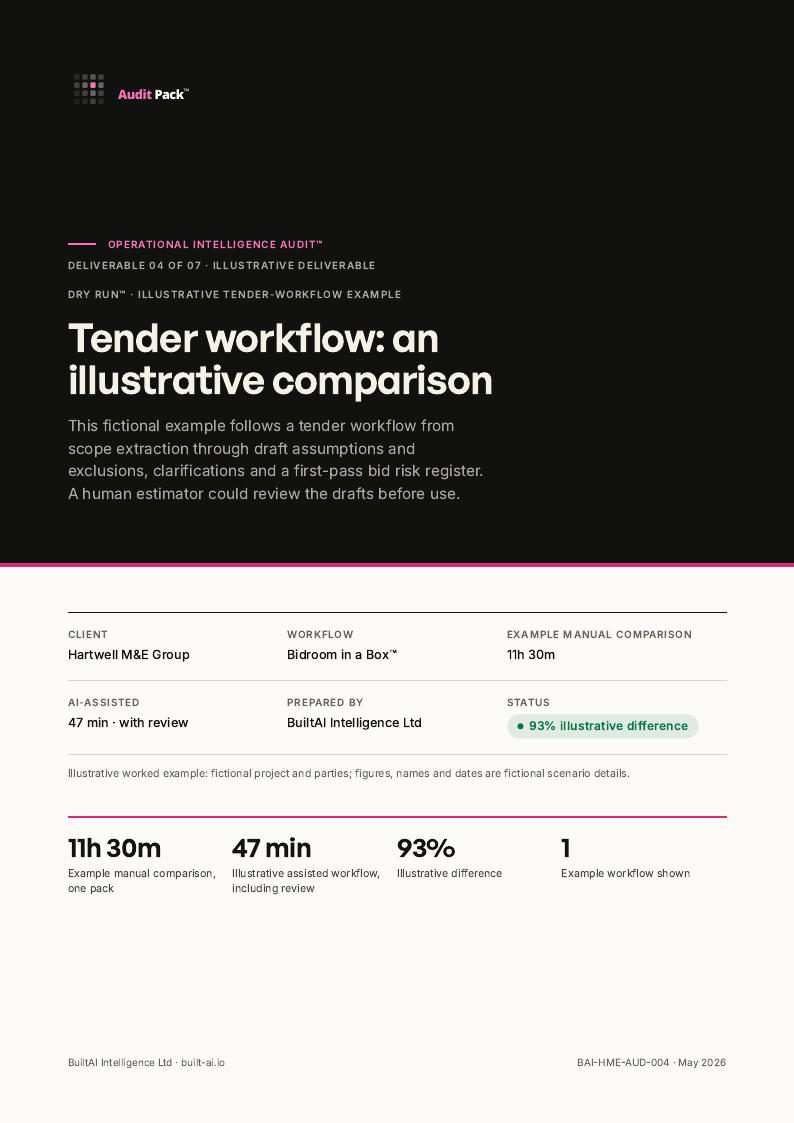
Reviews tender intake, bid production, scope extraction, assumptions discipline, clarifications, risk capture and estimating support.
Outputs may include
- Bid process maturity assessment
- Tender workflow improvement recommendations
- Bidroom in a Box™ pilot recommendation
- Tender capacity and bid-cycle improvement opportunities
Workstream 02
Contract & Compliance Discipline Review
Reviews contract administration, obligations awareness, change control, variation processes, evidence discipline, RAMS workflows, compliance outputs and approval gates.
Outputs may include
- Commercial control maturity assessment
- RAMS and compliance workflow assessment
- Priority risk exposures
- Governance and QA gate recommendations
Workstream 03
Operational Margin Visibility Review
Reviews contract-level profitability, WIP, completed-not-invoiced work, invoice blockers, deductions, reporting cadence, board reporting and QBR effort.
Outputs may include
- Margin visibility maturity assessment
- Margin leakage indicators
- WIP and invoice readiness improvement opportunities
- Operational Margin Cockpit™ pilot recommendation
Workstream 04
Systems & Governance Readiness Review
Reviews CAFM/CMMS, finance systems, CRM, spreadsheets, document control, exports, API readiness, data quality and AI governance.
Outputs may include
- Systems readiness assessment
- Red / Amber / Green data classification proposal
- Governance baseline
- Approval gate and audit trail recommendations
Controlled Demonstration Prototype
See one use case with your own data.
As part of the audit, Built AI can create a Controlled Demonstration Prototype using your own information. This is not a full software build or system integration. It is a practical demonstration of how one workflow could operate using your real tender, RAMS or reporting data.
Track A — Tender Intelligence Prototype
Input
Real tender pack
Output
Requirement extraction, scope structuring, clarifications, assumptions and bid risk outputs.
Track B — RAMS Automation Prototype
Input
Real job type
Output
Task-based RAMS structuring, hazard / control mapping and compliance output.
Track C — Operational Margin Snapshot Prototype
Input
Exported contract / job / finance data
Output
Margin snapshots, leakage indicators and invoice readiness opportunities.
The prototype gives leadership a clearer view of what Phase 1 implementation could look like before committing to wider rollout.
Deliverables
What you receive at the end of the audit
Seven decision-ready deliverables, designed to be reviewed with the leadership team and used to scope Phase 1 implementation.
01
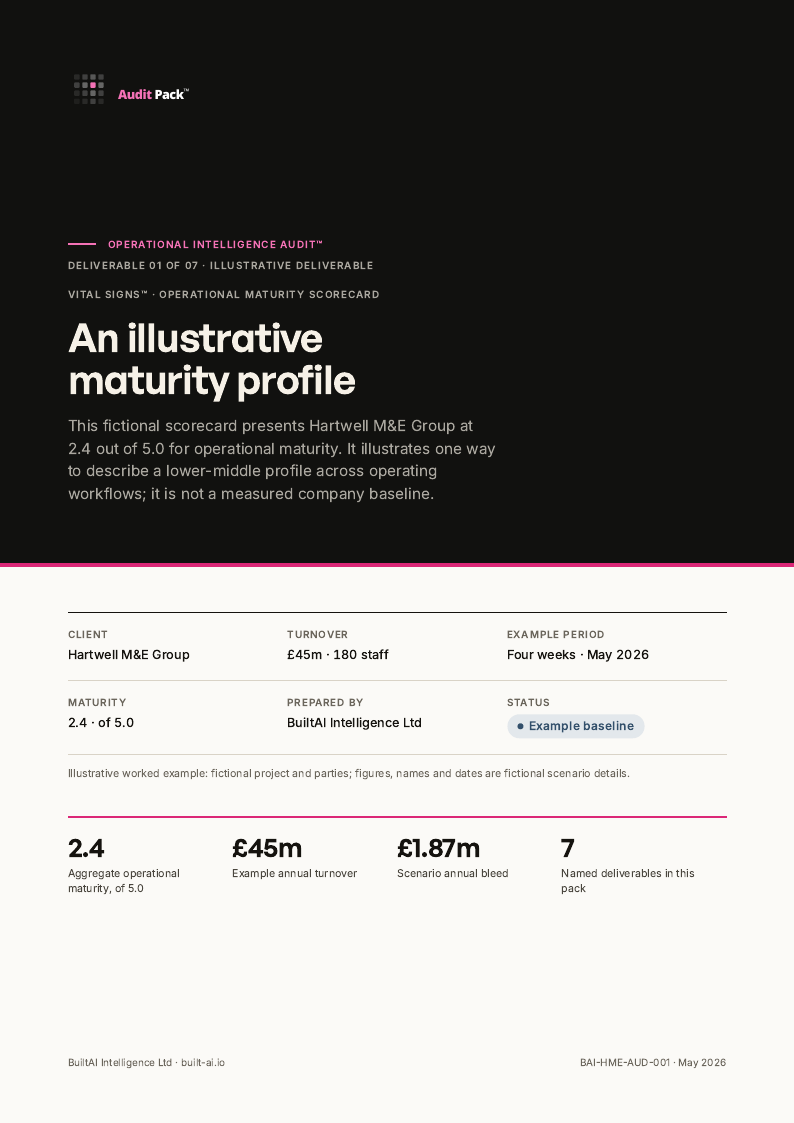
Operational AI Maturity Scorecard
Shows current maturity across bid, compliance, commercial, reporting, systems and governance areas.
02
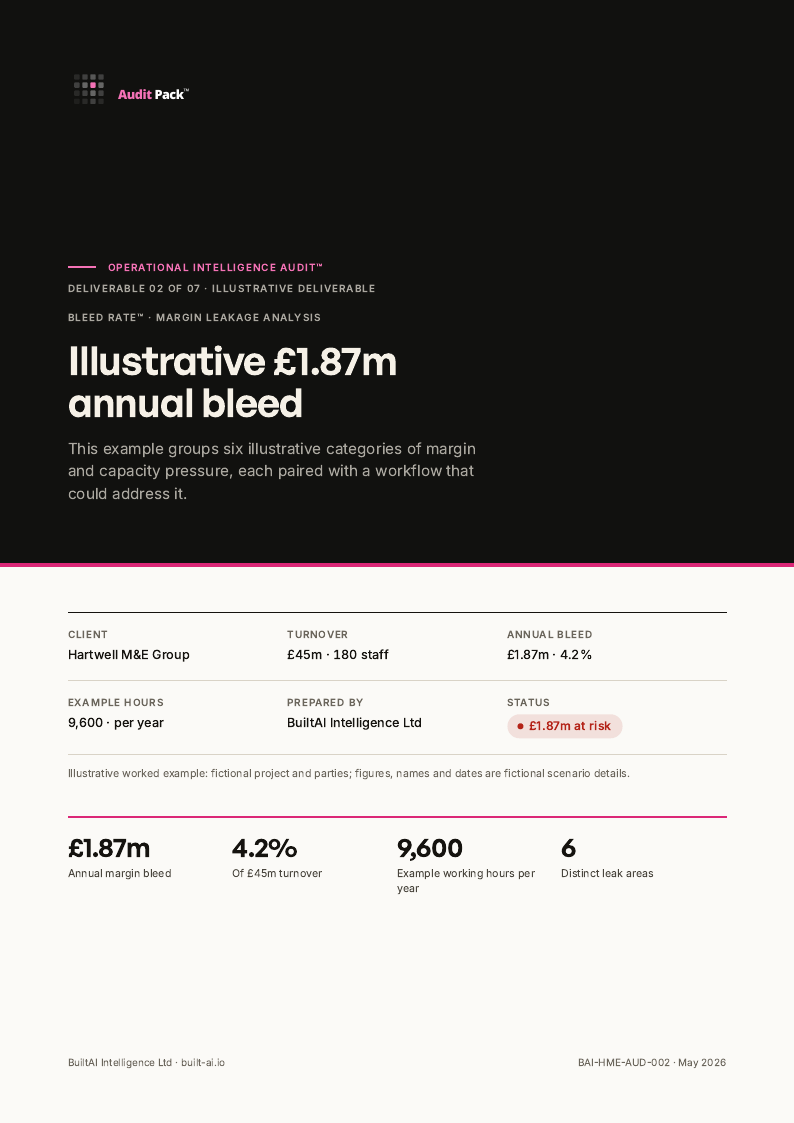
Margin Leakage and Efficiency Analysis
Identifies where admin burden, missed recovery, WIP, invoice blockers or reporting drag are creating cost and capacity issues.
03
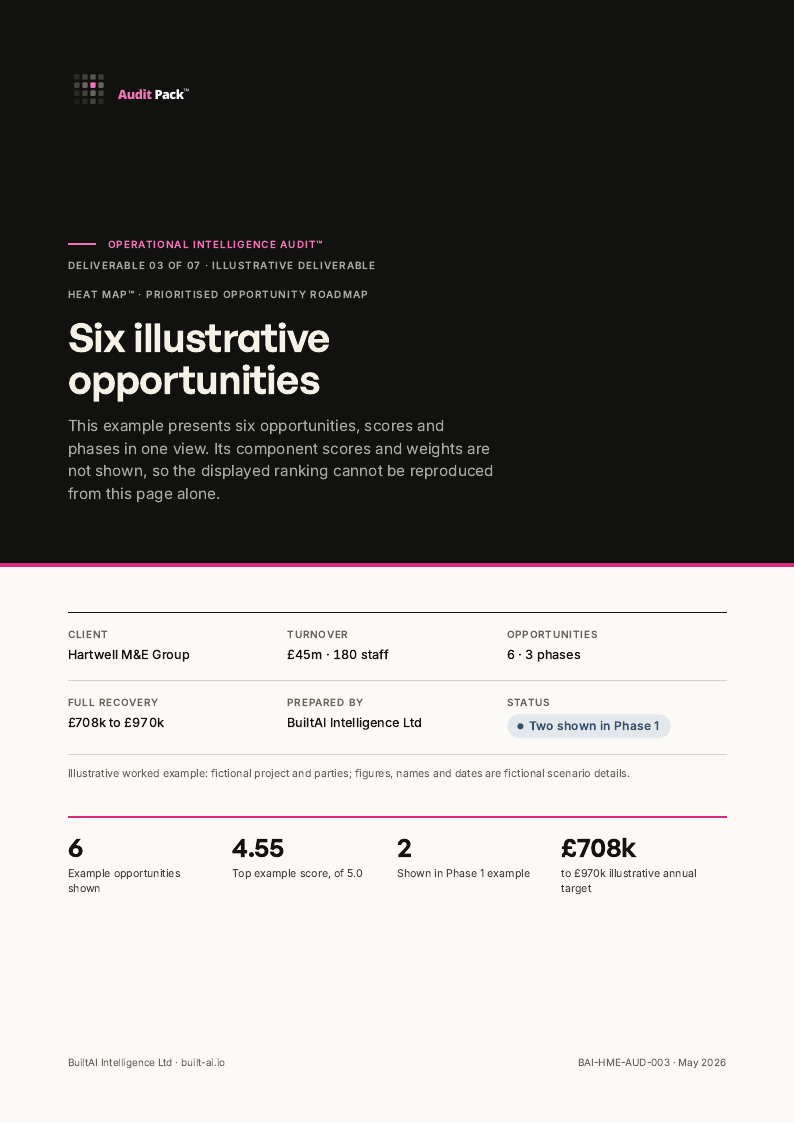
Prioritised AI Opportunity Roadmap
Ranks potential AI workflows by ROI, readiness, risk, complexity and speed to benefit.
04
Controlled Demonstration Prototype
Shows one practical use case using your own data. Not a full software build.
05
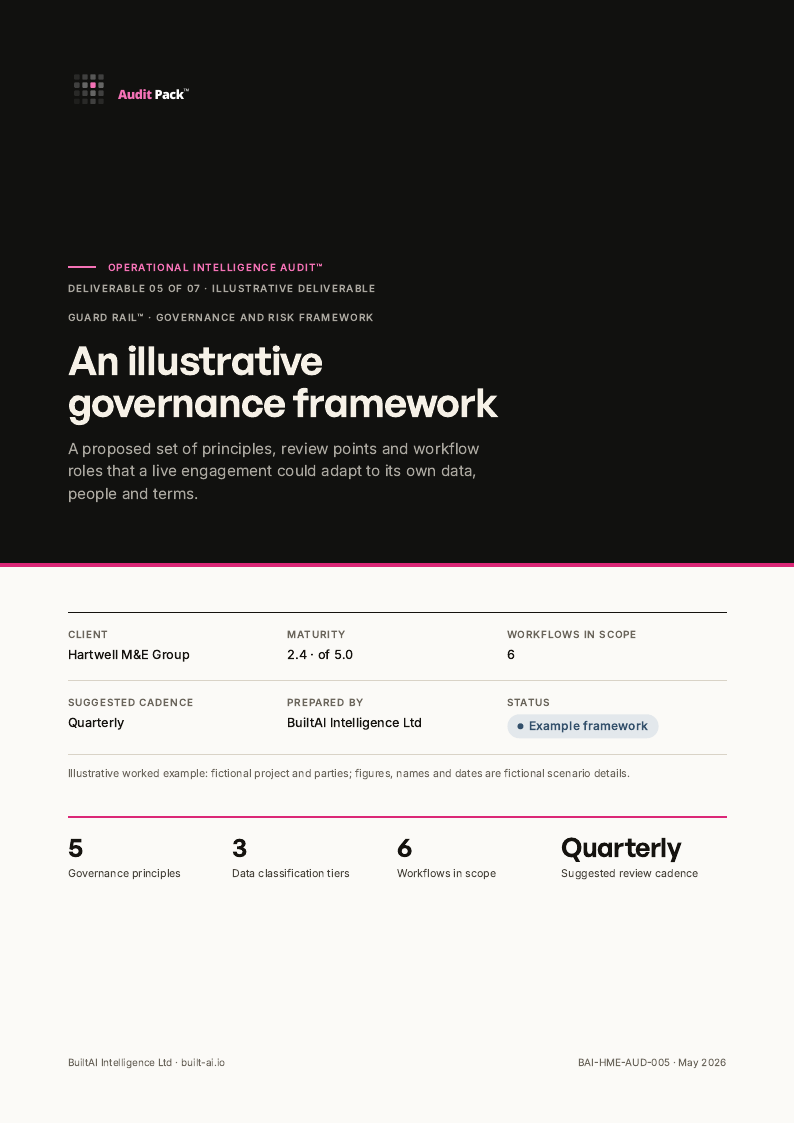
Governance and Risk Framework
Sets out data handling, approval gates, audit trails and safe operating boundaries.
06
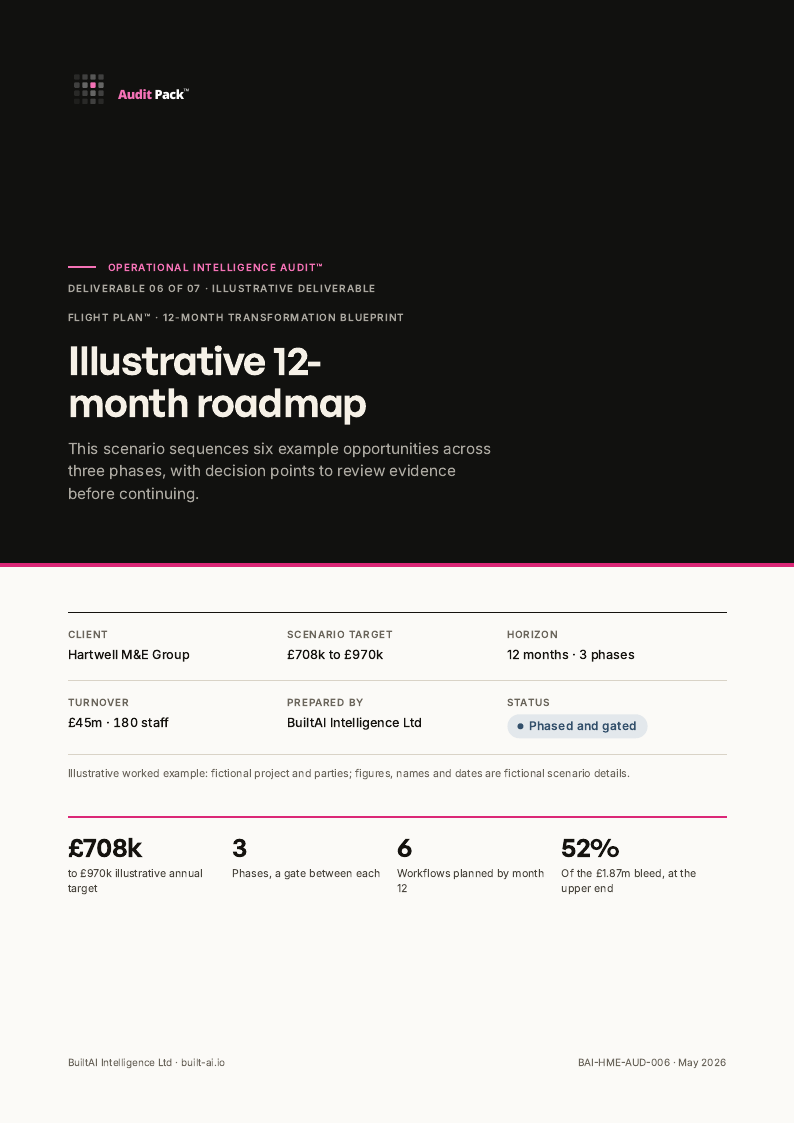
12-Month Transformation Blueprint
Defines a phased route from audit to pilot, rollout, integration and managed AI operations.
07
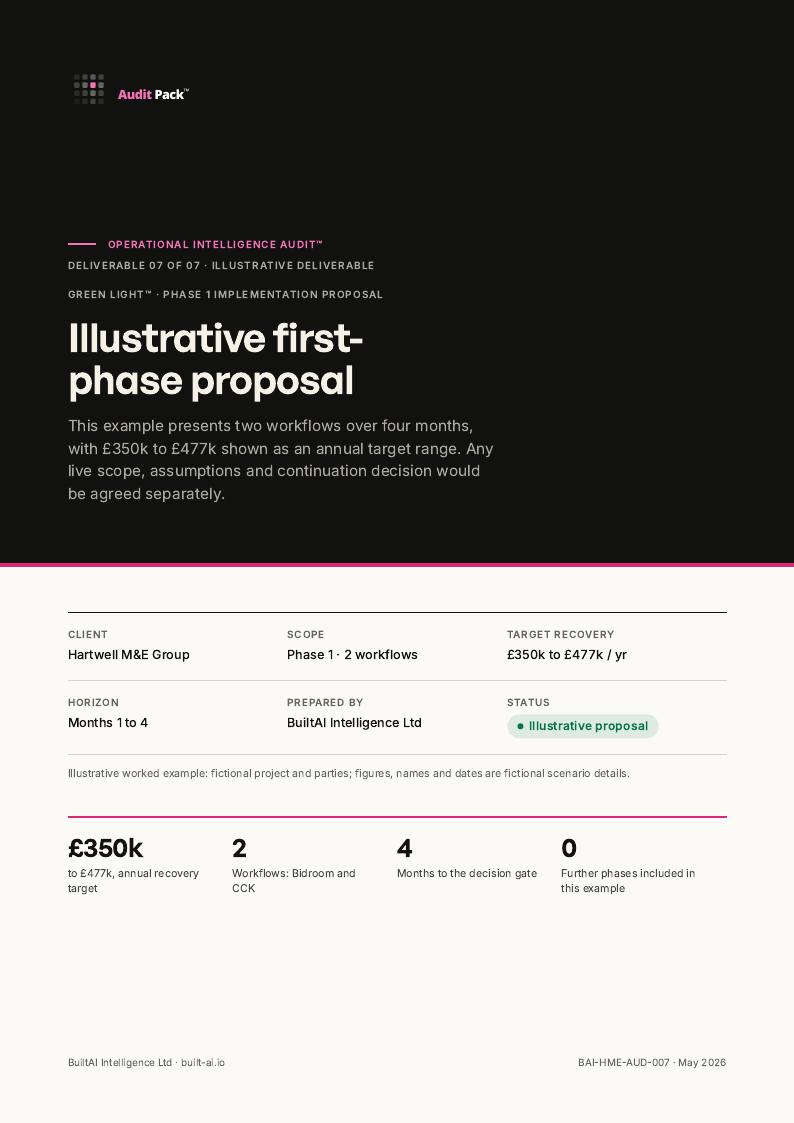
Phase 1 Implementation Proposal
Provides scope, timeline, deliverables, KPI targets and next-step pricing for the first implementation phase.
Timeline
A focused four-week process.
- Week 1
Mobilisation and discovery
Confirm stakeholders, data pack, prototype track and interview schedule.
- Week 2
Process and commercial analysis
Review workflows, documentation, pain points, commercial processes and data quality.
- Week 3
Use-case prioritisation and prototype build
Score opportunities, define priority use cases and build the controlled prototype.
- Week 4
Findings, roadmap and implementation plan
Present findings, prototype, roadmap, governance framework and Phase 1 proposal.
What we need from you
Clear inputs. Better outputs.
The audit works best when the right documents, data and stakeholders are available from the start.
Documents and data
- One representative tender pack
- One representative RAMS pack or job type
- Sample scope documents or templates
- Variation log or commercial register
- WIP, CNI or finance export
- Service desk tickets or SLA reporting (if relevant)
- Sample monthly report or QBR pack
- One key contract or schedule (where relevant)
Typical stakeholder interviews
- Managing Director / Operations Director
- Commercial Director / QS lead
- Estimating or Bid lead
- H&S / Compliance lead
- Finance lead
- Contract Manager / Service Desk lead
KPI framework
The audit is designed around measurable outcomes.
The audit identifies current baseline and future improvement opportunities across five areas — giving leadership a clear way to measure whether implementation is working.
Bid and Tender Efficiency
Tender hours, time to first structured draft, bid throughput, scope rework and clarification quality.
Compliance and Documentation
RAMS production time, approval cycle time, rework frequency and evidence completeness.
Commercial Control and Margin Protection
Change events logged, notices issued, variation recovery trend, time to submission and margin variance.
Operational and Cashflow Discipline
Aged WIP, completed-not-invoiced work, invoice readiness time, blocker categories and reporting effort.
SLA and Service Performance
SLA compliance, deductions trend, first-time classification accuracy, repeat callout rate and evidence completeness.
Governance
Procurement-safe AI adoption from day one.
The audit assesses both opportunity and risk. The governance workstream sits alongside the diagnostic and defines the controls Built AI recommends for the way you adopt AI going forward.
The aim is to make AI adoption practical, commercially useful and defensible — not informal, inconsistent or uncontrolled.
Explore Governance- Data classification model
- Human approval gates
- High-risk output controls
- Audit trail recommendations
- Procurement disclosure posture
- Data minimisation guidance
- Safe usage boundaries
- Escalation and review requirements
Commercial model
Fixed scope. Clear outputs. Practical next steps.
The Operational Intelligence Audit™ is delivered as a fixed-scope engagement. Typical pricing depends on business size, complexity, data readiness and scope, but the audit is designed to be a clear gateway into practical implementation rather than an open-ended advisory exercise.
Where Phase 1 implementation is commissioned following the audit, part of the audit fee can be credited against the implementation programme. This creates a clear route from diagnostic to delivery.
Best fit
Who the audit is for
The Operational Intelligence Audit™ is designed for businesses that:
- Know AI could help but are unsure where to start
- Want to reduce admin burden but need a controlled approach
- Need to increase tender capacity
- Have RAMS, compliance or reporting bottlenecks
- Are losing margin through missed notices, weak evidence or poor recovery
- Have aged WIP, invoice blockers or cashflow drag
- Operate FM service desks with SLA deductions or inconsistent triage
- Need better governance before adopting AI more widely
- Want a board-ready roadmap before committing to implementation
Especially useful for mid-market contractors, FM providers, M&E businesses and PE-backed operators looking for measurable operational improvement.
Example outputs
View example audit outputs
See the kind of structured, decision-ready content the audit can produce.
- AI maturity scorecard
- Workflow opportunity map
- Tender capacity assessment
- RAMS workflow assessment
- Margin leakage analysis
- Prototype output
- Prioritised roadmap
- KPI framework
- Phase 1 implementation plan
Examples are redacted and provided to demonstrate structure, format and quality. Final audit outputs are tailored to each client's workflows, data, systems and commercial priorities. Built AI helps produce structured, detailed and review-ready outputs. Final review, validation, approval and reliance remain with the client's competent people.
Ready to find the right place to start?
Book an Audit Readiness Call to identify where AI could help your business increase tender capacity, reduce admin, improve document quality, protect margin and deploy AI safely.