


Change and variations · For QSs and commercial managers
Keep change visible. Put your commercial team in control.
The kit logs the change, tracks the notice and drafts the narrative, the evidence index and the valuation. Your QS reviews, approves and issues each one before it reaches the Project Manager.
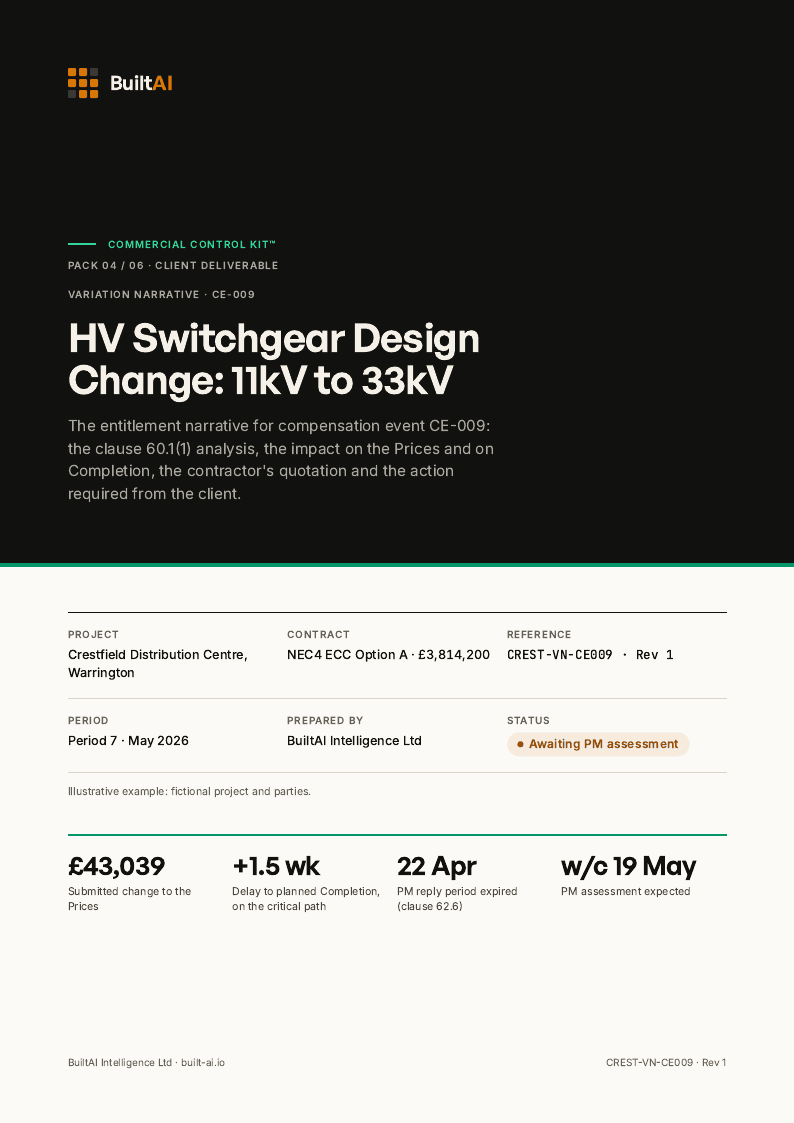
Open the full document (4 pages) 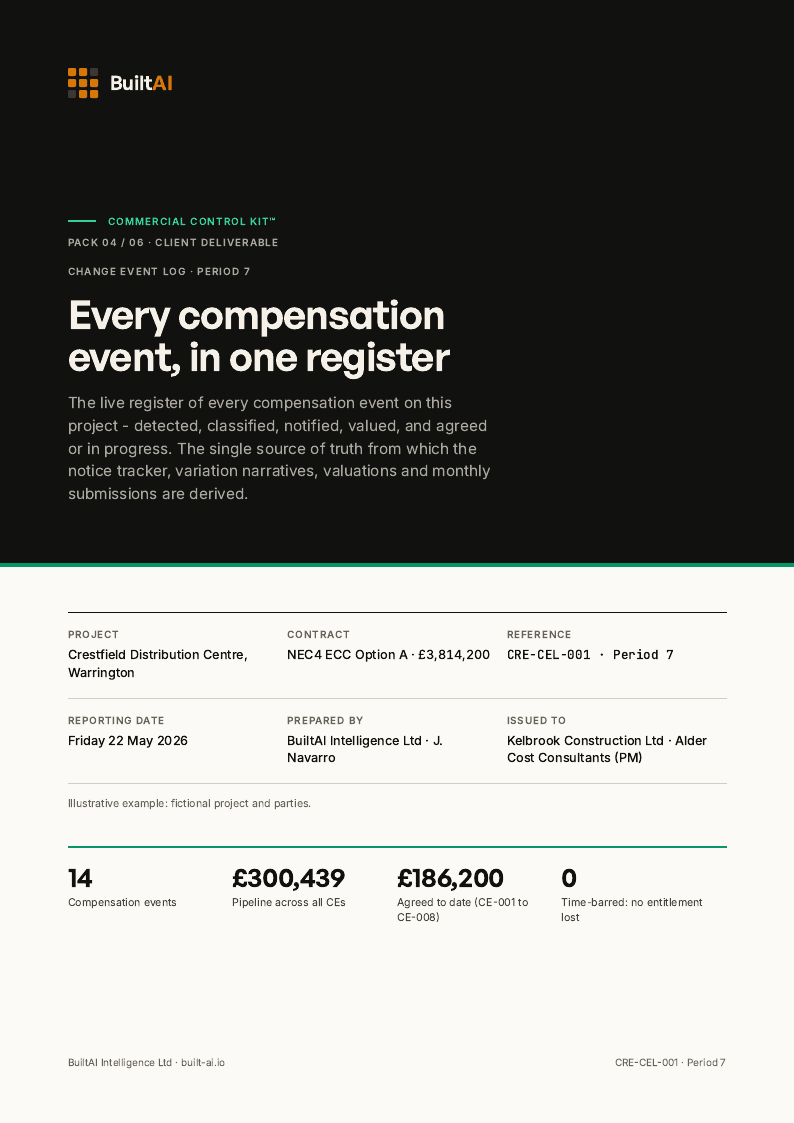
Open the full document (4 pages) 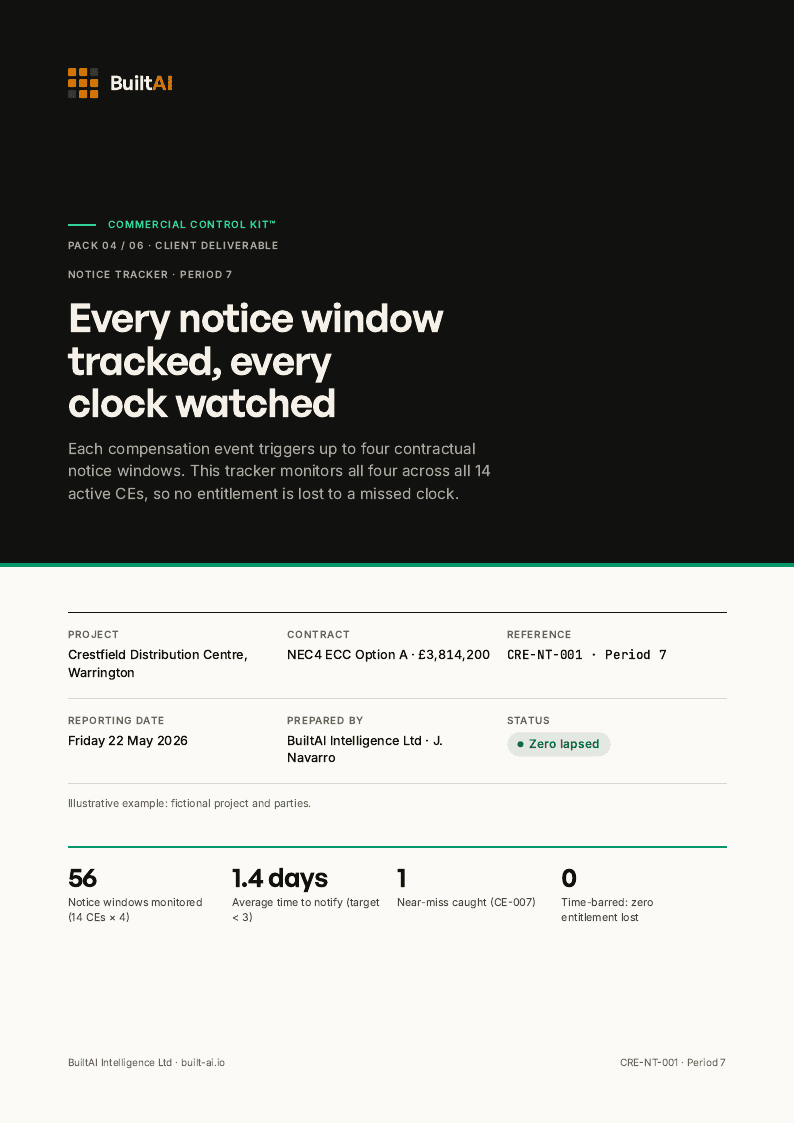
Open the full document (3 pages) 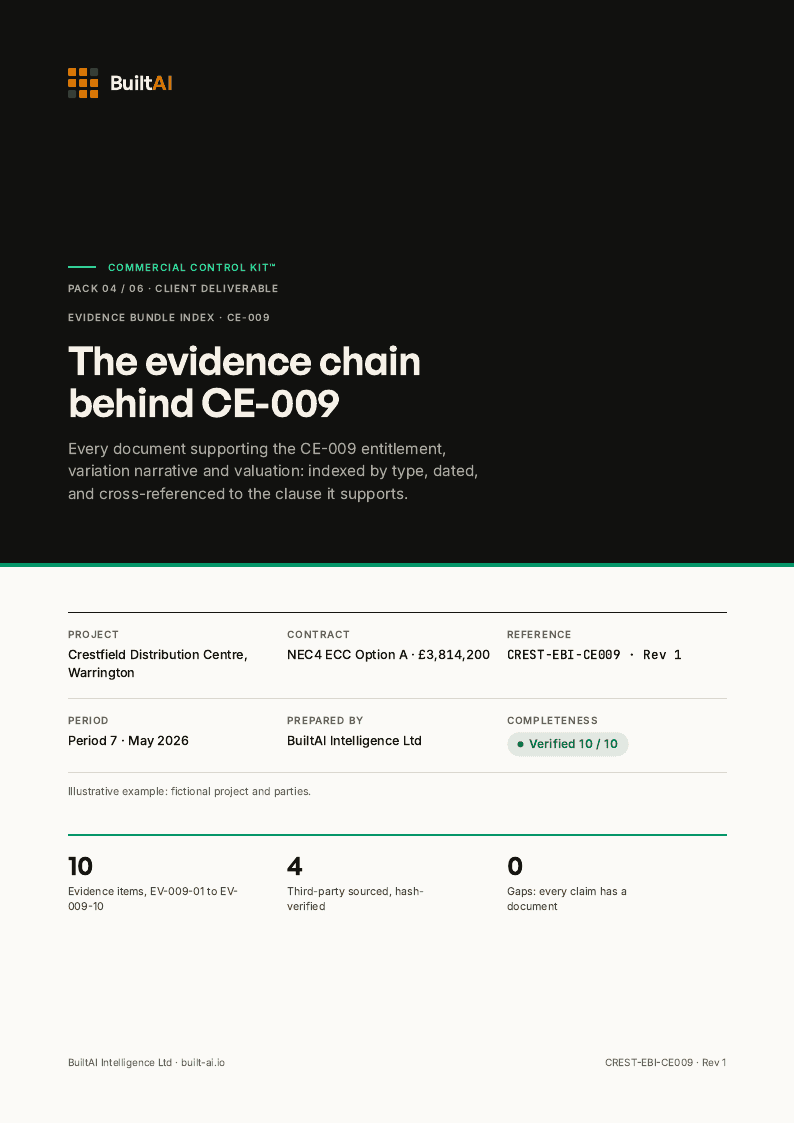
Open the full document (3 pages) 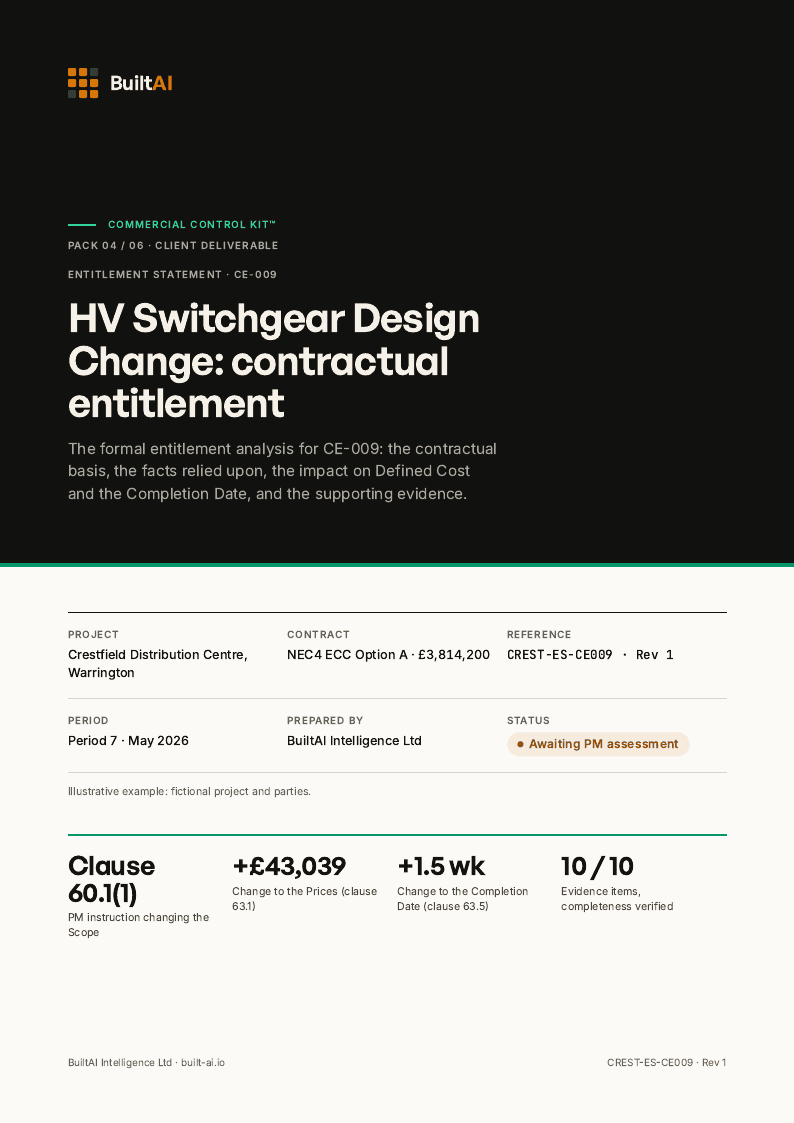
Open the full document (3 pages) 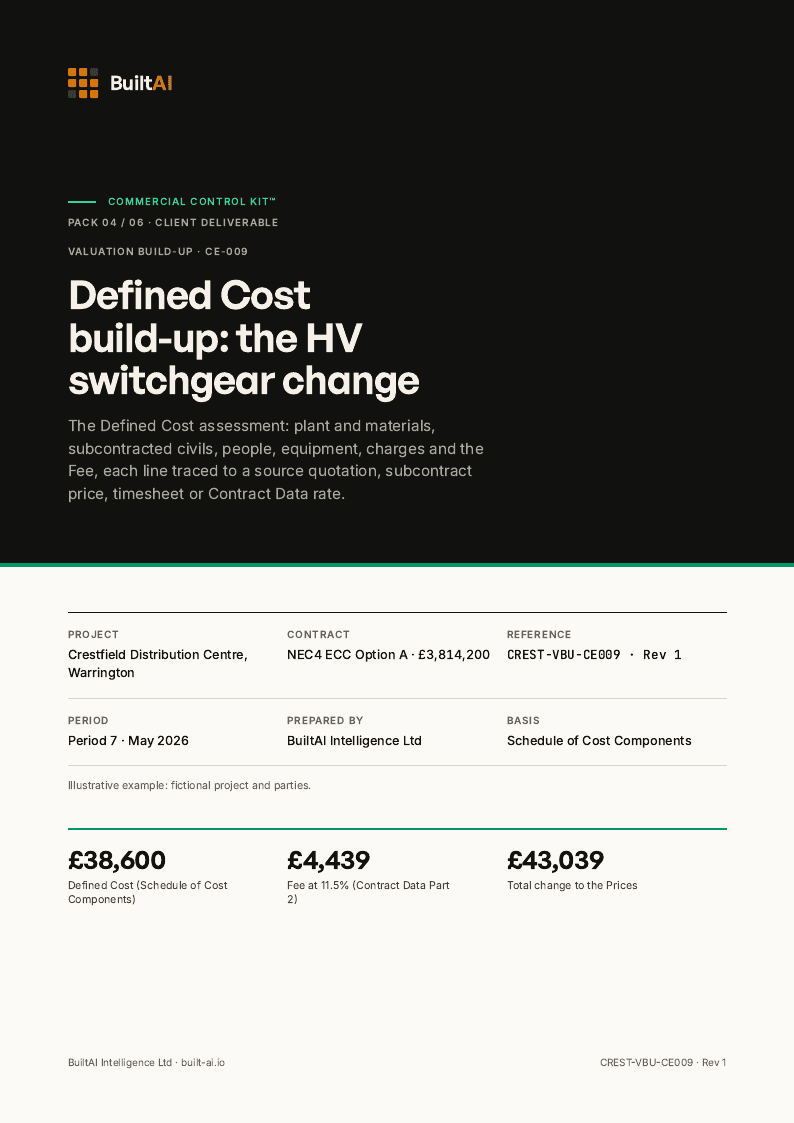
Open the full document (2 pages) 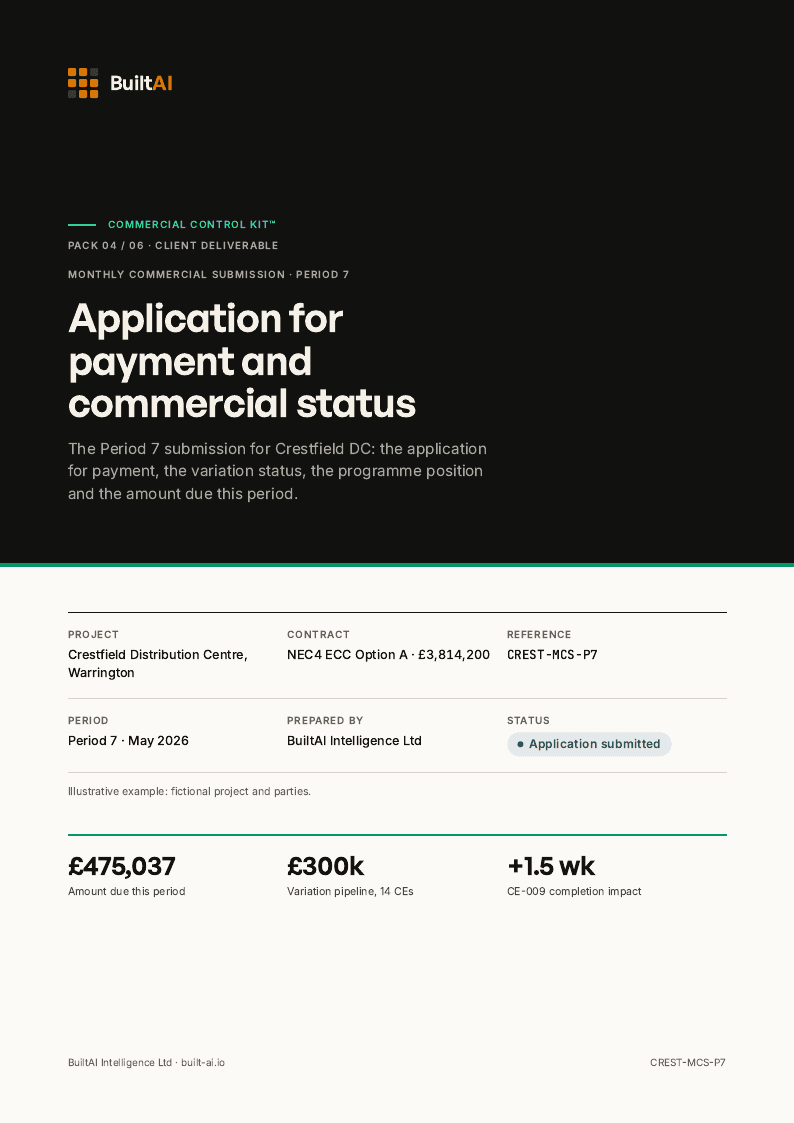
Open the full document (2 pages) 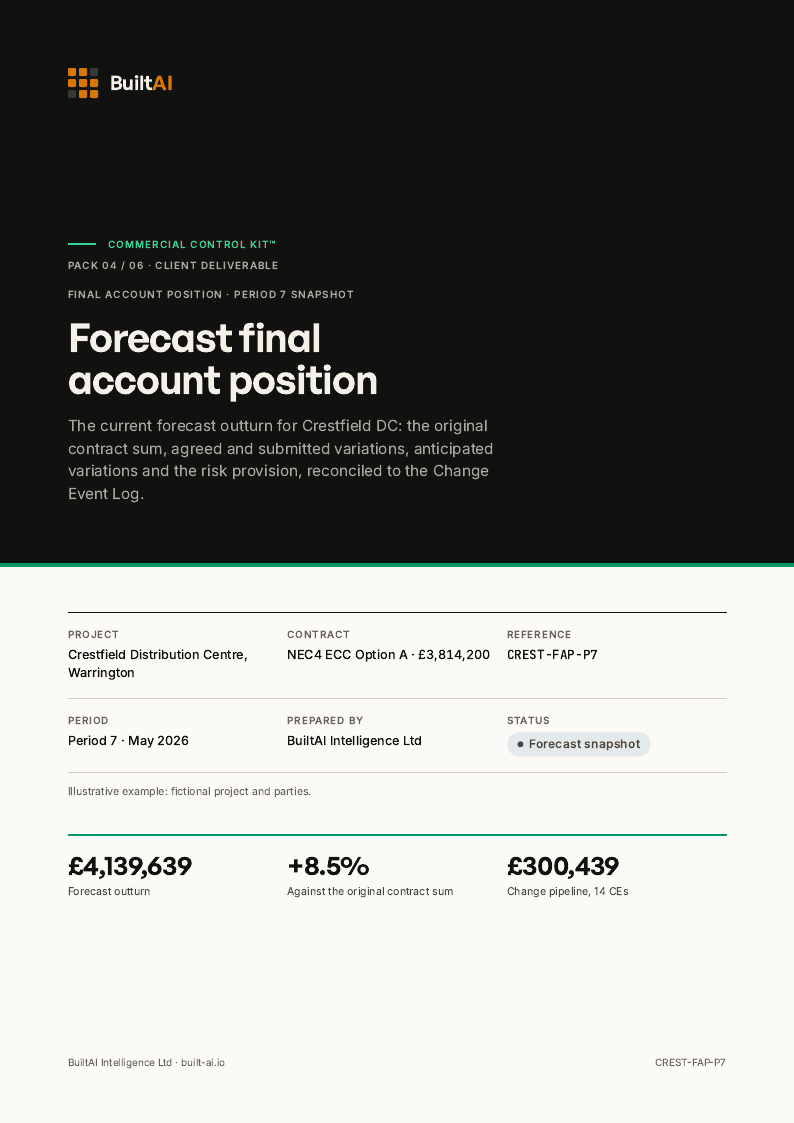
Open the full document (2 pages)
The period
Change event in. An evidence-led submission for your QS to review.
Six stages run in order, each one a gate. Your QS clears it before anything reaches the Project Manager.
Stage 1 of 6 · Change capture
The Radar
Open the stage exampleStage 2 of 6 · Notice tracking
The Clock
Open the stage exampleStage 3 of 6 · Entitlement narrative
The Case
Open the stage exampleStage 4 of 6 · Evidence assembly
The File
Open the stage exampleStage 5 of 6 · Valuation
The Count
Open the stage exampleStage 6 of 6 · Submission
The Drop
Open the stage exampleChange captureStage 1 of 6
The Radar
The change is logged at the moment of recognition and classified against the contract: NEC clause 60.1, JCT clause 5 or bespoke. The notice clock starts.
Project manager or QS confirms the trigger event
Open the stage exampleNotice trackingStage 2 of 6
The Clock
Date served, party, method and acknowledgement recorded. Time-bar windows surfaced before they close.
QS issues the notice and confirms acknowledgement
Open the stage exampleEntitlement narrativeStage 3 of 6
The Case
The cause, effect and entitlement chain: what changed, what followed, why entitled, with every claim traced to a drawing, instruction or RFI response.
QS owns the contractual position and language
Open the stage exampleEvidence assemblyStage 4 of 6
The File
Drawings, instructions, RFI responses, photographs, daywork sheets and programme extracts, numbered and source-linked.
QS or commercial co-ordinator verifies completeness
Open the stage exampleValuationStage 5 of 6
The Count
Defined Cost built up: labour, plant, materials, subcontractor, prelims and fee, each layer traced to current rates and the contract pricing mechanism.
QS or estimator sets the rates
Open the stage exampleSubmissionStage 6 of 6
The Drop
Narrative, evidence index, valuation and entitlement statement compiled to the Project Manager's template, with the audit trail logged.
Commercial manager signs and submits
Open the stage example
What comes back
Eight documents in the change account, from first notice to final account position.
The narrative, the evidence index, the entitlement statement and the valuation are built from the same change event, so the assessor reads one argument, not four.
- Stages
- 06
- Documents
- 08
- Review
- Named
Worked example on a fictional job.
Commercial Control Kit
Change account · BAI-CCK
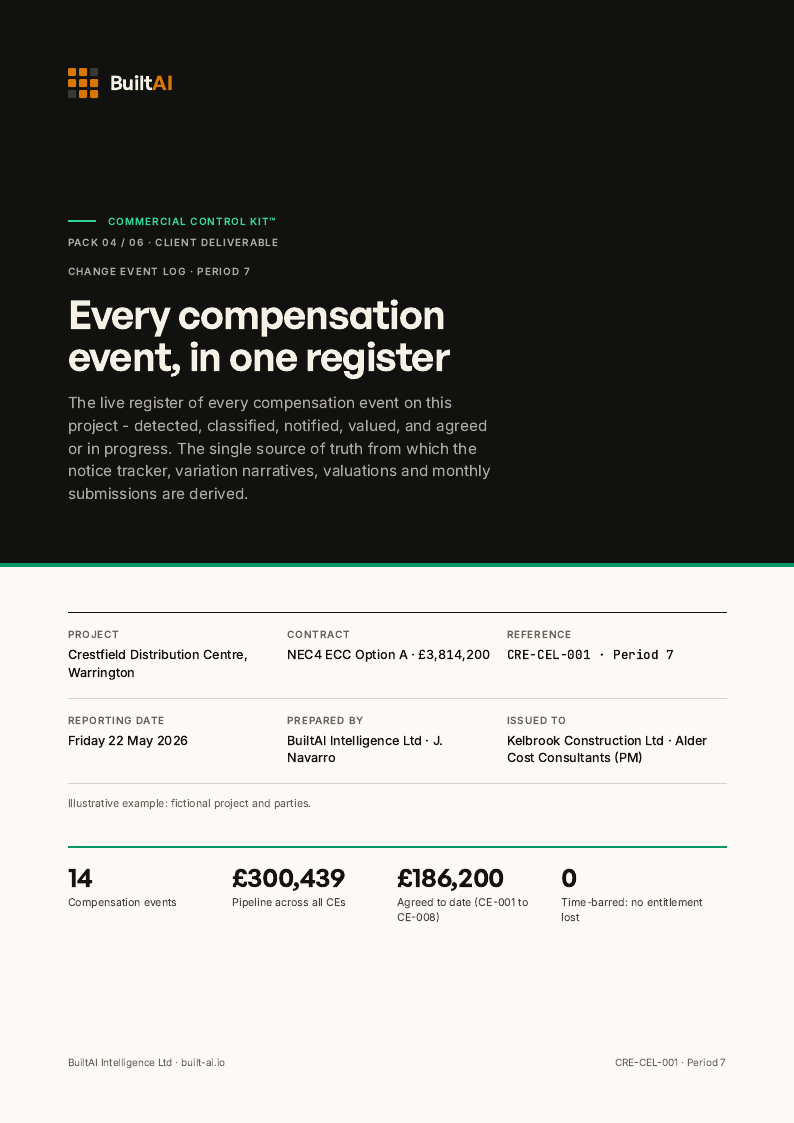
- Change event log4 pages
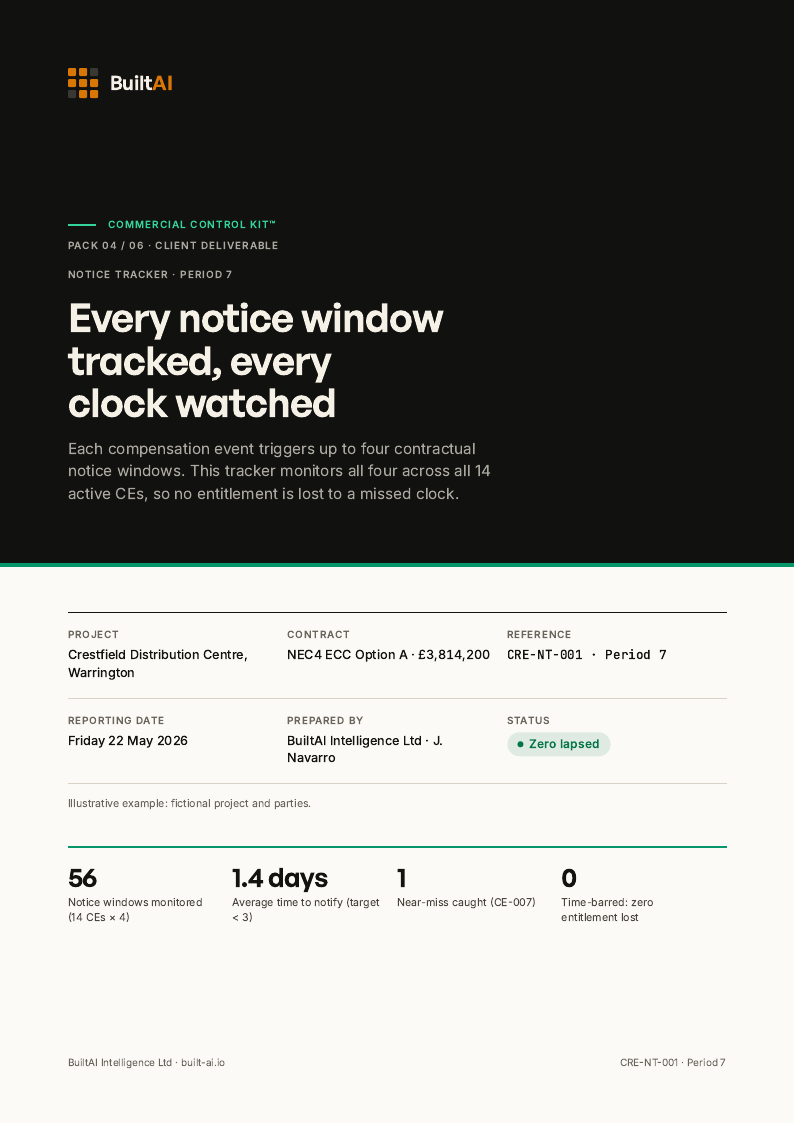
- Notice tracker3 pages
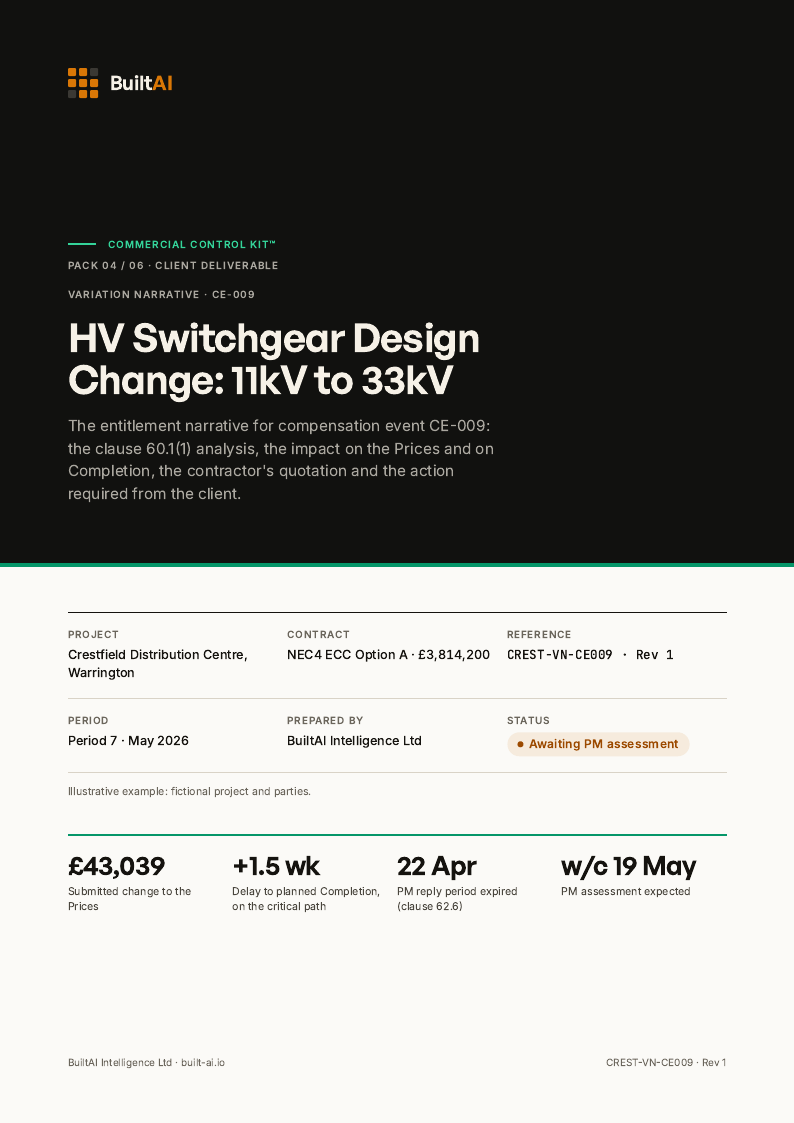
- Variation narrative, CE-0094 pages
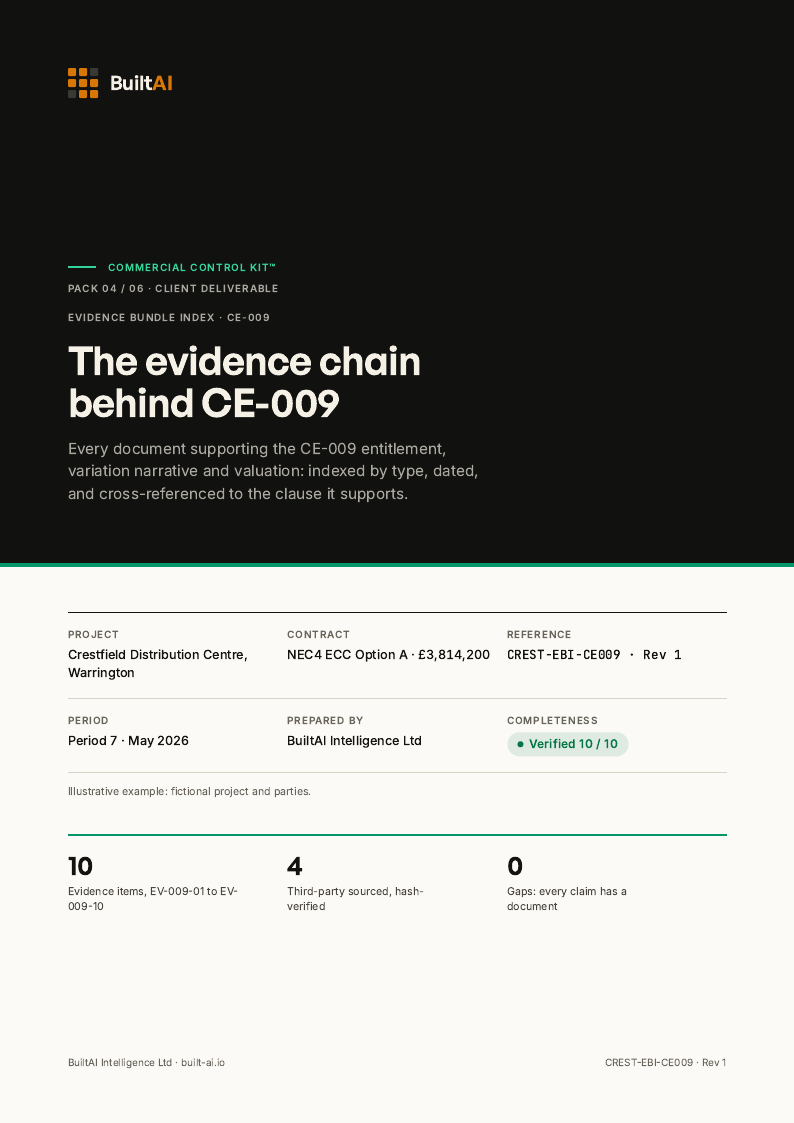
- Evidence bundle index, CE-0093 pages
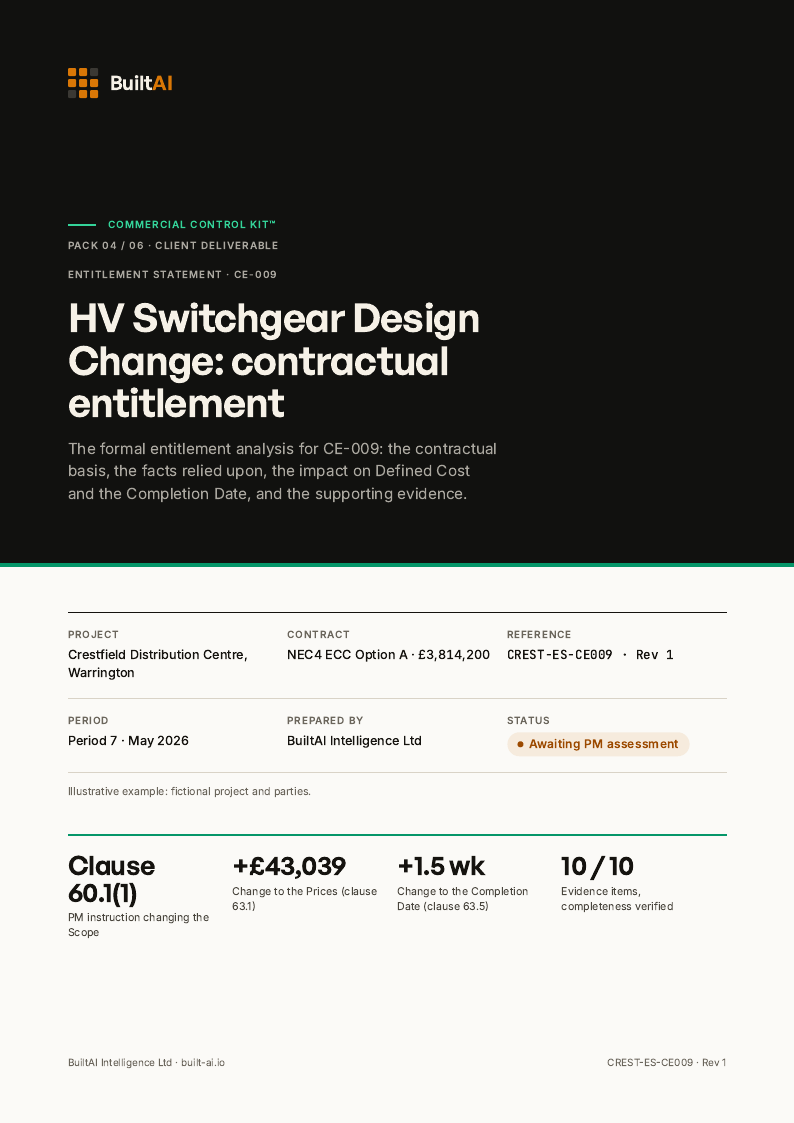
- Entitlement statement, CE-0093 pages
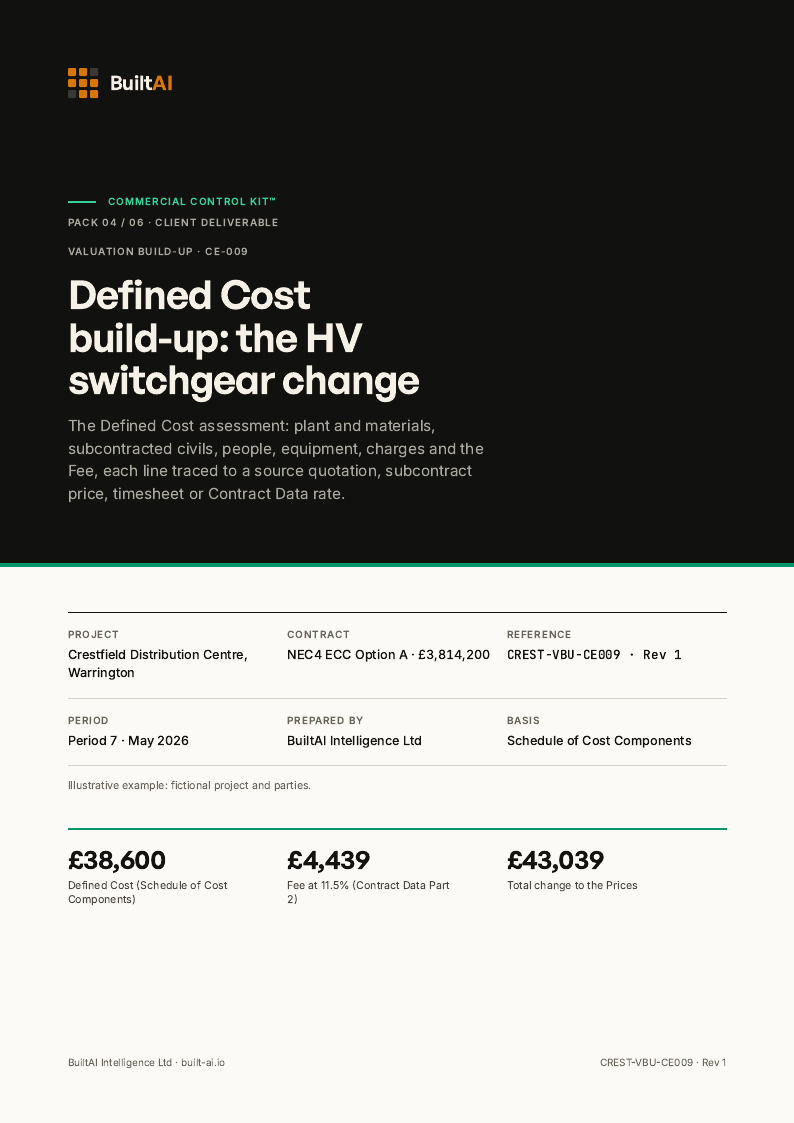
- Valuation build-up, CE-0092 pages
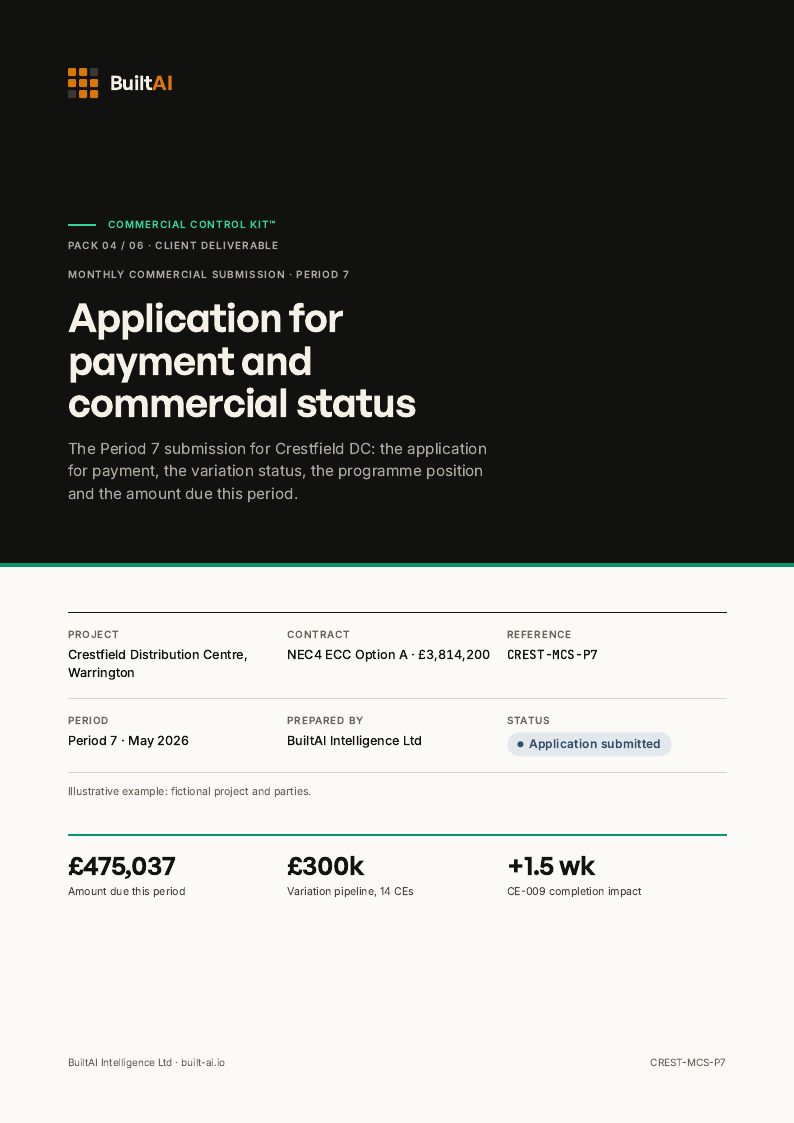
- Monthly commercial submission2 pages
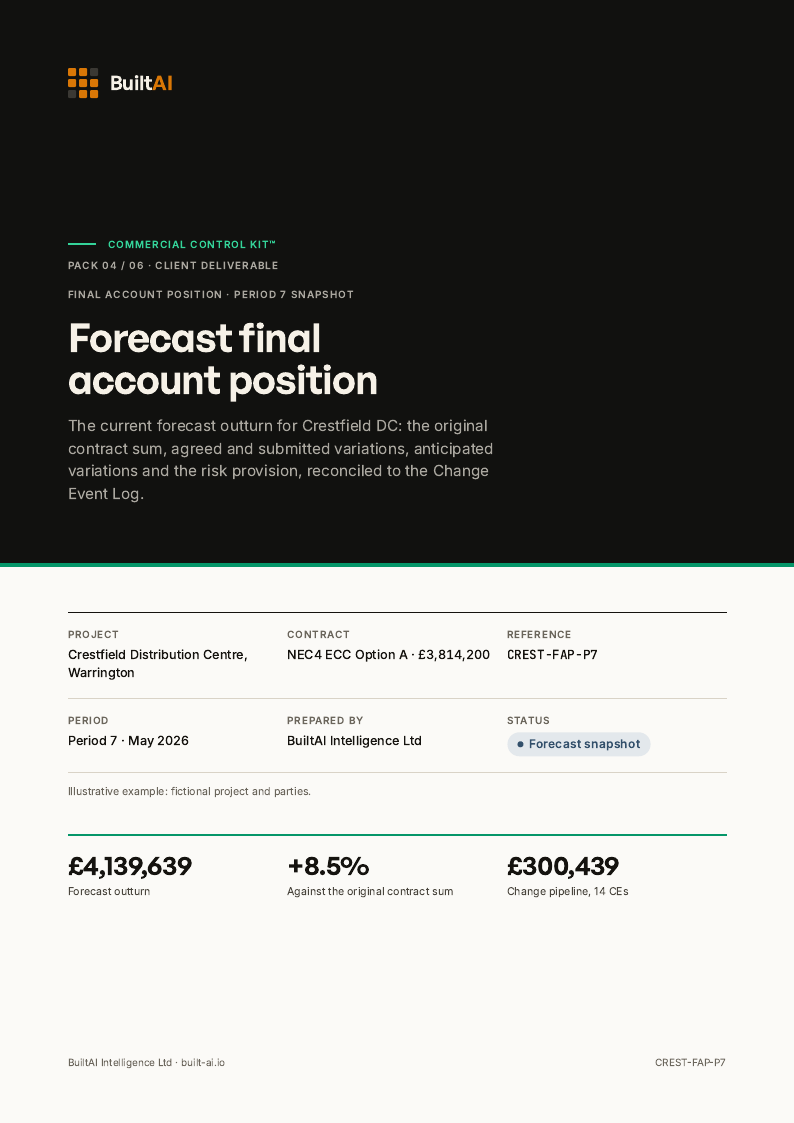
- Final account position2 pages
Worked example on a sample project: one compensation event on an NEC4 distribution-centre contract, carried from recognition to submitted quotation. The full documents are on the worked-example page, one link from the top of this one.
Open the worked exampleWho signs
The kit builds the file. Your QS holds the position.
The kit builds the file
Instructions, correspondence, drawings and programme extracts in; notices, narratives, evidence indexes and valuations out as drafts, clauses cited.
Your QS holds the position
Whether an event is a compensation event, what the entitlement argument is, which rates to defend and when to concede stay with your QS and commercial manager.
The submitted pack locks
Every notice and submission is recorded against its change event with who signed it. An edit after approval voids it and asks for it again.
The gates, by role
Stage 6 of 6 · The Drop
Commercial manager signs and submits
Open the stage example
Stage 1 of 6 · The Radar
Project manager or QS confirms the trigger event
Open the stage example
Stage 1 of 6 · The Radar
Project manager or QS confirms the trigger event
Open the stage exampleStage 2 of 6 · The Clock
QS issues the notice and confirms acknowledgement
Open the stage exampleStage 3 of 6 · The Case
QS owns the contractual position and language
Open the stage exampleStage 4 of 6 · The File
QS or commercial co-ordinator verifies completeness
Open the stage exampleStage 5 of 6 · The Count
QS or estimator sets the rates
Open the stage example
Stage 4 of 6 · The File
QS or commercial co-ordinator verifies completeness
Open the stage example
Stage 5 of 6 · The Count
QS or estimator sets the rates
Open the stage example
Where it runs
The kit runs in The Plant Room, change event by change event, gate by gate.
Your commercial team sees each change event, its notice clock, who cleared each stage and what is next to run. Every submission keeps who signed it on the record.
The Plant Room →05 / Questions
Before we talk.
Questions teams ask about this pack. The 30-minute call covers the rest.
Do we need to switch project-management tools to use the kit?
No. Commercial Control sits alongside whatever PM or CRM stack you already run (Procore, Aconex, Asta, Excel). The instruction log and notice tracker live in BuiltAI; references to source documents stay where they are.
What changes first once the kit is running?
Notices and change events are logged as they happen, with the evidence attached, so the account position is current rather than reconstructed at the end of the period. What that is worth depends on the contract value and how disciplined the baseline already is; we look at that together on the call.
What is the smallest team this kit makes sense for?
Two or three live projects with at least one named commercial sponsor. Below that, a written SOP is usually enough; we would recommend the Operational Intelligence Audit first and only deploy if it confirms recurring leakage.
Build a clearer route from change event to submission.
Tell us about the variation, the notice position and where the commercial process gets held up. Arrange a 30-minute call to explore the next step.
How the commercial model works →