


RAMS and COSHH · For SHEQ leads and competent persons
RAMS Factory – task-specific RAMS, signed by your competent person
RAMS Factory is BuiltAI's governed safety-document workflow. From a job intake it drafts the method sequence, hazard–risk–control matrix, PPE and plant schedules, COSHH index, permits and isolations, and the approval trail. AI drafts; your competent person and SHEQ team review, approve and issue before anything goes to site. Worked examples on this page use fictional projects.
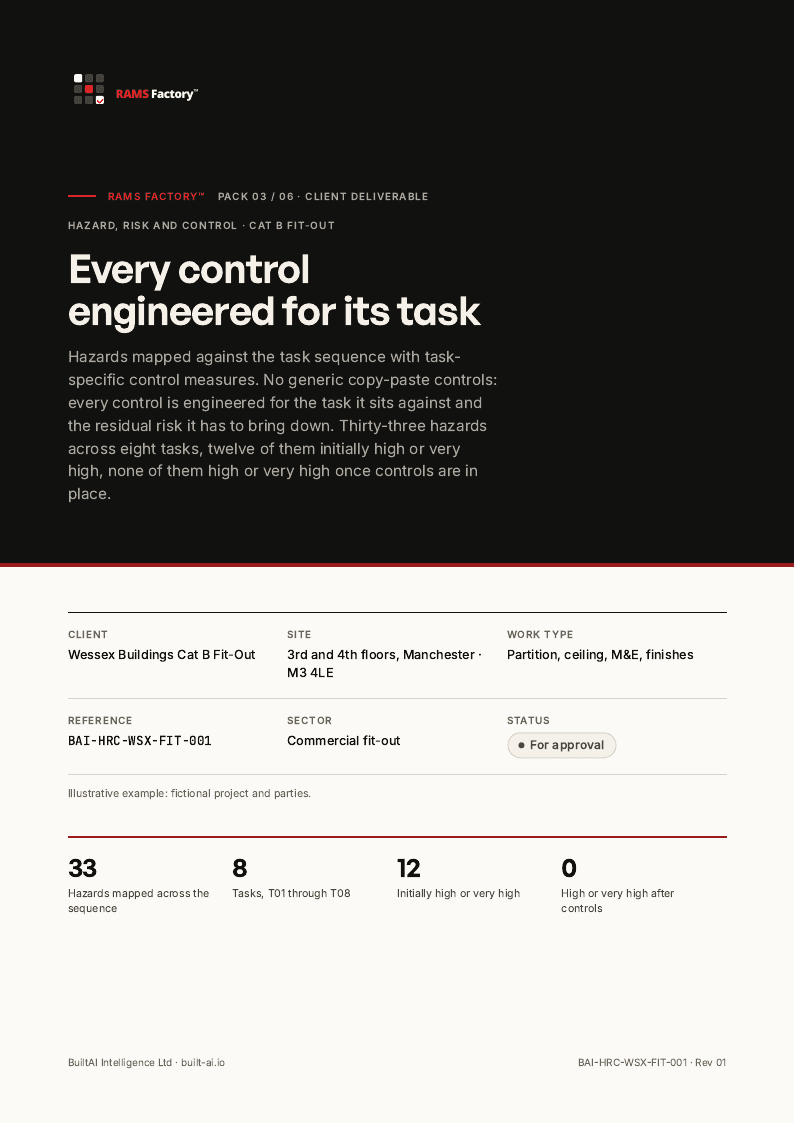
Open the full document (3 pages) 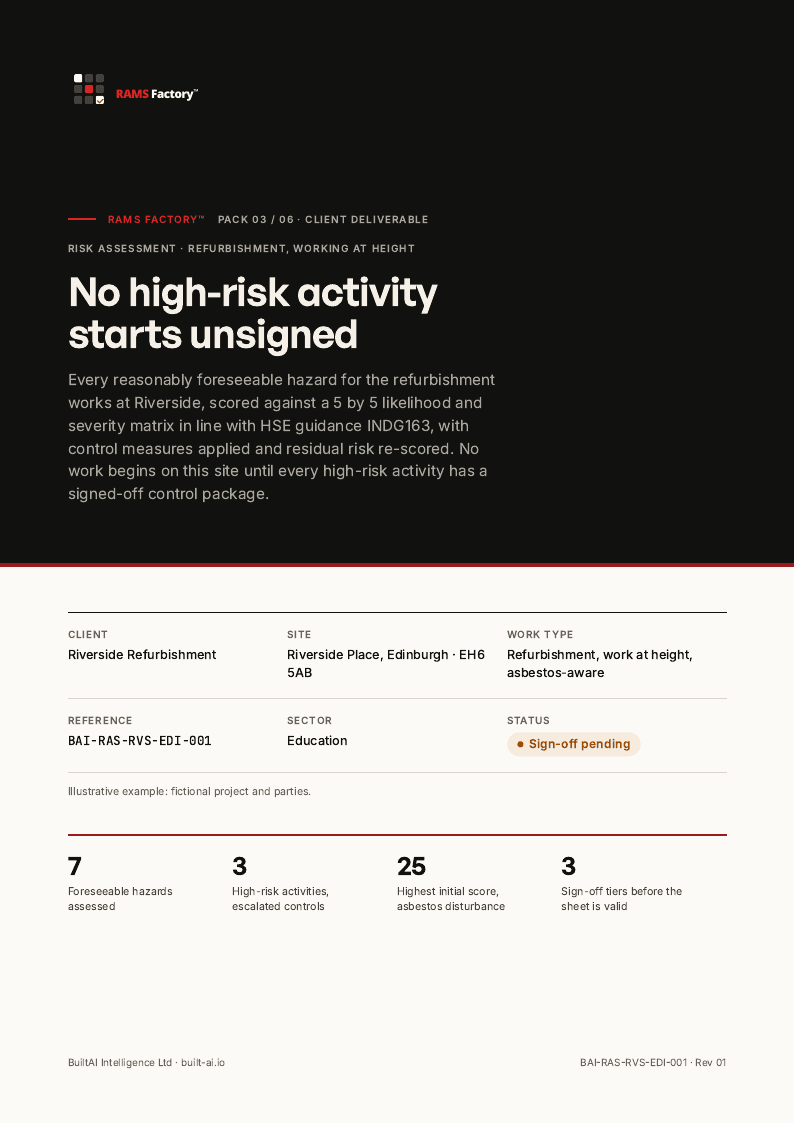
Open the full document (3 pages) 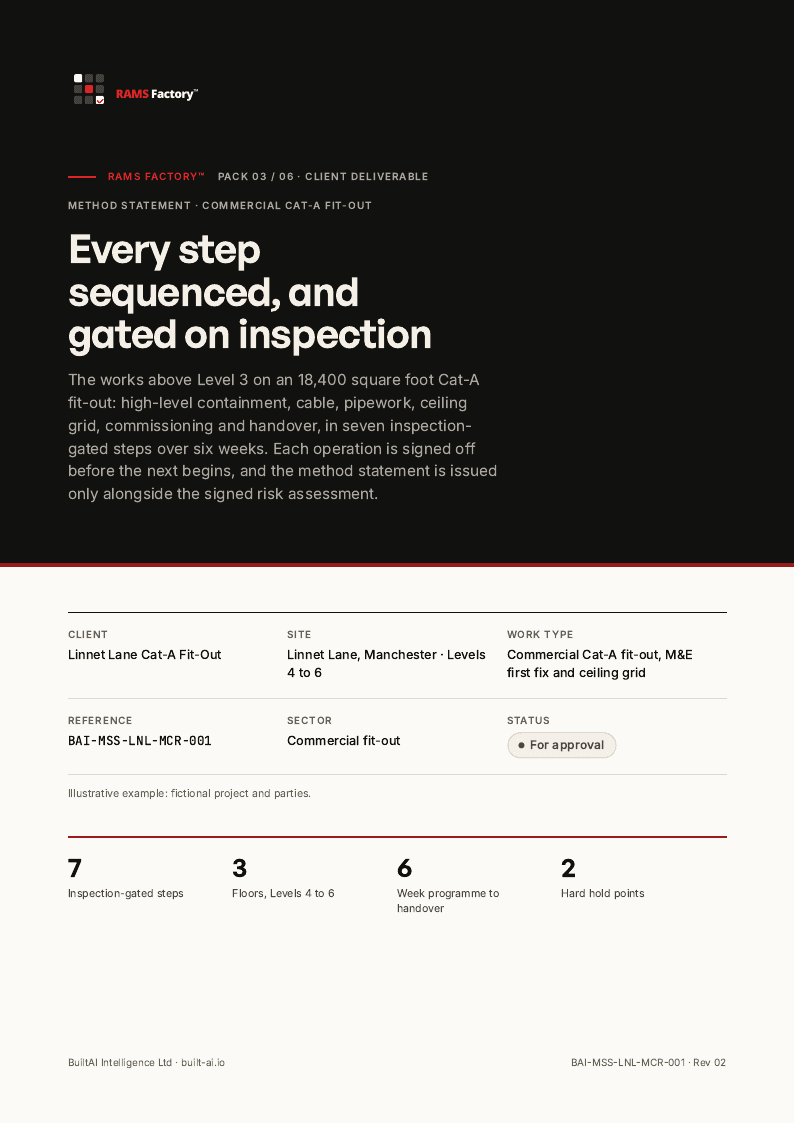
Open the full document (3 pages) 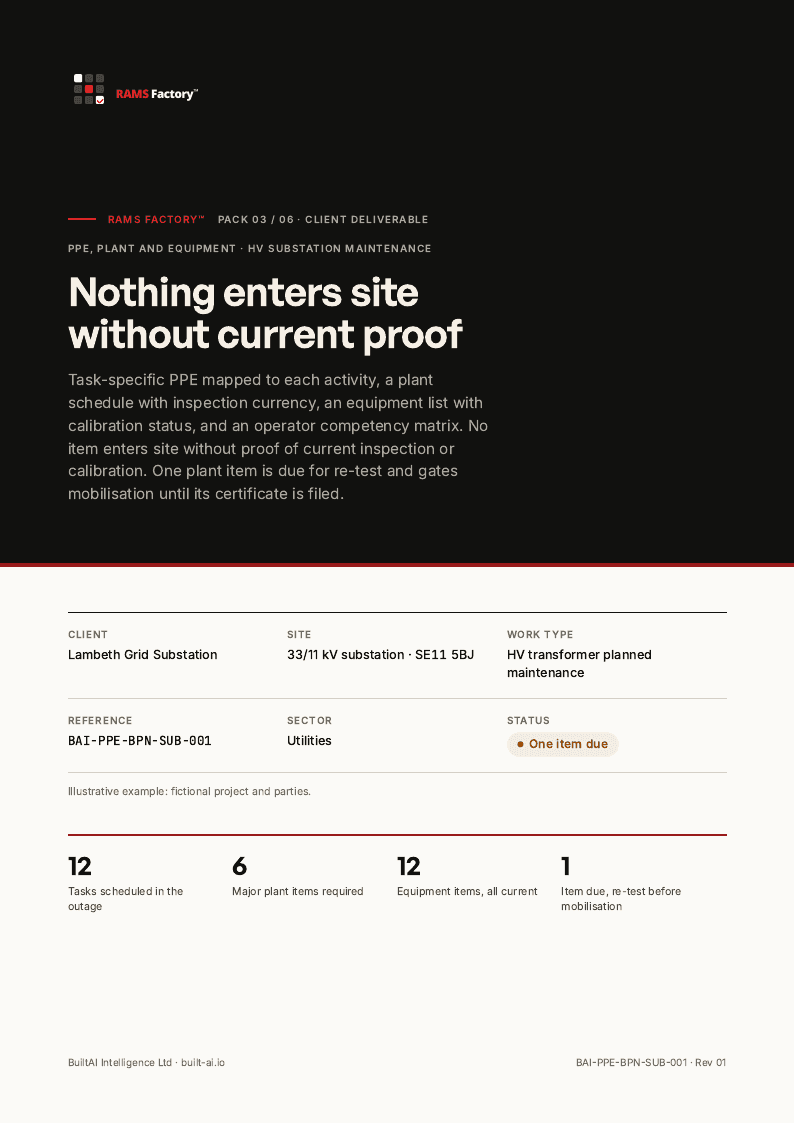
Open the full document (3 pages) 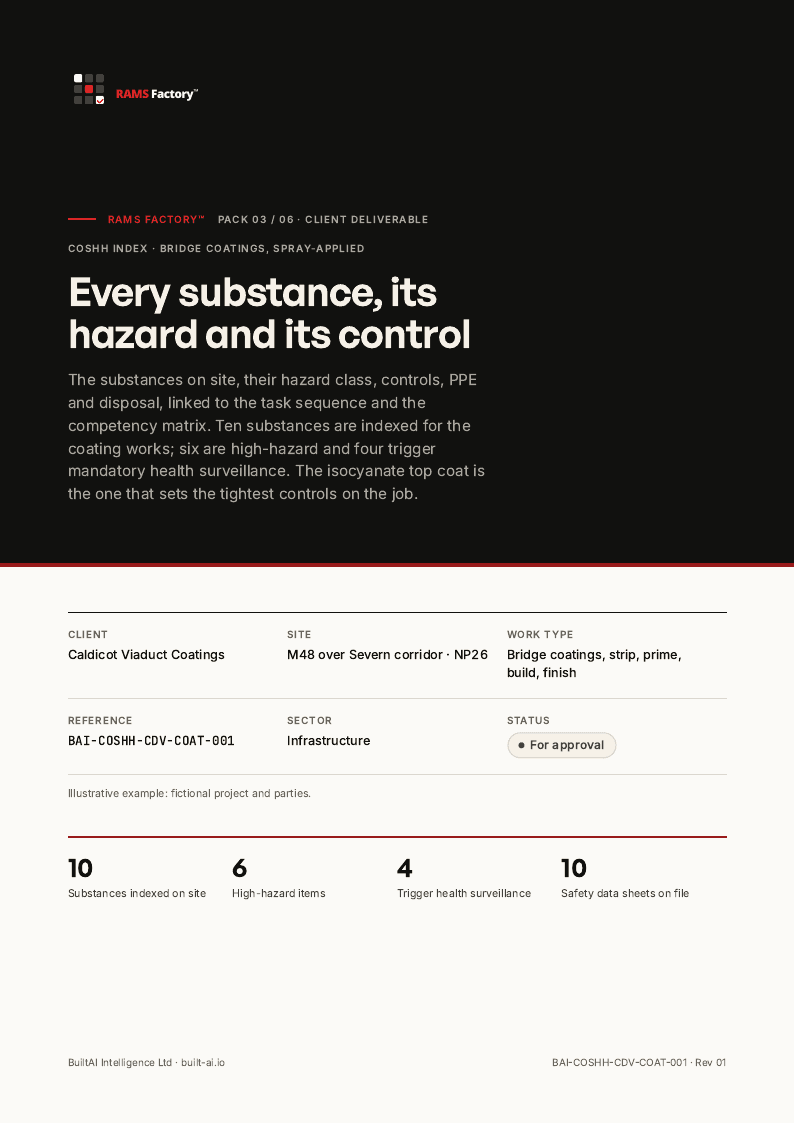
Open the full document (3 pages) 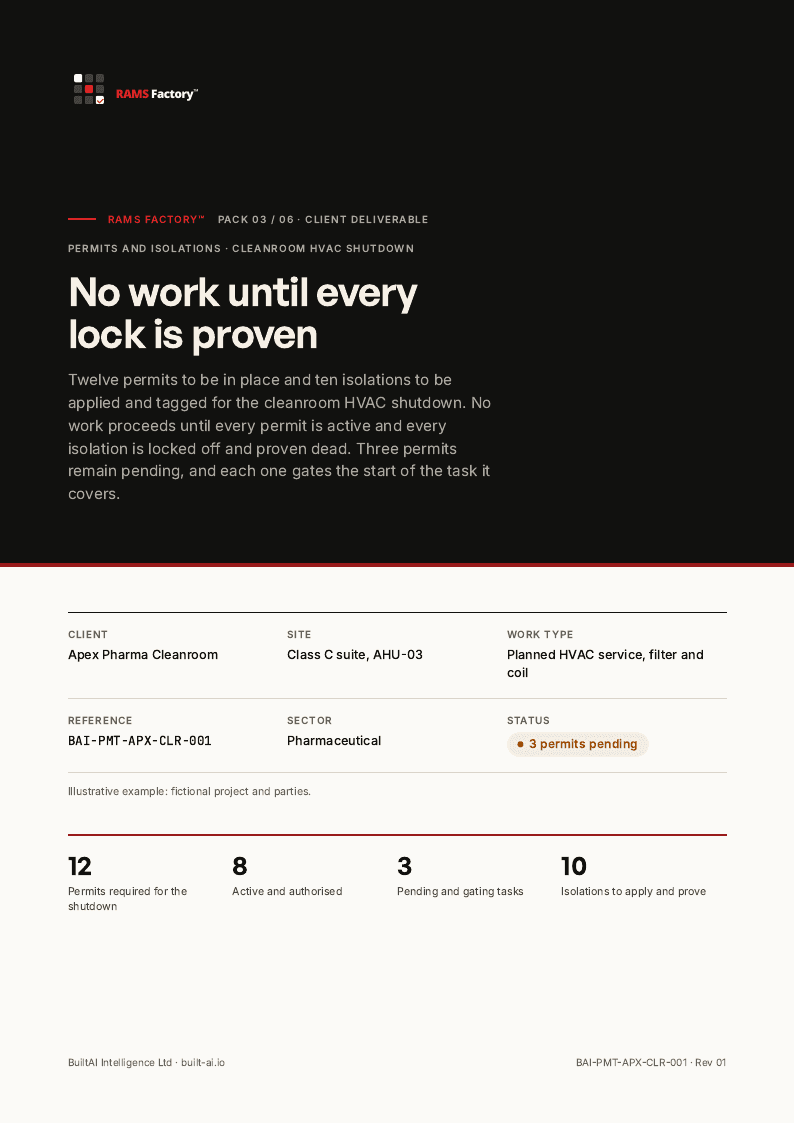
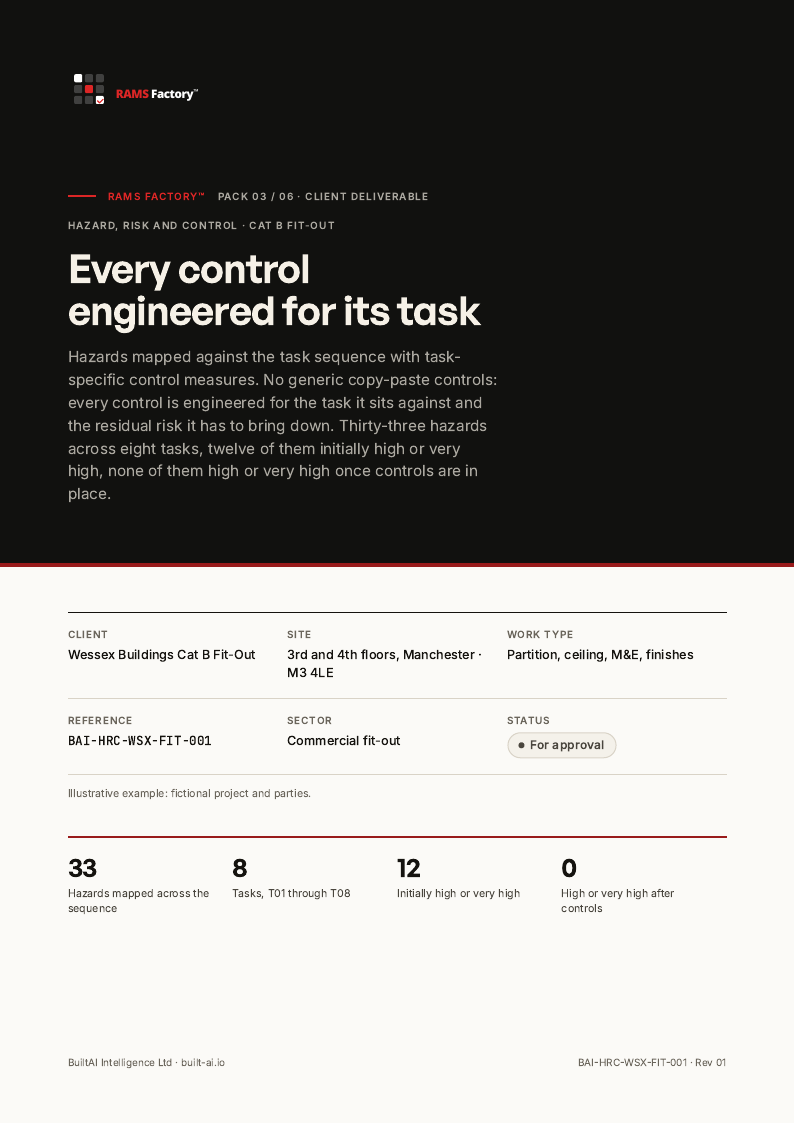
Open the full document (3 pages) 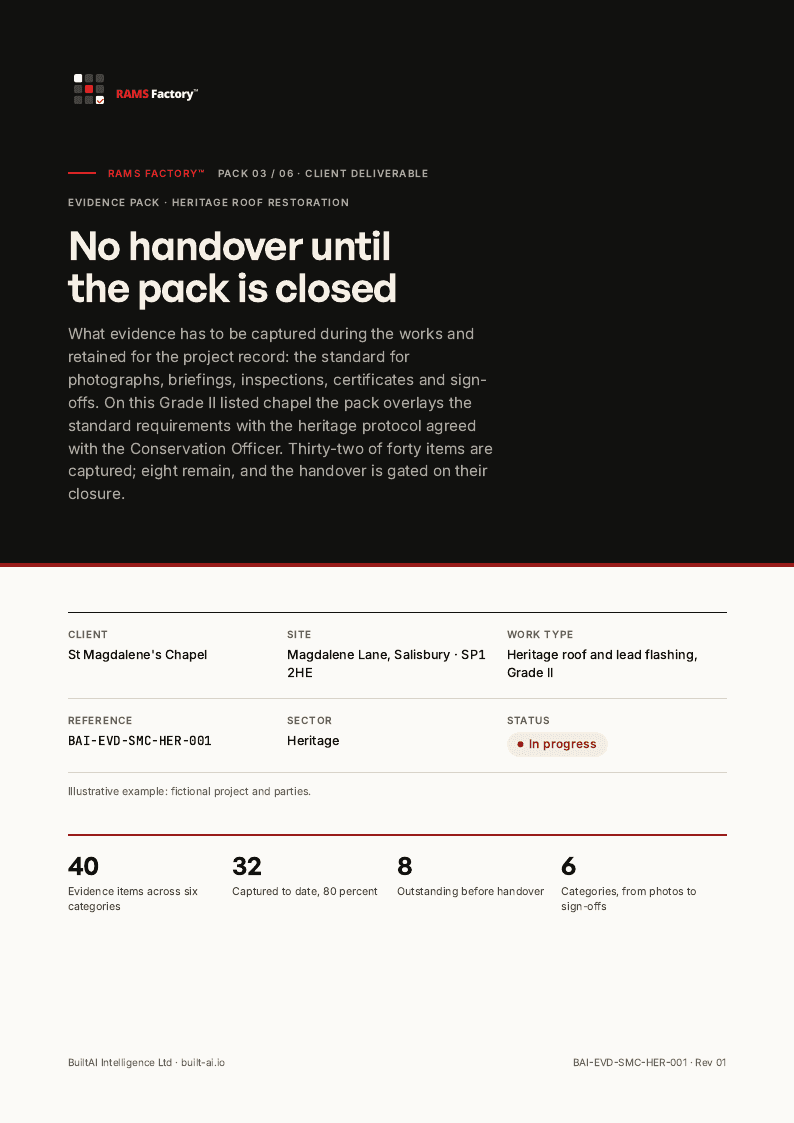
Open the full document (2 pages) 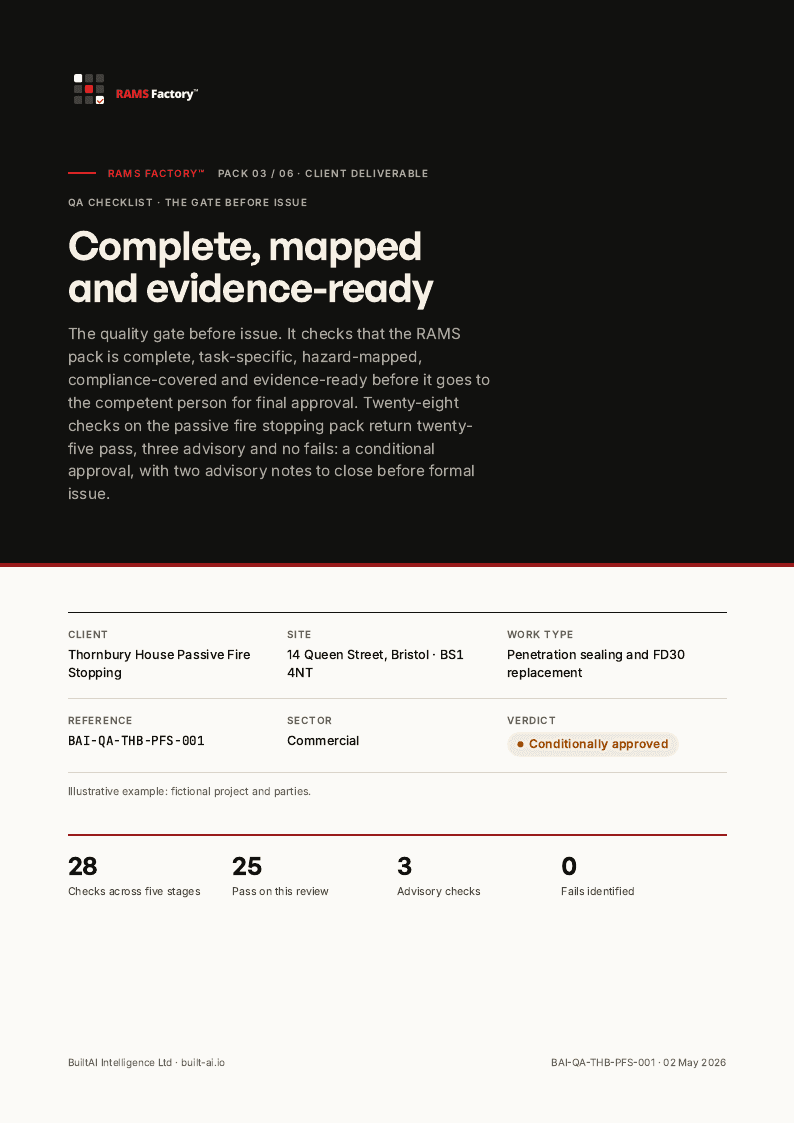
Open the full document (3 pages)
The workflow
Task brief in. Draft RAMS ready for competent-person review.
Five stations run in order, each one a gate. Your competent person clears it before the pack goes to site.
Stage 1 of 5 · Task intake
Job Card
Open the stage exampleStage 2 of 5 · Method sequence
The Method
Stage 3 of 5 · Hazard, risk and control
The Matrix
Task intakeStage 1 of 5
Job Card
The task, its location, programme constraints and site context are captured, and the right method template, hazard library and controls library are surfaced.
Site or project manager confirms the scope
Open the stage exampleMethod sequenceStage 2 of 5
The Method
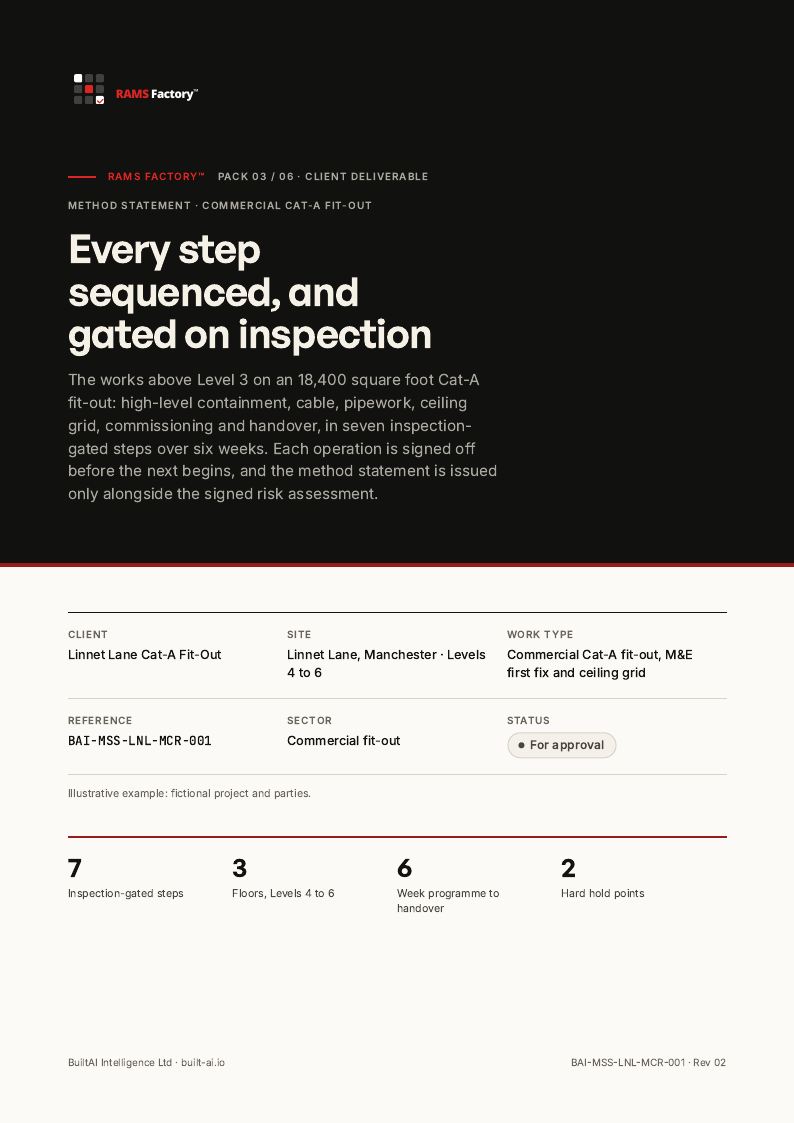
A first-draft method statement from the task and the template, with dependencies, isolations and permits identified before anything starts.
Method author adapts it to site reality
Hazard, risk and controlStage 3 of 5
The Matrix
The hazard taxonomy applied to every step, the hierarchy of control respected, the applicable ACoPs and regulations cited.
Competent person approves the coverage
Plant, PPE, COSHH and permitsStage 4 of 5
The Toolbox
Plant scheduled with inspection status, PPE specified per step, current COSHH assessments pulled in, permits listed with their issuing authority.
SHEQ co-ordinator confirms the data is current
Approval and audit trailStage 5 of 5
Sign-Off
Author, reviewer and competent-person sign-off, with version, supersession, briefing and induction records, formatted to the principal contractor's template.
Competent person issues the RAMS
What comes back
Eight documents in the site pack, and the paper trail behind them.
The method statement, the matrix and the schedules are drafted from the same task sequence, so every control answers a named hazard and every permit has an issuing authority.
- Stages
- 05
- Documents
- 08
- Review
- Named
Worked example on a fictional job.
RAMS Factory
Site pack · BAI-RAMS
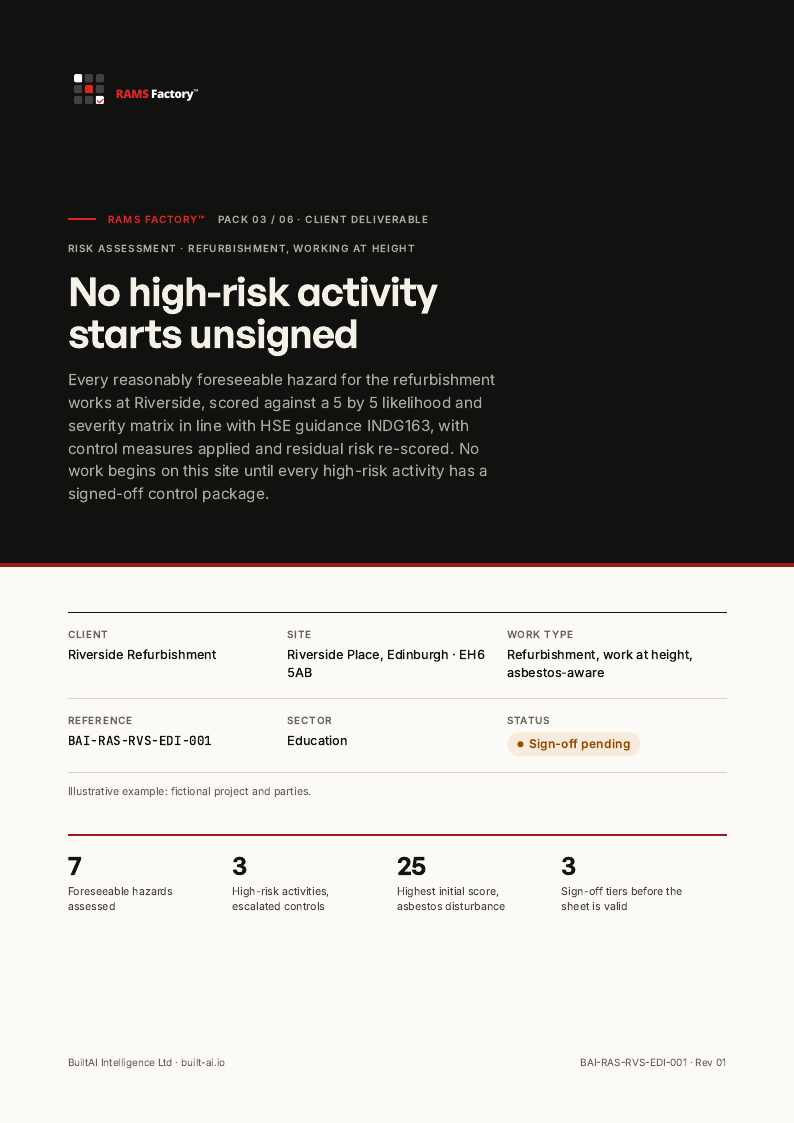
- Risk assessment sheet3 pages
- Method statement3 pages
- Hazard, risk and control matrix3 pages
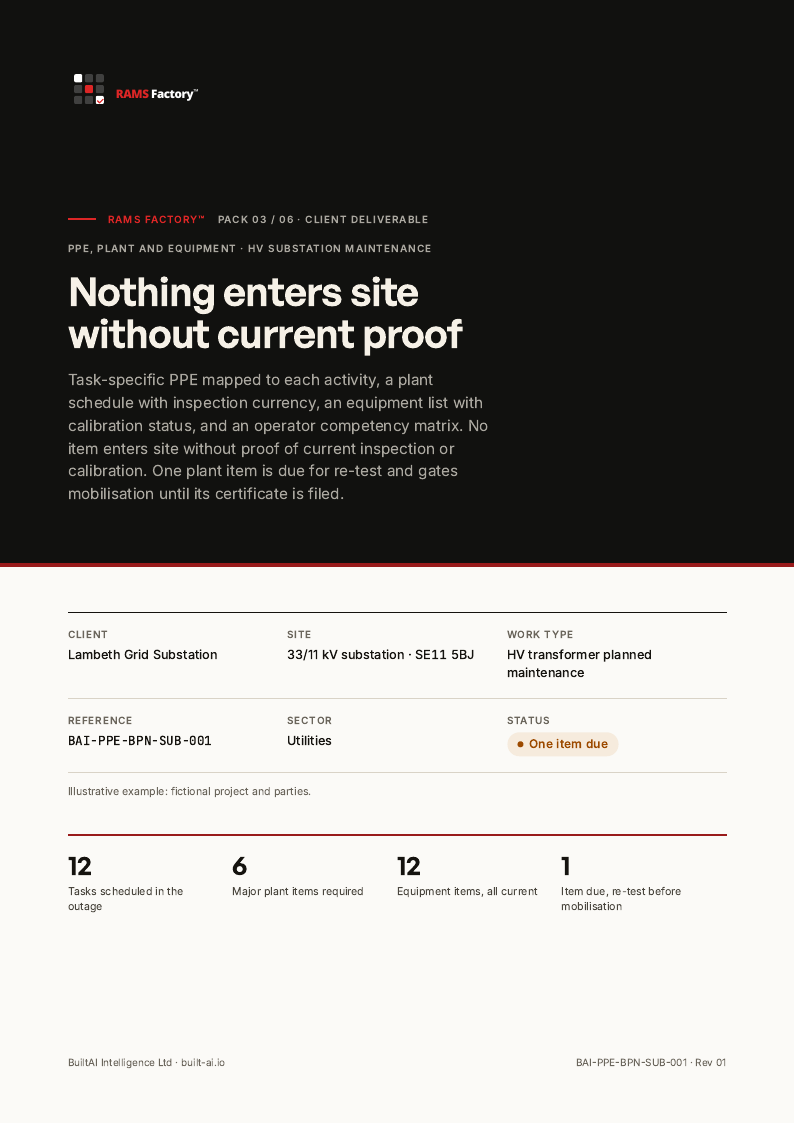
- PPE and plant schedule3 pages
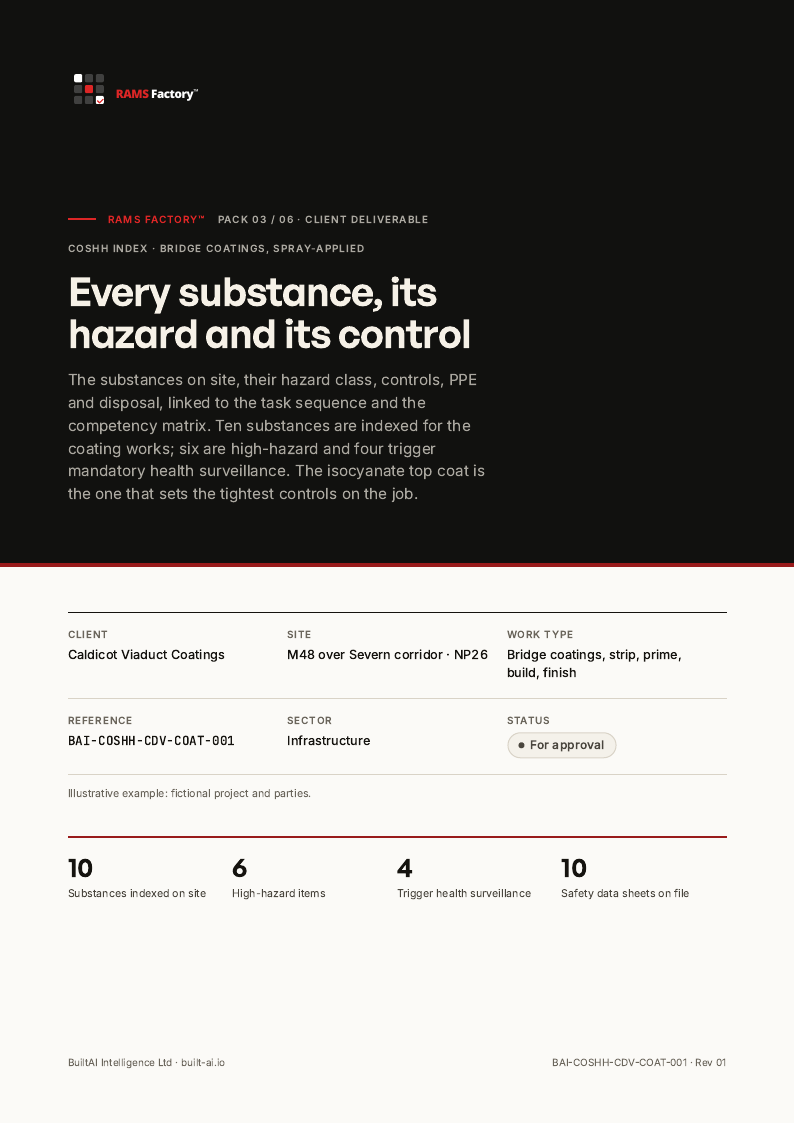
- COSHH index3 pages
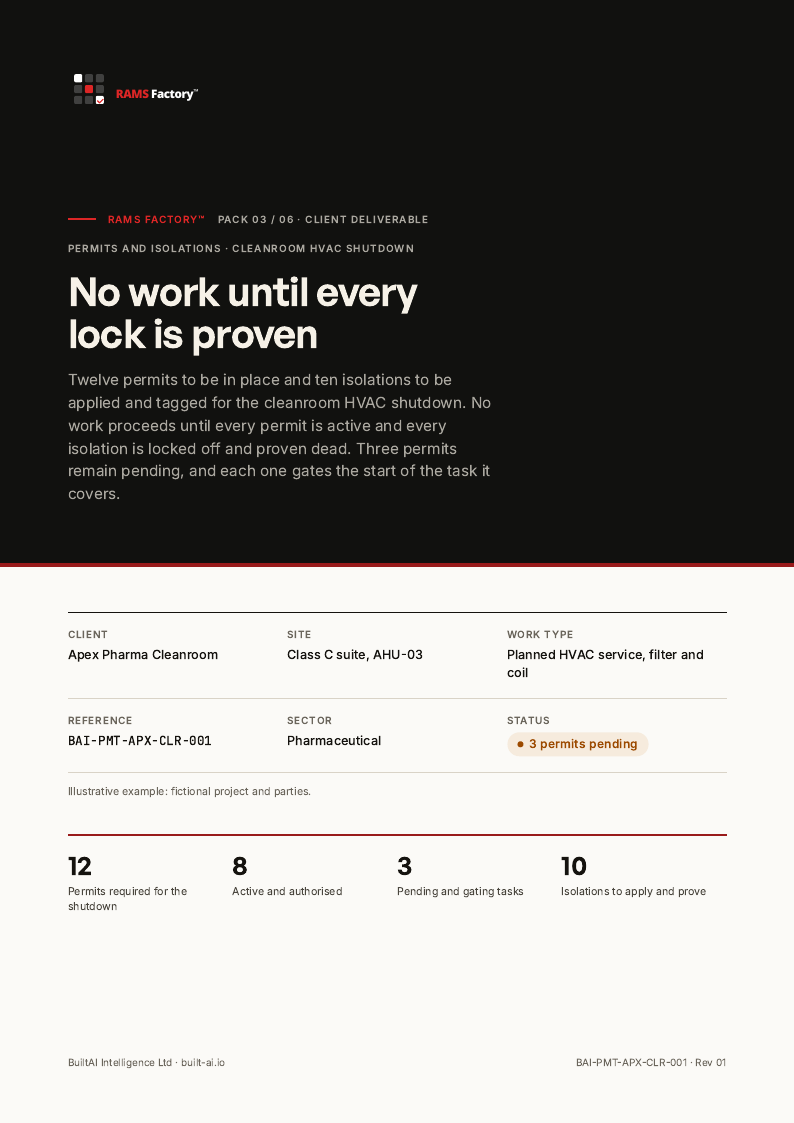
- Permits and isolations checklist3 pages
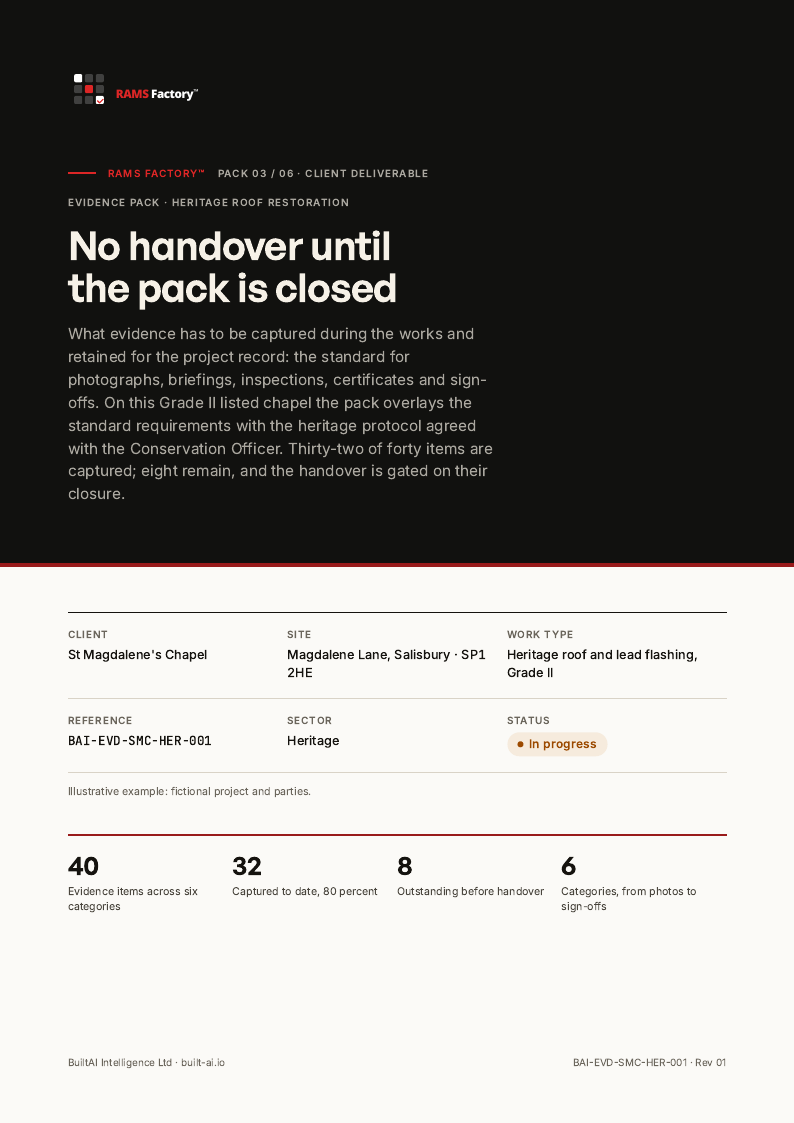
- Evidence pack checklist2 pages
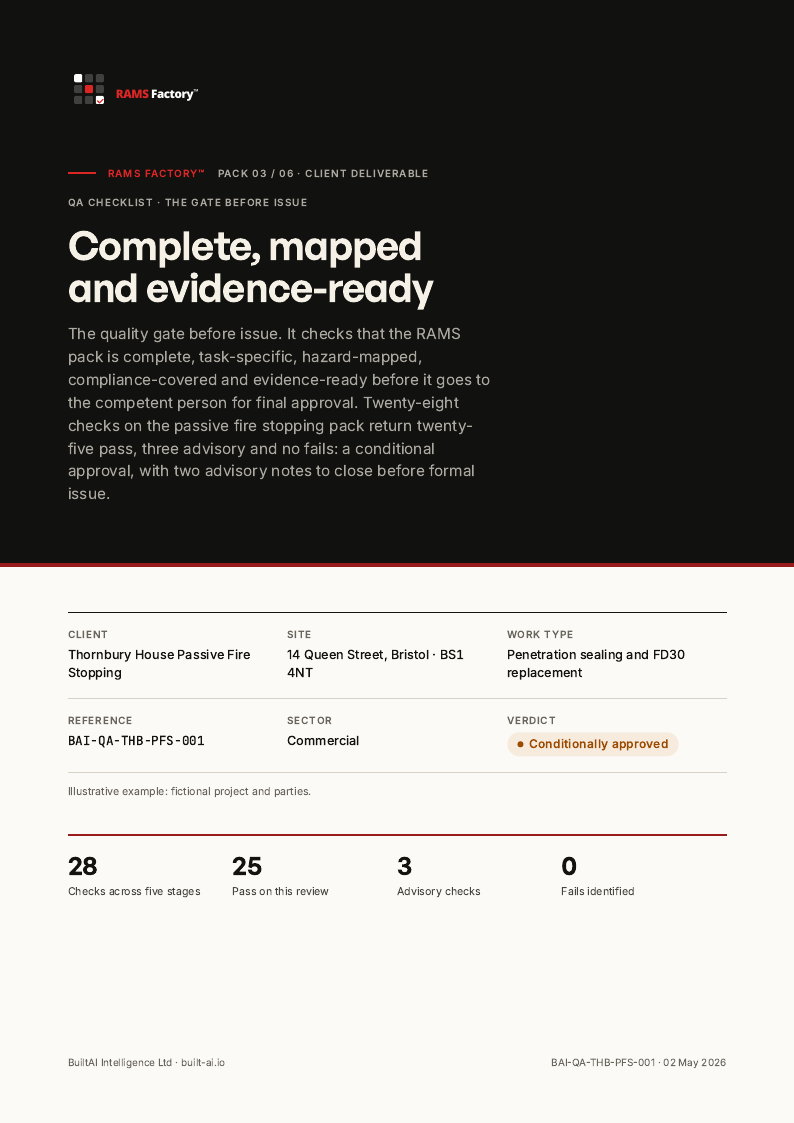
- RAMS QA checklist3 pages
Sample documents from the RAMS worked-example library. Each demonstrates a different task and fictional engagement. The full documents are on the worked-example page.
Open the worked exampleWho signs
The Factory drafts. Your competent person decides.
The Factory drafts
Task brief, drawings and site context in, with your own method, hazard and controls libraries; the method statement, the matrix and the schedules out as drafts, standards cited.
Your competent person decides
Whether a control suits this site, whether the sequence is safe to put to work and whether the pack is fit to issue stay with your SHEQ team.
The issued RAMS locks
Author, reviewer and competent person are recorded on every RAMS with version and supersession. An edit after approval voids it and asks for it again.
The gates, by role
Stage 3 of 5 · The Matrix
Competent person approves the coverage
Stage 5 of 5 · Sign-Off
Competent person issues the RAMS
Stage 1 of 5 · Job Card
Site or project manager confirms the scope
Open the stage example
Stage 2 of 5 · The Method
Method author adapts it to site reality
Stage 4 of 5 · The Toolbox
SHEQ co-ordinator confirms the data is current
Where it runs
The pack runs in The Plant Room, station by station, gate by gate.
Your SHEQ team sees each station, who cleared it and what is next to run. Every issued RAMS keeps its author, reviewer and competent person on the record.
The Plant Room →05 / Questions
Before we talk.
Questions teams ask about this pack. The 30-minute call covers the rest.
What is RAMS Factory?
RAMS Factory is a BuiltAI workflow pack that drafts site- and task-specific RAMS packs – method statements, hazard matrices, schedules and evidence checklists – for competent-person review and issue.
Will competent persons still review every RAMS?
Yes. The pack accelerates drafting and consistency. It never replaces competent-person sign-off. Issued RAMS carry author, reviewer and competent-person records.
Can the hazard library match our trades?
Yes. Hazard and control libraries are structured around your content and templates. You own the library content used in your deployment.
Are the sample RAMS on the site real client jobs?
No unless explicitly labelled otherwise. Current public readers are demonstration / fictionalised examples for format and structure. Final RAMS always need client-specific information and competent-person approval.
Build a clearer route from task brief to competent-person review.
Tell us about the task, the site requirements and where the RAMS process gets held up. Arrange a 30-minute call to explore the next step.
How the commercial model works →