Example outputs – see how BuiltAI structures the work
Inspect documents and worked examples for tenders, RAMS, commercial control and FM. Projects, clients and figures are fictional. Your team reviews and approves any live work.
The projects, clients and figures in these examples are fictional. Final documents remain subject to client-specific information, commercial validation and H&S review where applicable before issue or reliance.
One path per business decision, in the pack pages' and worked readers' own words. The documents use fictional jobs, not client results.
01Bidroom in a Box
Tender capacity
When the bid team is the constraint on the tenders you can answer.
See the four annotationsShow fewer↕
Source received
An inventory of what actually arrived in the tender pack and what is missing from it.
Draft returned
Every bid document out as a draft, each claim traced to its source.
Questions raised
The gaps are routed onward as clarifications rather than closed with a guess.The three that never got an answer are carried as stated commercial assumptions in the tender letter rather than left silent.
Review decision
The bid or no-bid call, the rates you carry, the departures you accept and the win strategy stay with your estimator and bid manager.
When margin leaks between the change event and the invoice.
See the four annotationsShow fewer↕
Source received
Commercial Control Kit: Instructions, correspondence, drawings and programme extracts in.Margin Cockpit: Finance, WIP and variation data in.
Draft returned
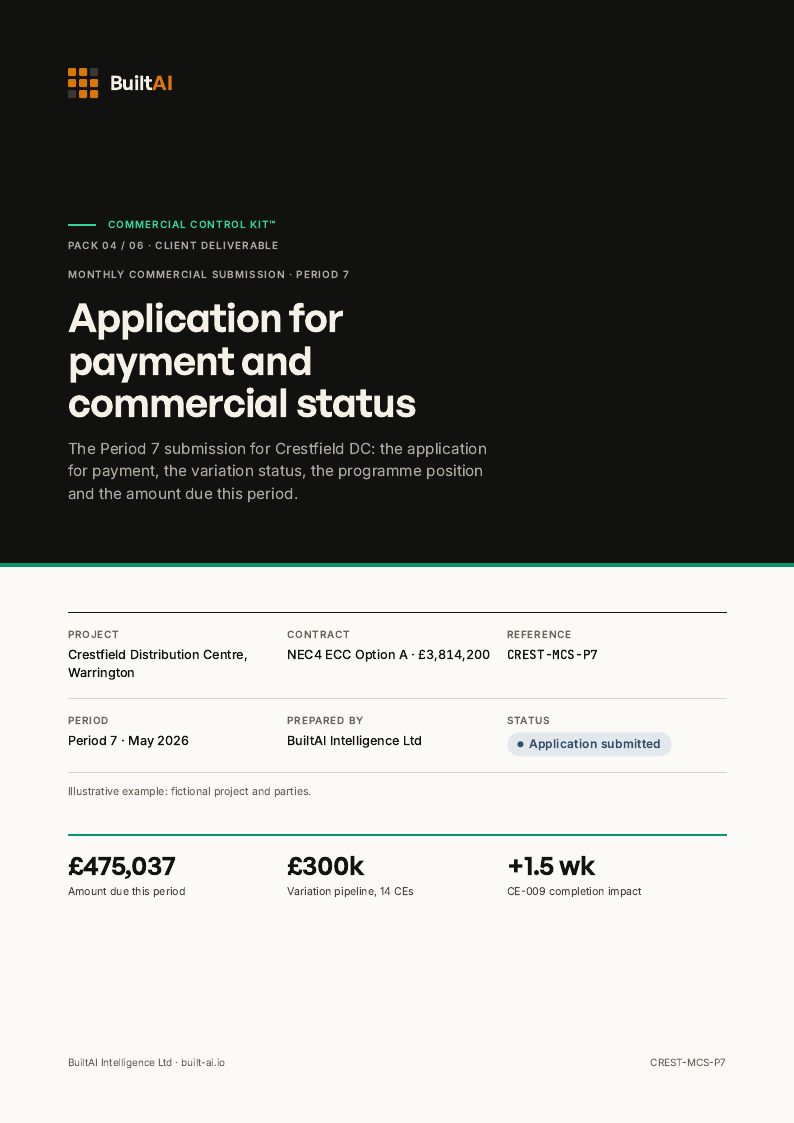
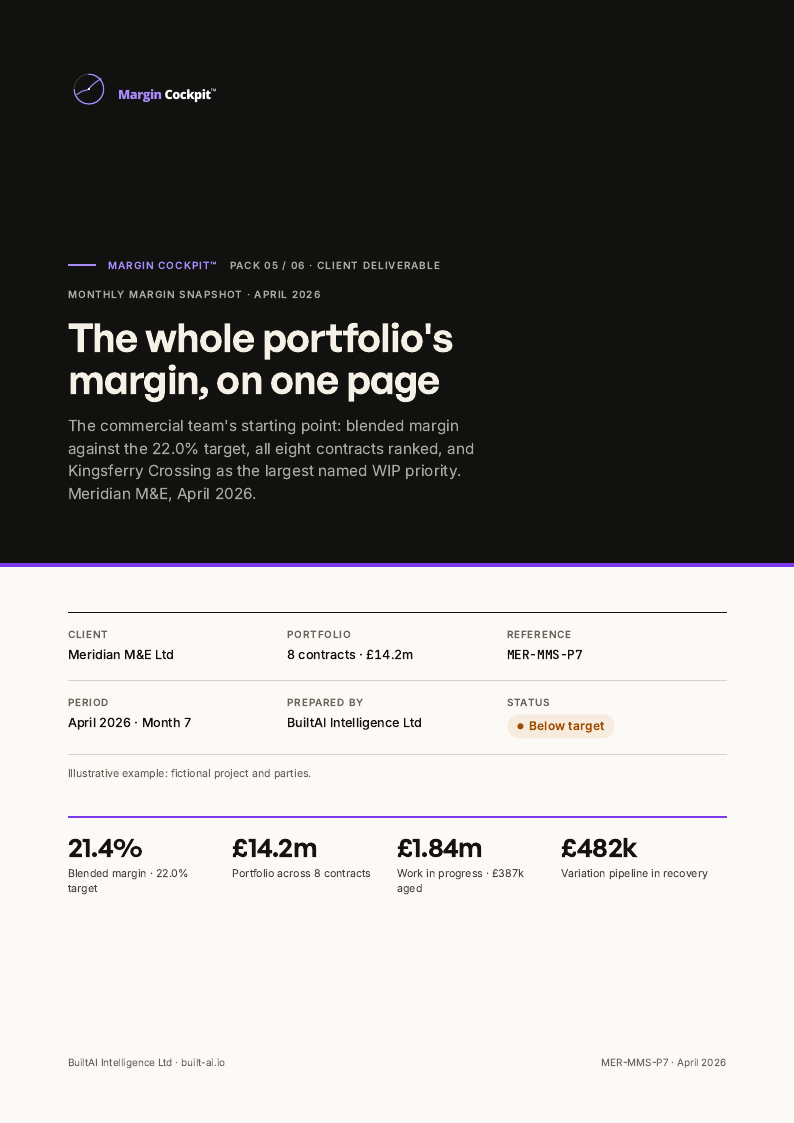
Commercial Control Kit: Notices, narratives, evidence indexes and valuations out as drafts, clauses cited.Margin Cockpit: The snapshot, the bridge, the trackers and the board narrative out as drafts, every figure traced to its source.
Questions raised
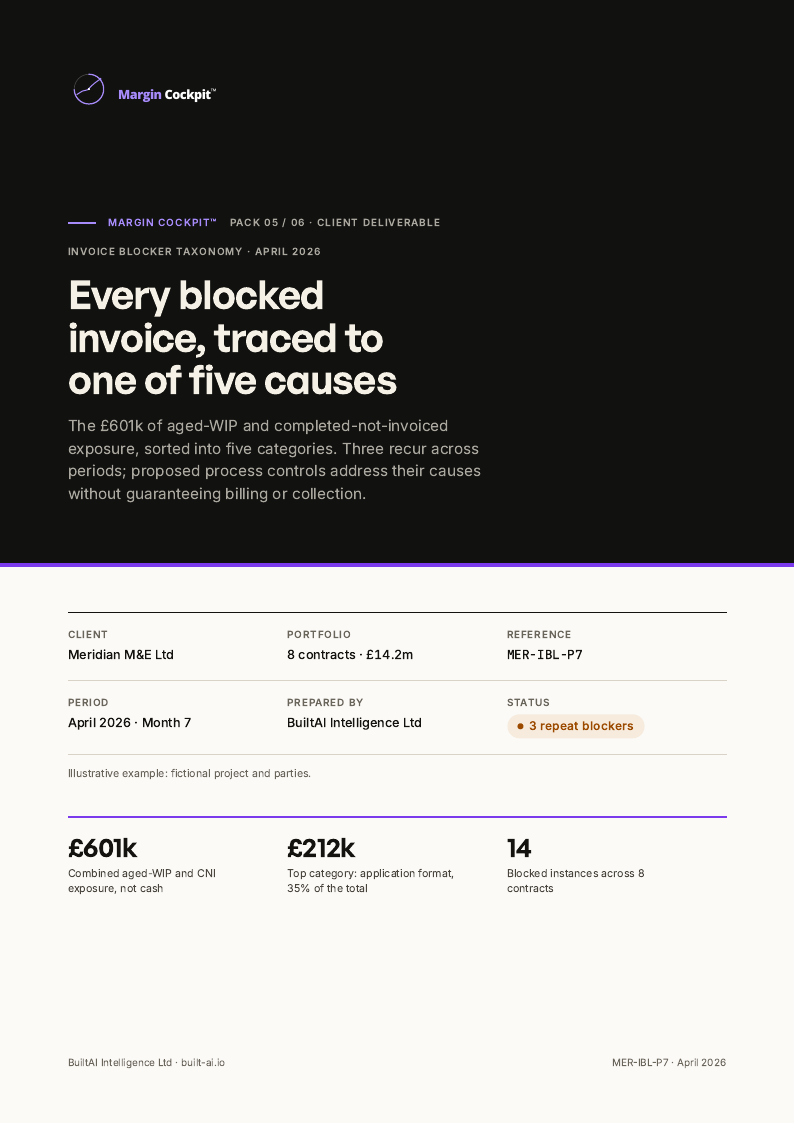
Commercial Control Kit: One near-miss is highlighted in the table, notified late and caught with three days to spare.Margin Cockpit: The invoice blocker summary flags rate queries, valuation disputes, missing evidence and retention conditions that may delay application or billing.
Review decision
Commercial Control Kit: Whether an event is a compensation event, what the entitlement argument is, which rates to defend and when to concede stay with your QS and commercial manager.Margin Cockpit: What the margin position means, which actions to take and what goes to the board stay with your FD and commercial director.
Task brief, drawings and site context in, with your own method, hazard and controls libraries.
Draft returned
The method statement, the matrix and the schedules out as drafts, standards cited.
Questions raised
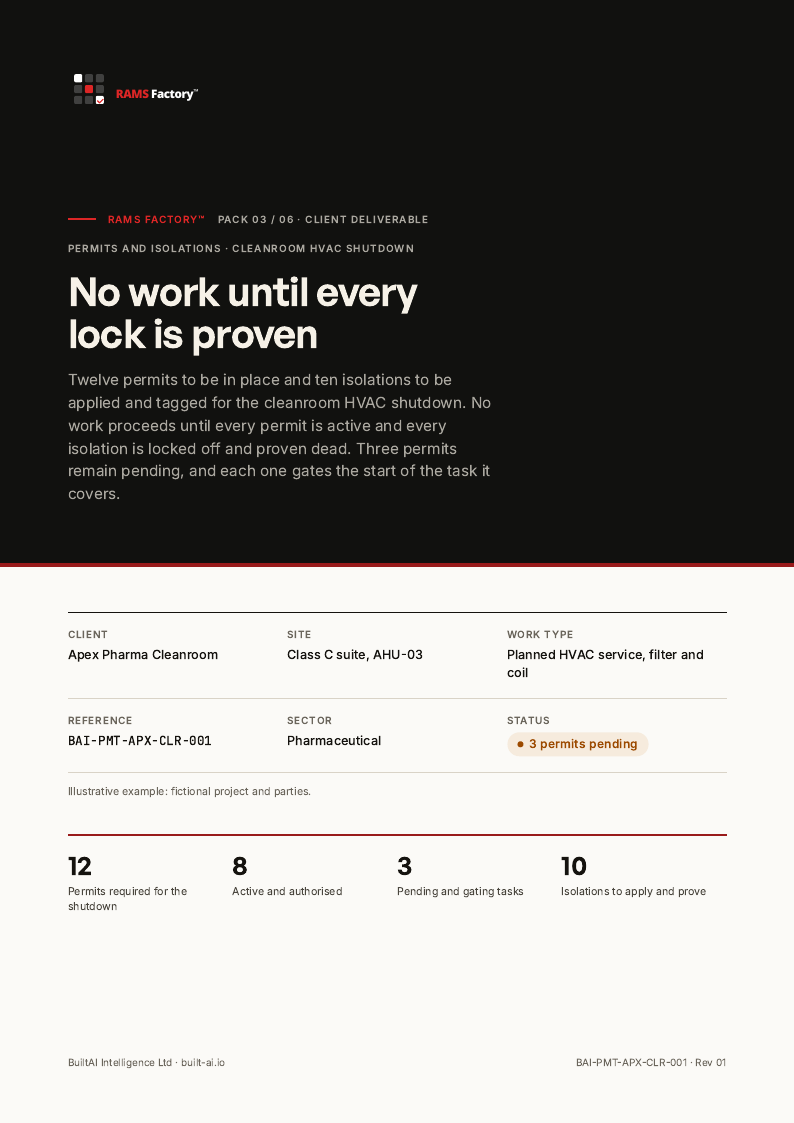
Records the job as only conditionally ready to draft - an asbestos survey and a structural load check are unresolved.Three permits are still pending and are shown gating the tasks that depend on them.
Review decision
Whether a control suits this site, whether the sequence is safe to put to work and whether the pack is fit to issue stay with your SHEQ team.This example returns twenty-five passes, three advisories and no fails, and closes as conditionally approved.
Each document on this path comes from a different fictional job. They are not one reconciled site pack.
Each document needs client-specific review and approval before use.
01 / The library
See the work. Judge the detail.
Inspect 43 examples, then open the full document or its companion PDF. The structure gives a competent reviewer a clearer basis for checking, editing and deciding what is ready to issue.
01 / Tender & Bid
Tender and bid examples
Bidroom in a Box® can help produce structured tender and quote outputs with stronger detail, traceability and commercial control.
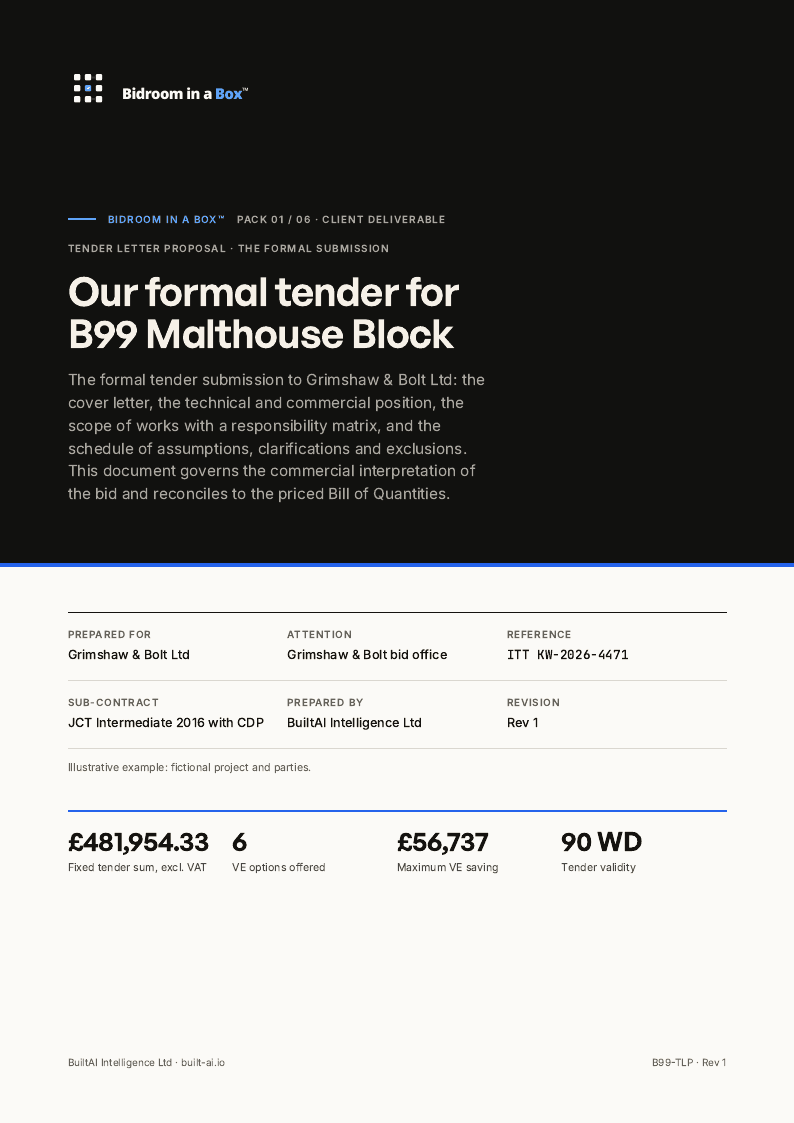
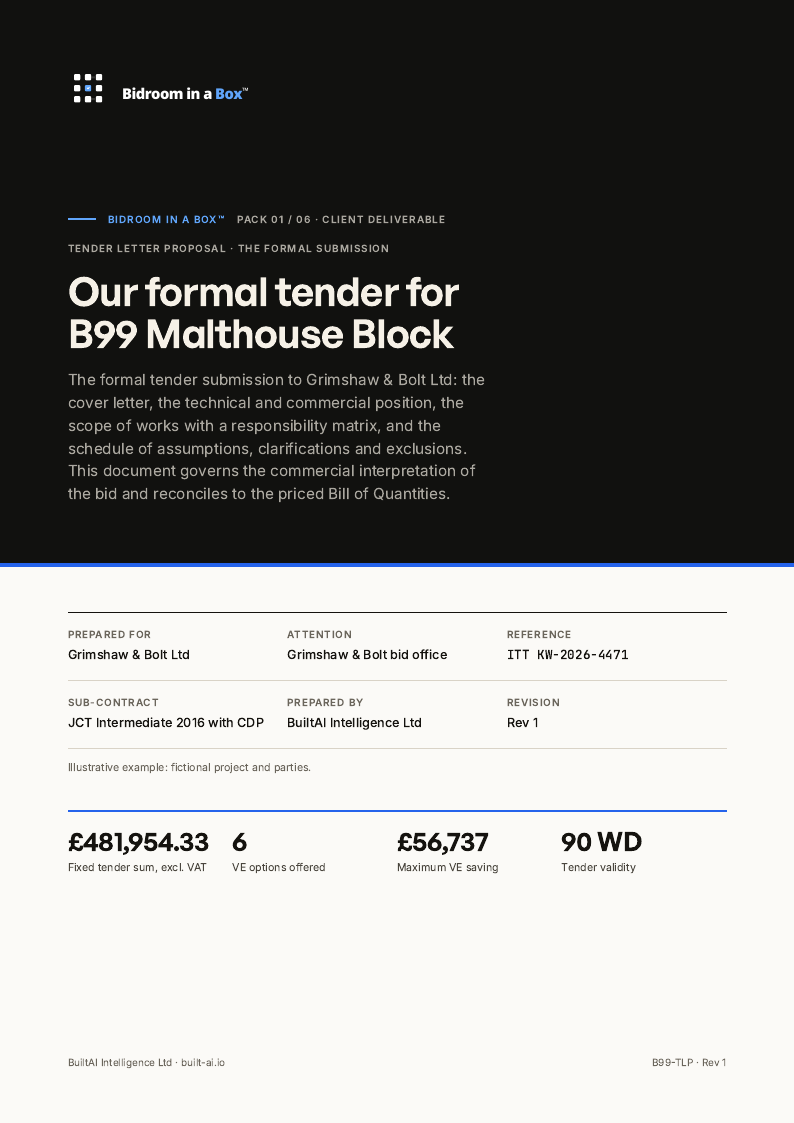
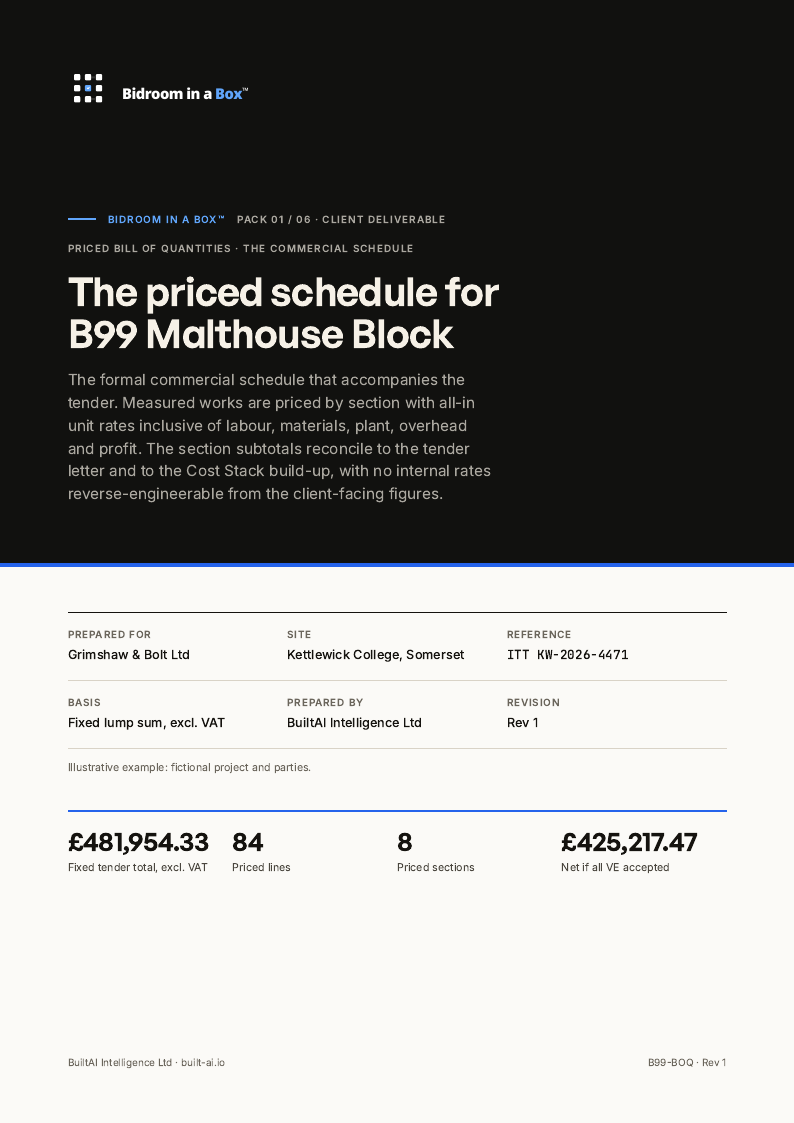
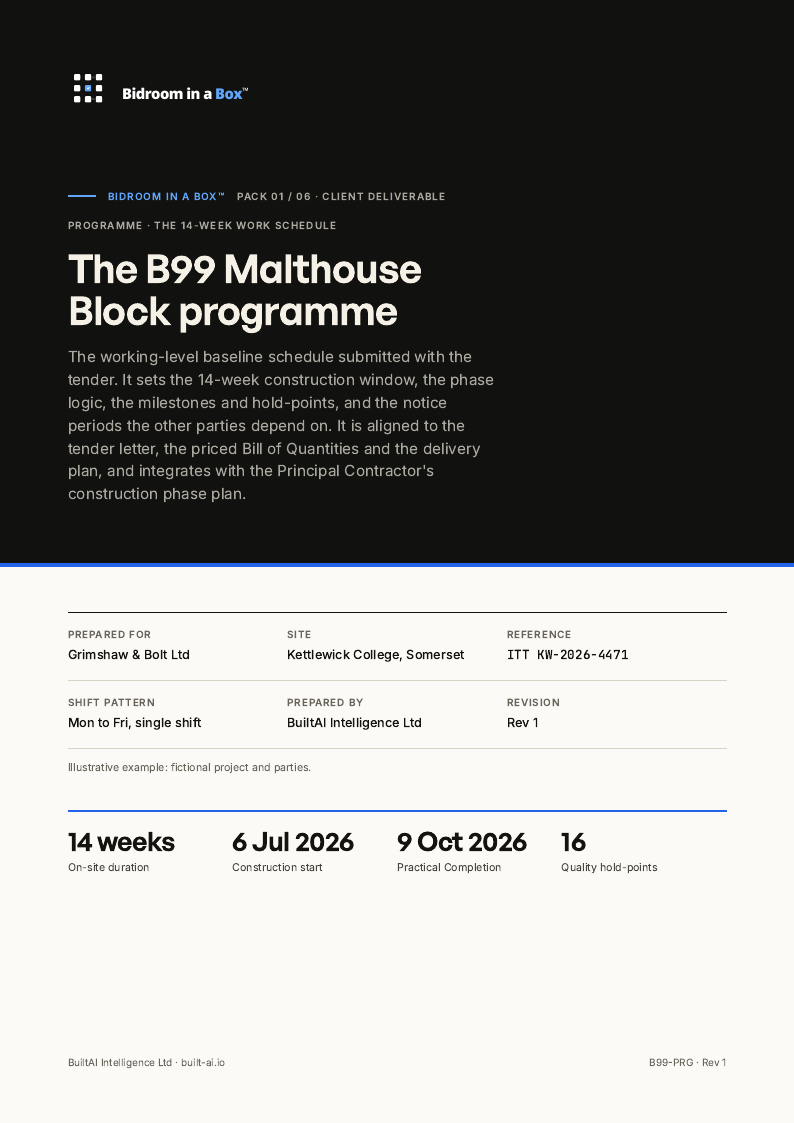
A sample priced bill of quantities, showing the pricing basis, item breakdown and value-engineering options.
Why this shapeA priced bill of quantities sets out items, pricing basis and value-engineering options so the commercial team can review the submission clearly.
A sample tender intake record, covering the tender clock, project information, bid decision and team sign-off.
Why this shapeA structured intake record brings the tender deadline, project information, bid decision and named sign-offs into one reviewable starting point.
BuiltAI drafts; your team reviews, edits and issues. Source-traced, never auto-sent. Final outputs require client-specific review and approval.
02 / Pre-Con & Mobilisation
Pre-construction and mobilisation examples
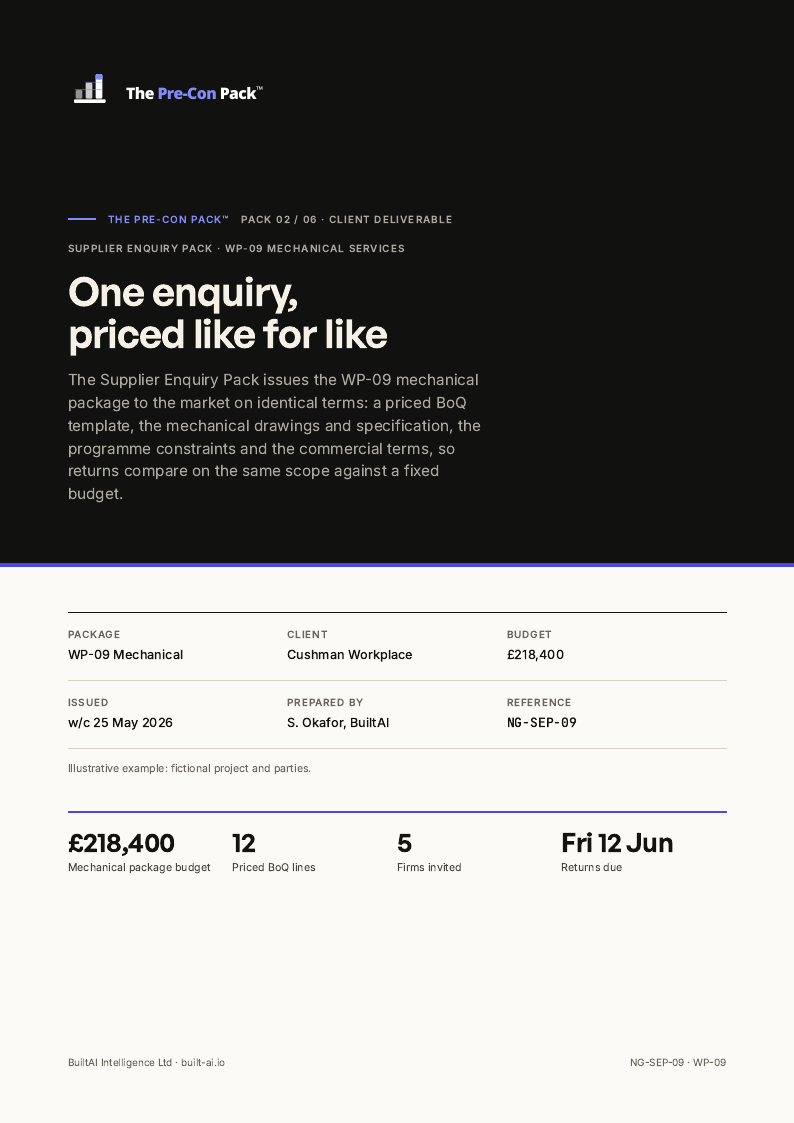
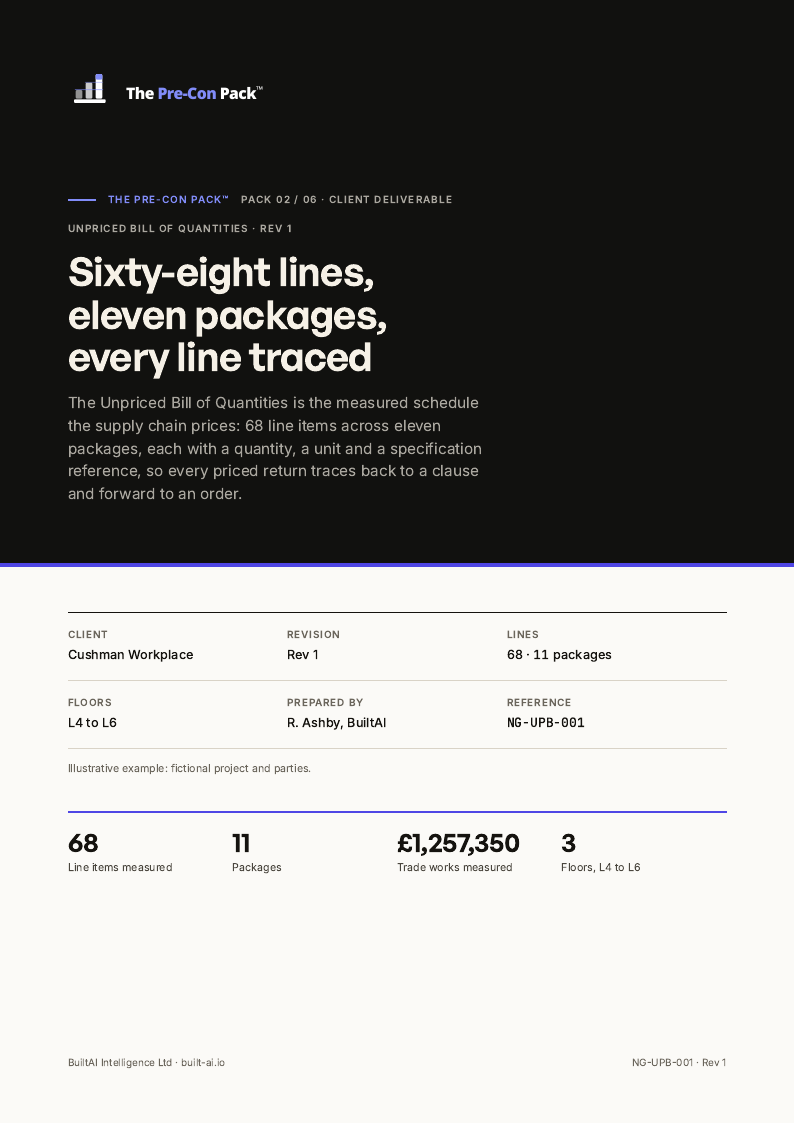
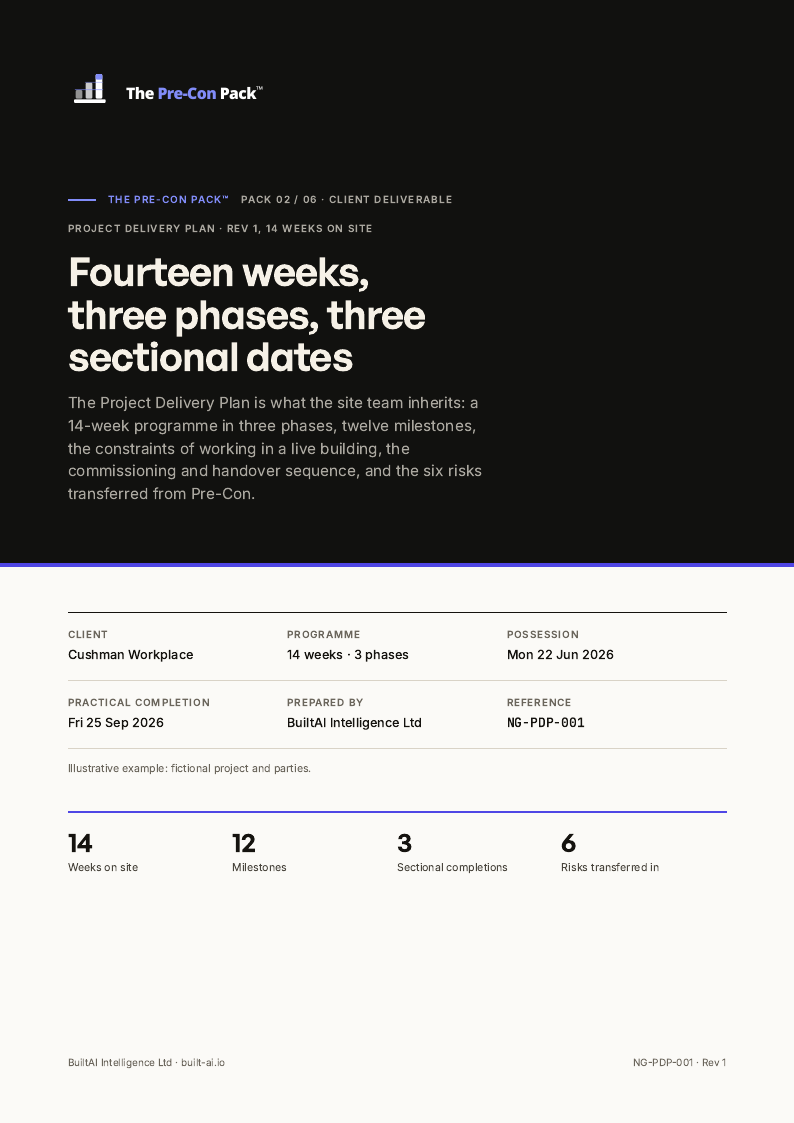
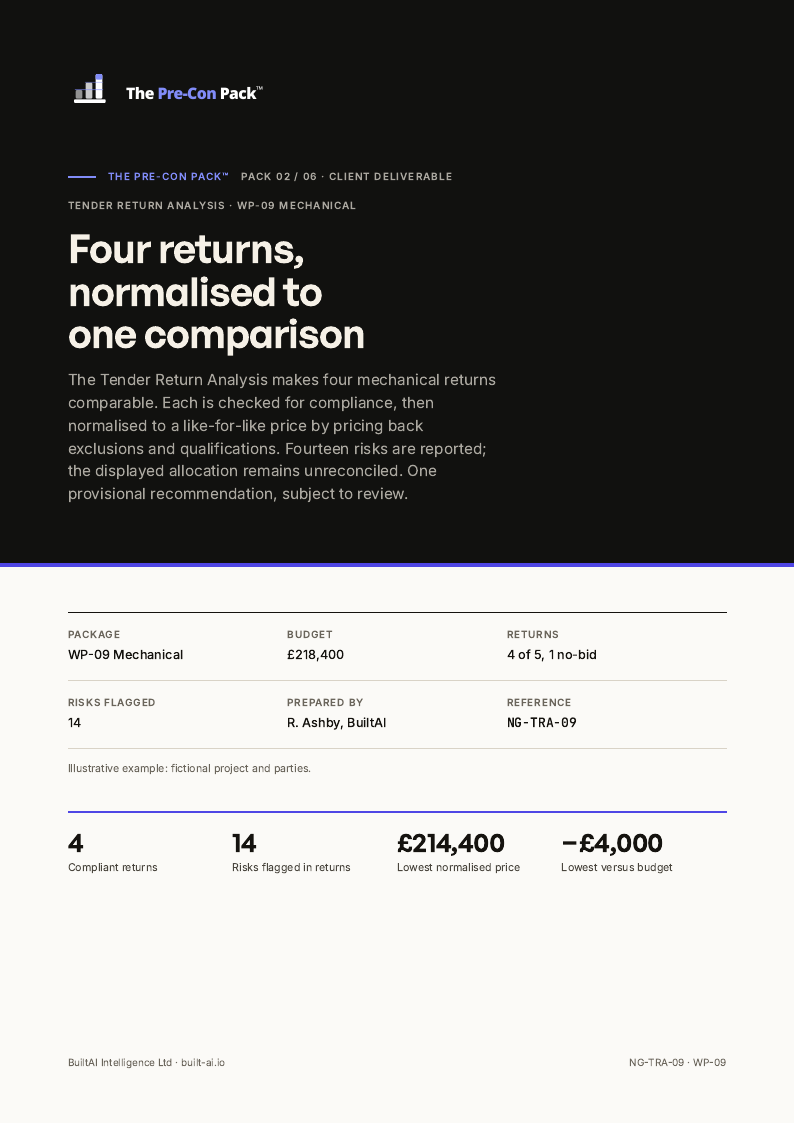
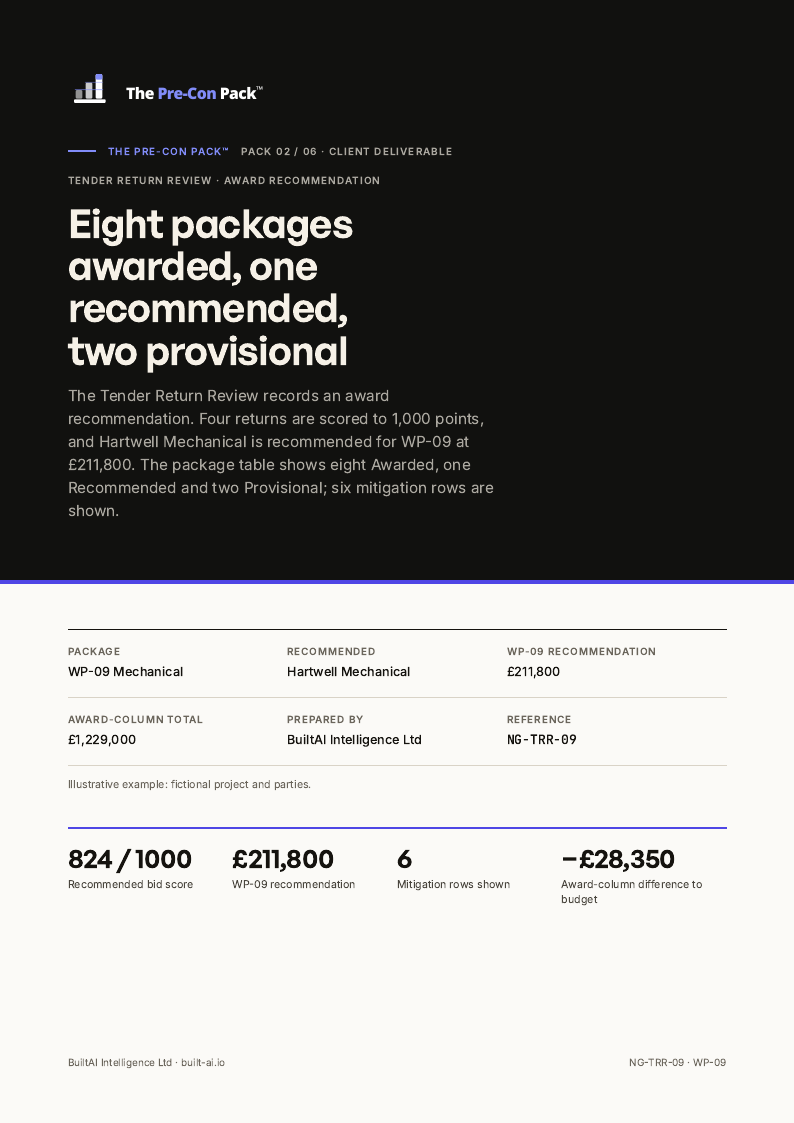
Pre-Con Pack™ can help turn awarded scope into a controlled mobilisation plan, with the specification, scope, supplier enquiries and tender returns drafted for review.
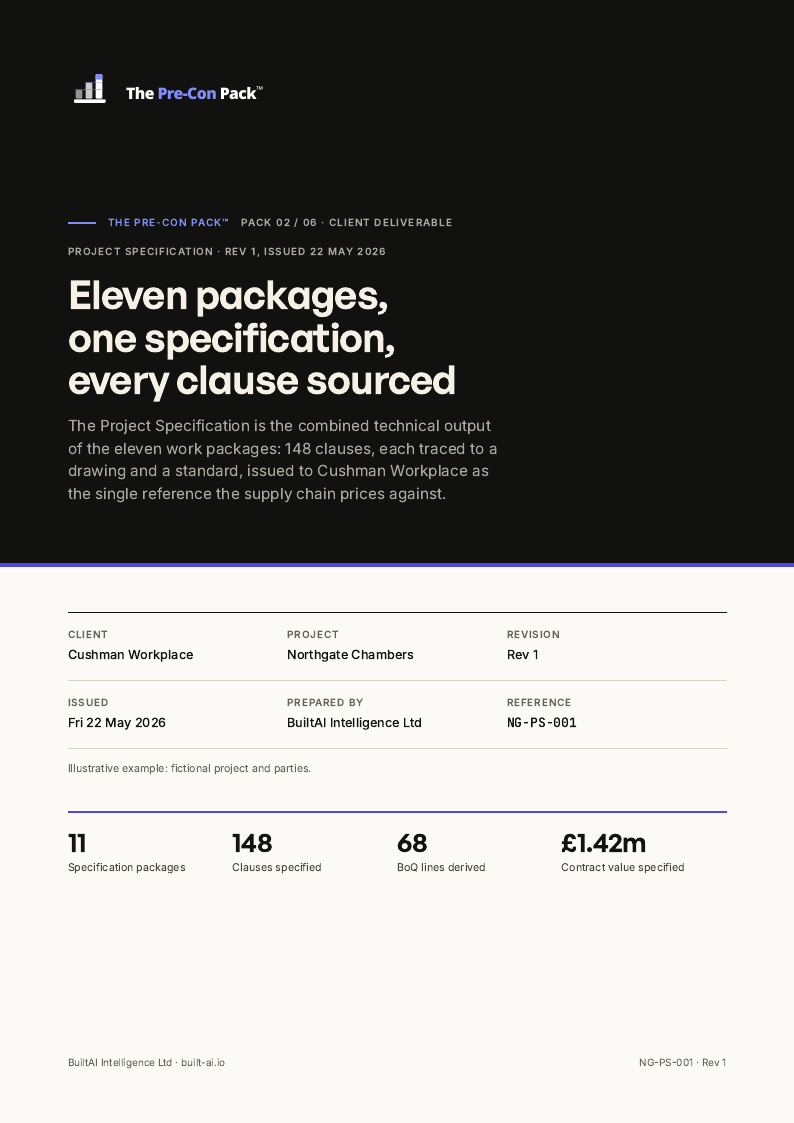
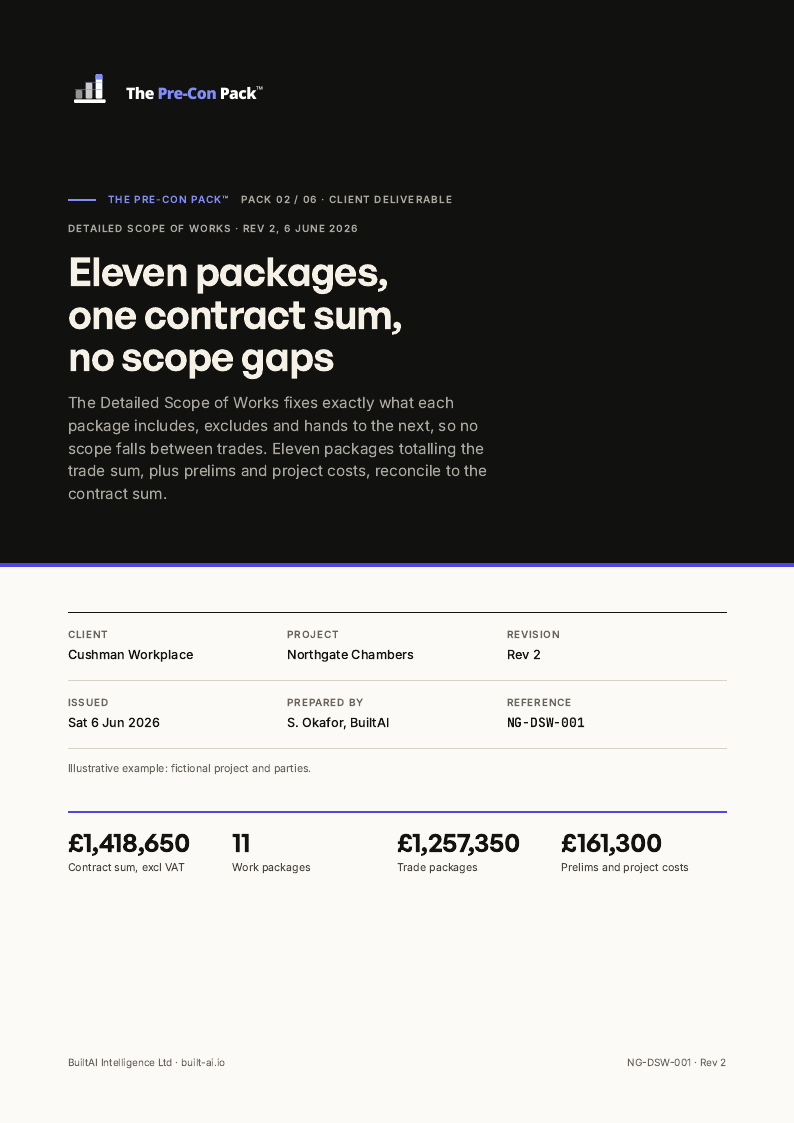
Pack-by-pack scope with inclusions, exclusions and interface points called out.
Why this shapeScope is split by work package with its inclusions, exclusions and interfaces, so each enquiry goes out with its boundaries already drawn.
BuiltAI drafts; your team reviews, edits and issues. Source-traced, never auto-sent. Final outputs require client-specific review and approval.
03 / RAMS & Compliance
RAMS and compliance examples
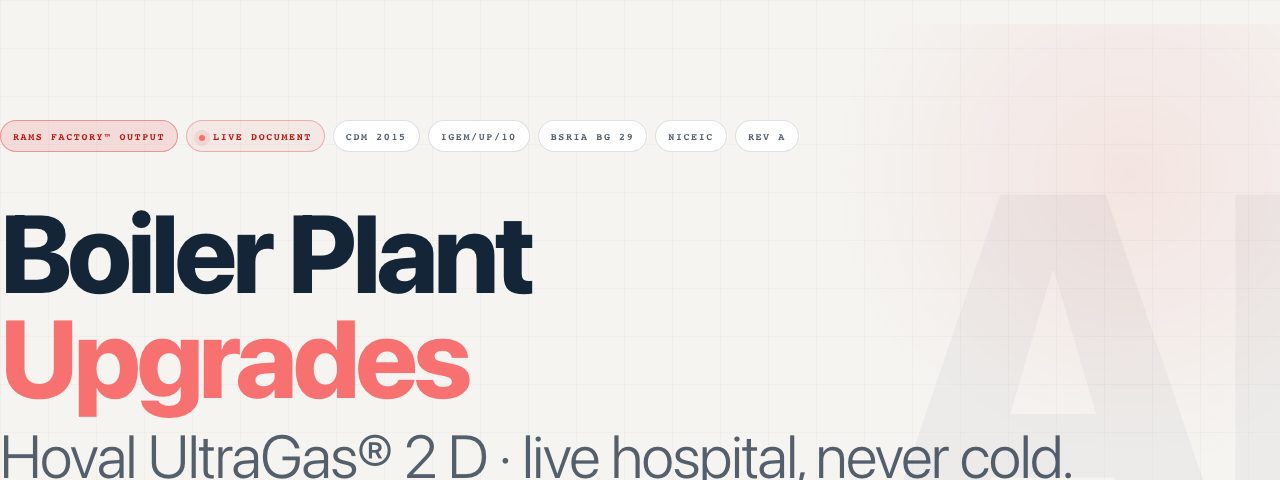
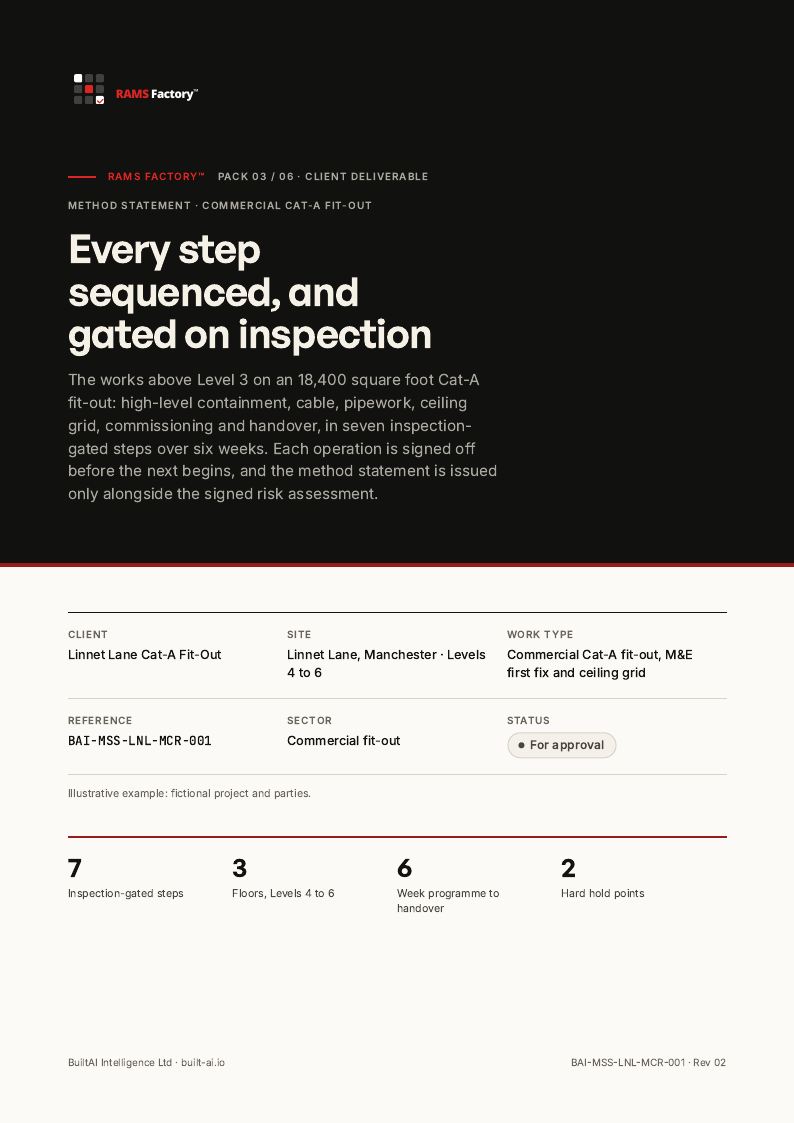
RAMS Factory® can help produce site-specific RAMS, method statements, risk assessments and evidence packs with stronger structure and approval readiness.
Example document
01RAMS Factory®
RAMS Document
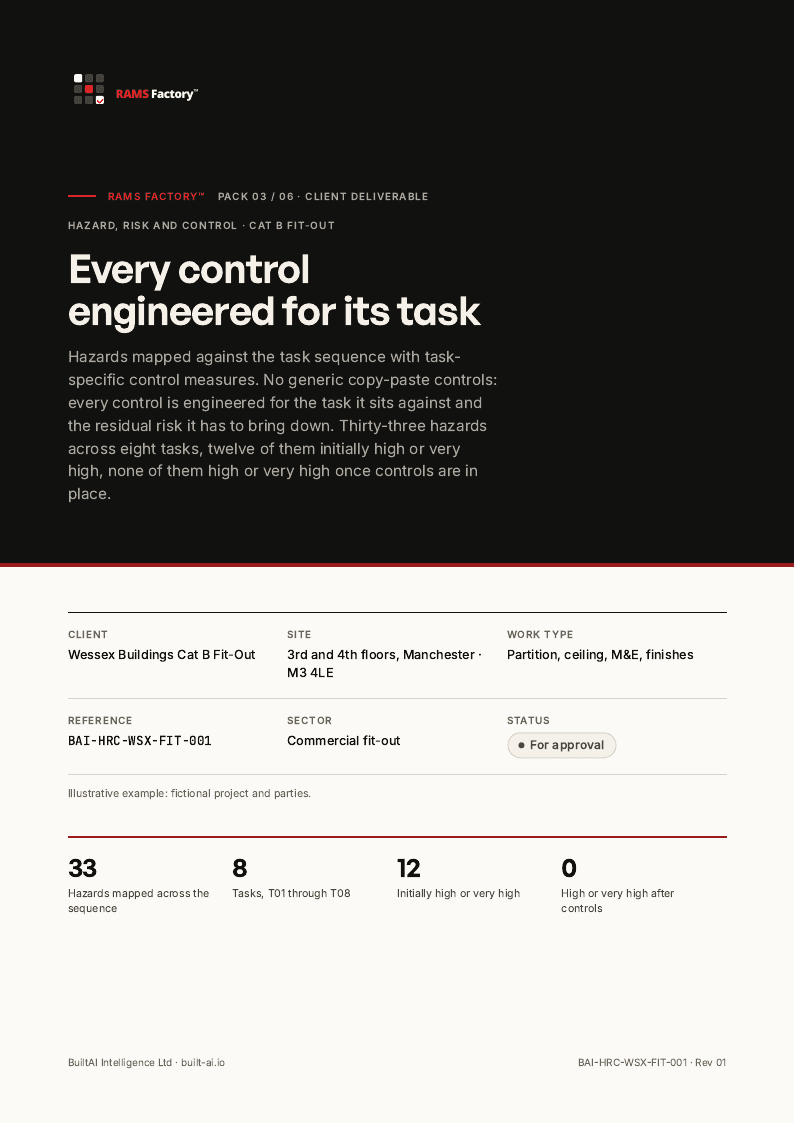
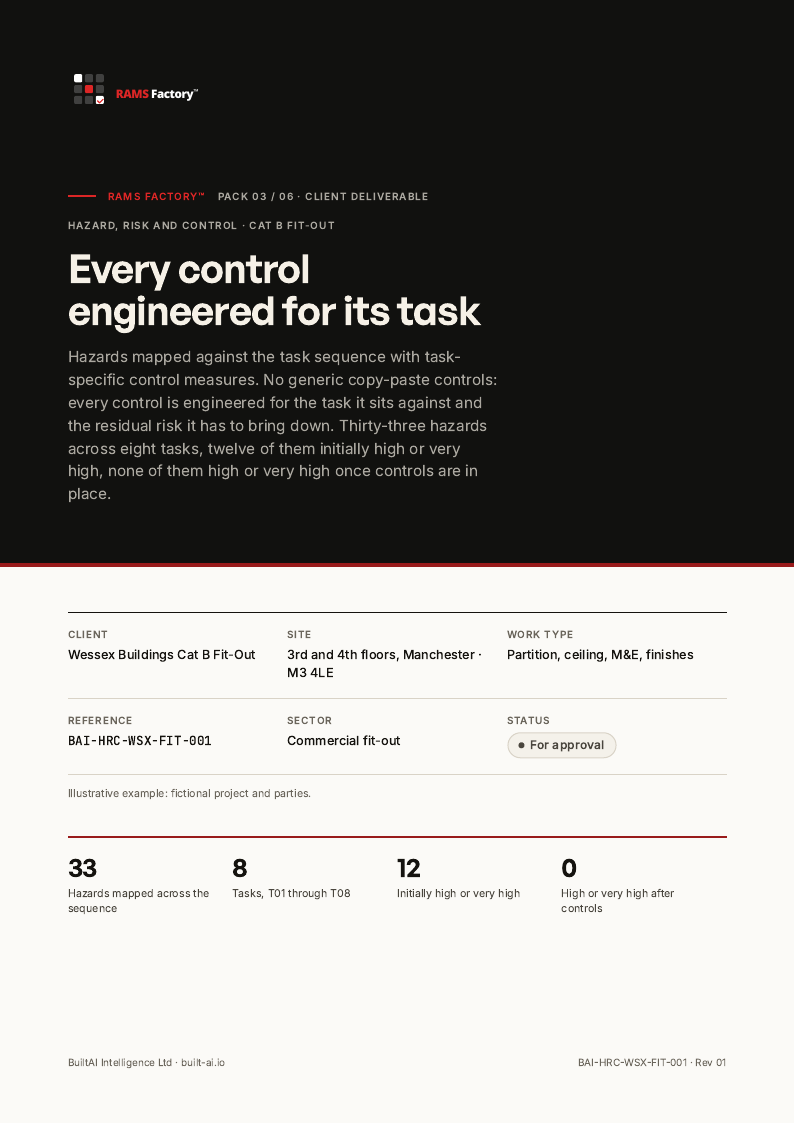
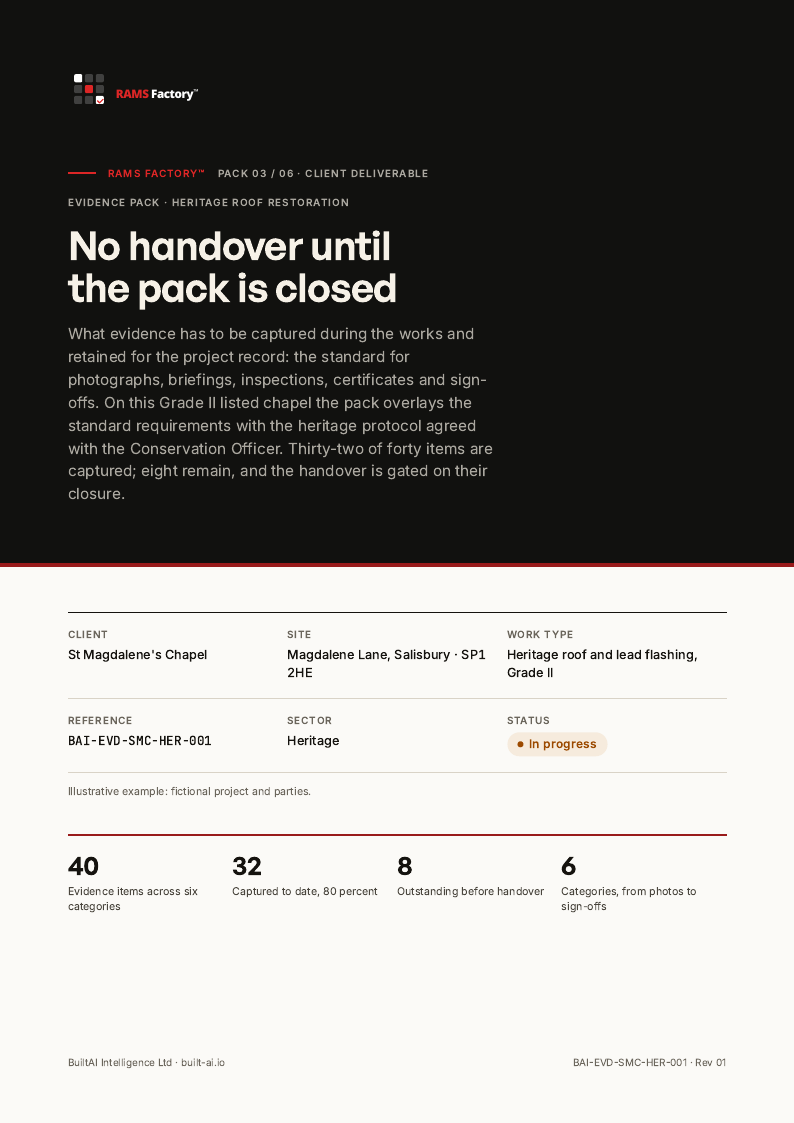
Example of a structured RAMS pack built around job intake, task sequencing, hazard controls, permits and evidence requirements.
Why this shapeBuilt around the actual job - intake, task sequence, hazards, permits and evidence - so the RAMS reflects this site, not a copied template.
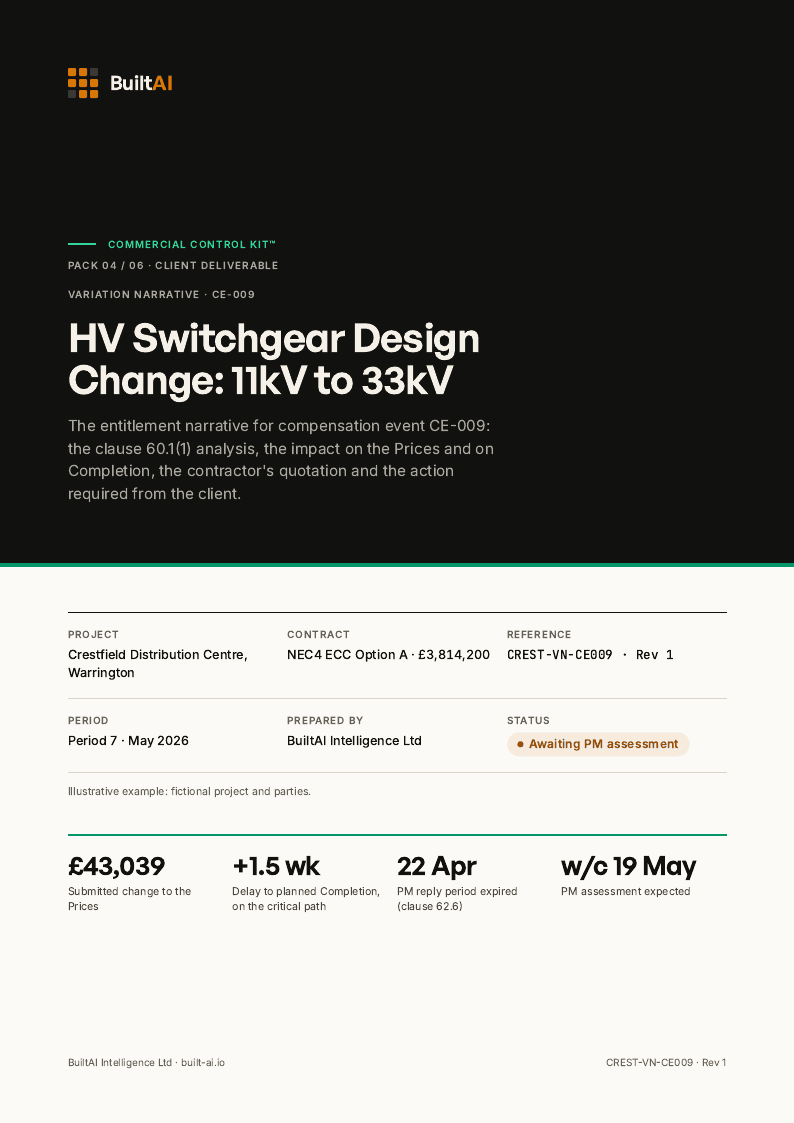
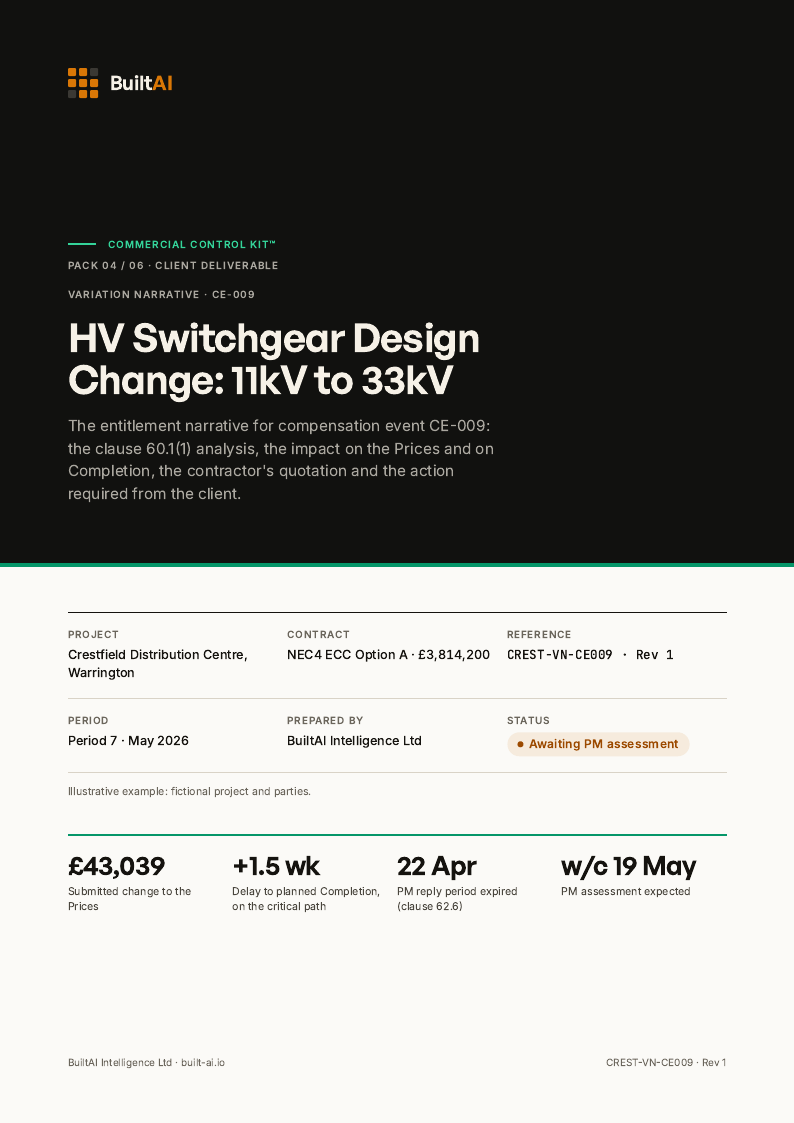
Example of a cause, effect and entitlement narrative structured around a change event and supporting evidence.
Why this shapeCause, effect and entitlement run in the order an adjudicator reads, so the commercial case is legible and evidence-backed before money is at stake.
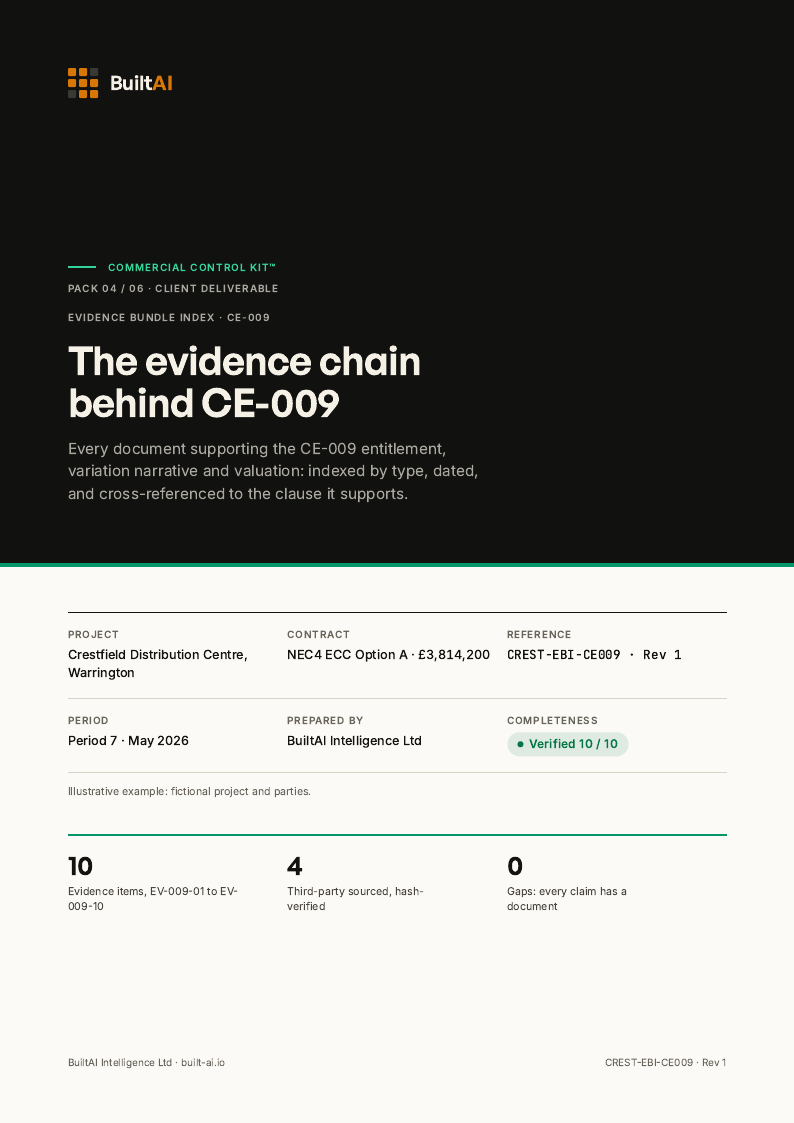
Example of how photos, emails, job sheets, permits, timesheets and other evidence can be organised against a change event.
Why this shapePhotos, emails, job sheets and timesheets are indexed against the change event, so the claim doesn't rely on memory or retrospective reconstruction.
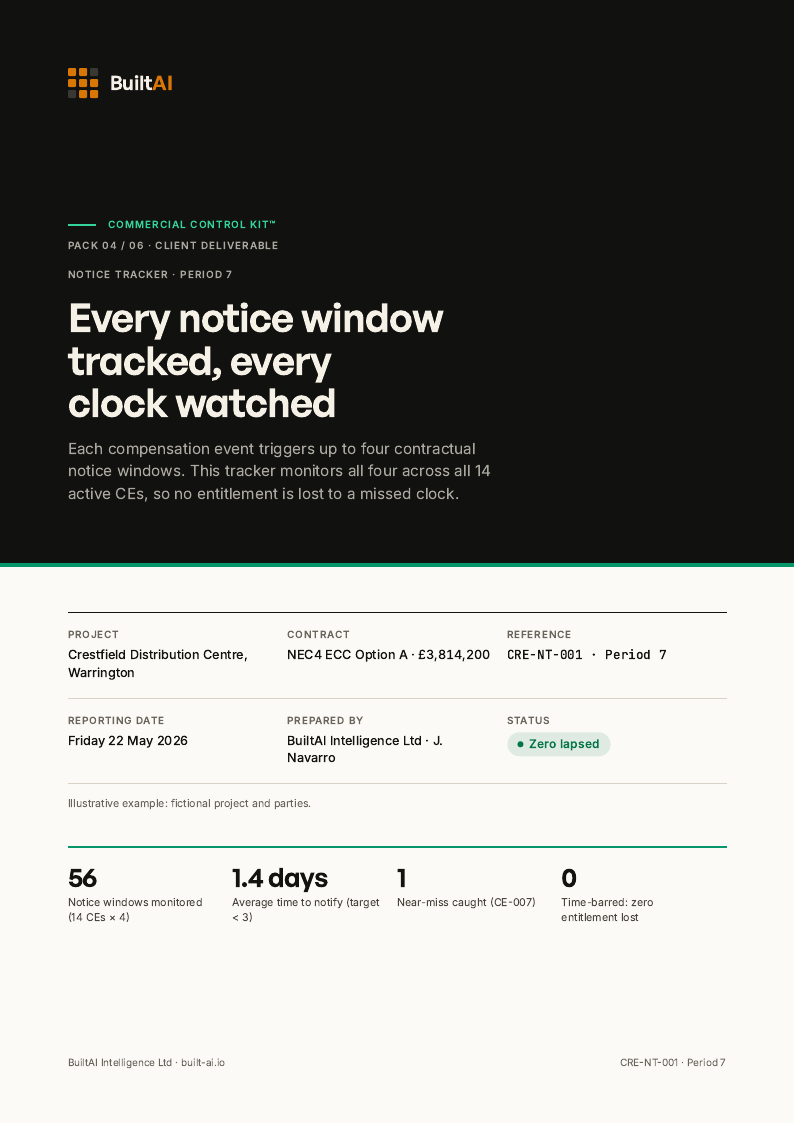
Example of how notice deadlines, status, owners and actions can be tracked to reduce missed entitlement risk.
Why this shapeDeadlines, owners and status sit in one place, so a missed notice - and the entitlement attached to it - is caught before the window closes.
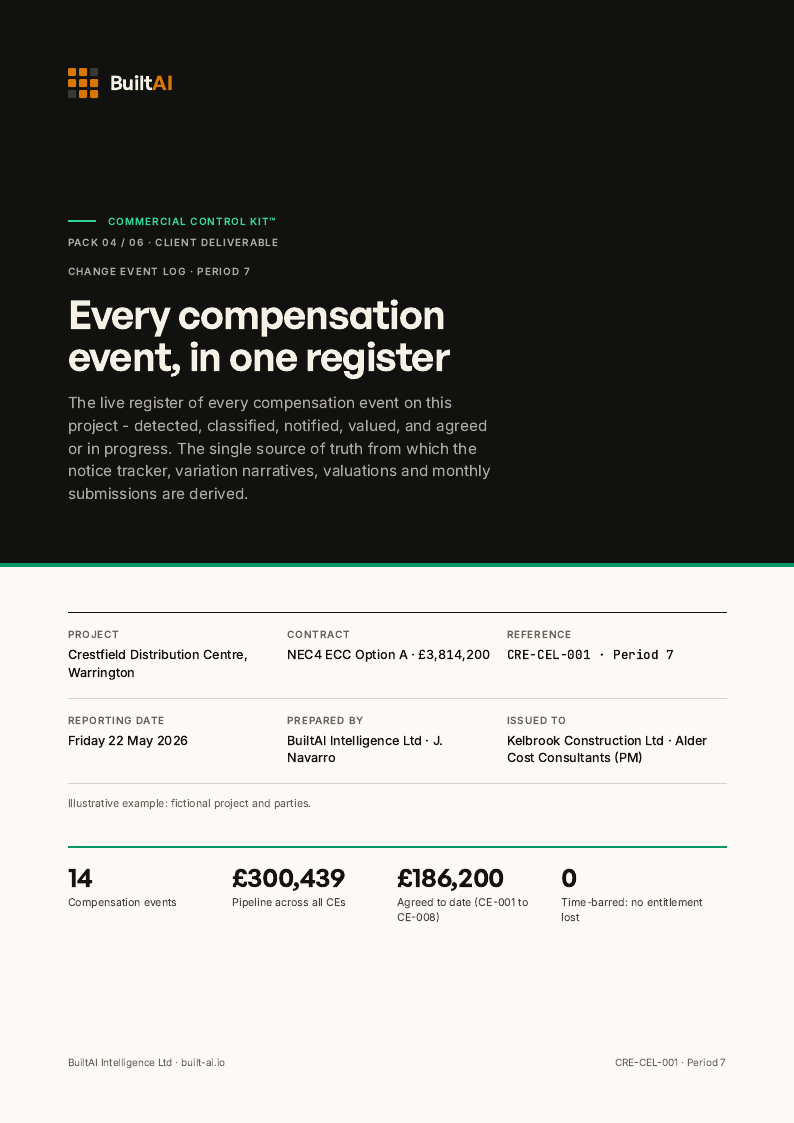
Example of how instructions, access issues, delays and additional works can be captured at source.
Why this shapeInstructions, delays and access issues are captured at source, so commercial control starts when the change happens, not at final account.
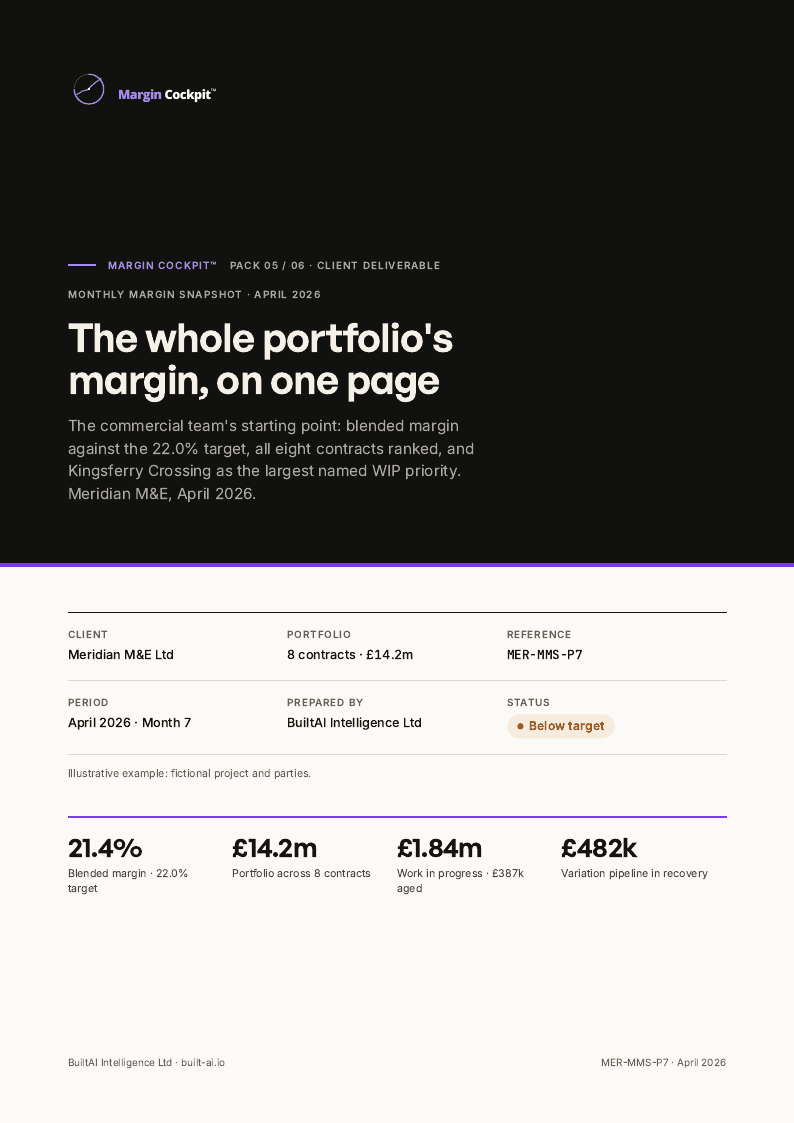
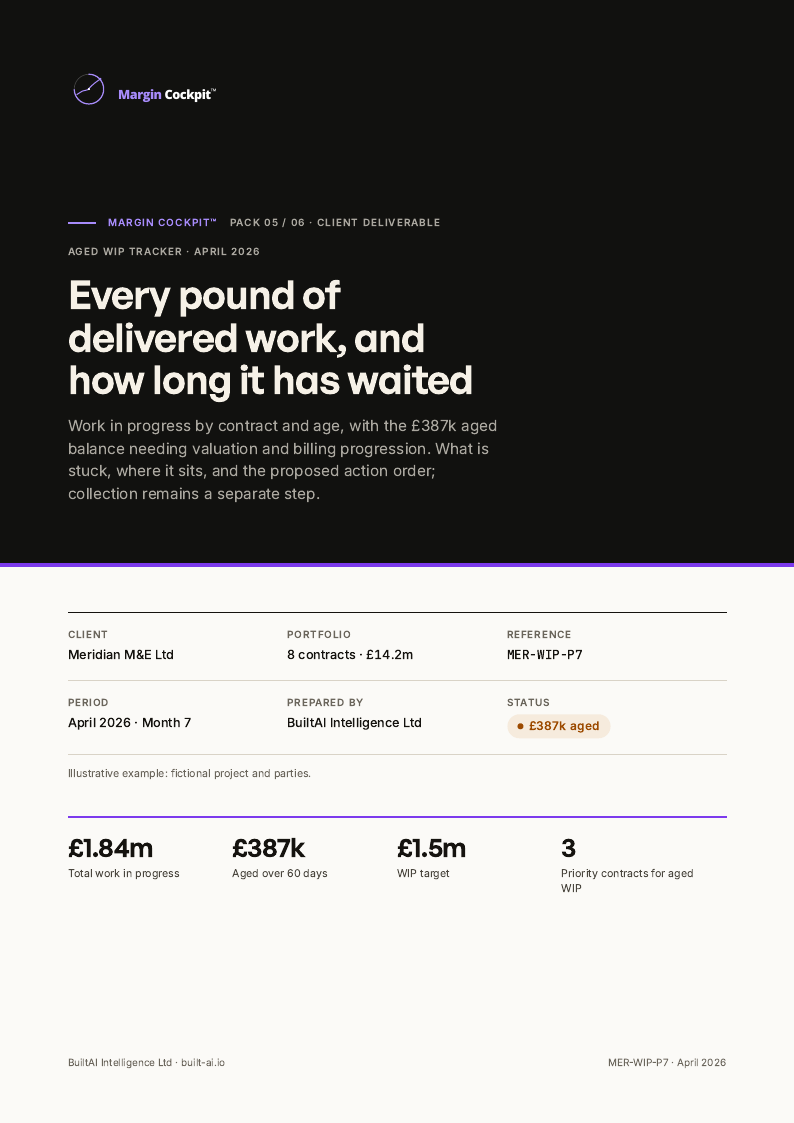
Example of a contract or project-level snapshot showing performance, movement, blockers and actions.
Why this shapePerformance, movement, blockers and actions sit together, so a contract review drives decisions rather than just describing the past month.
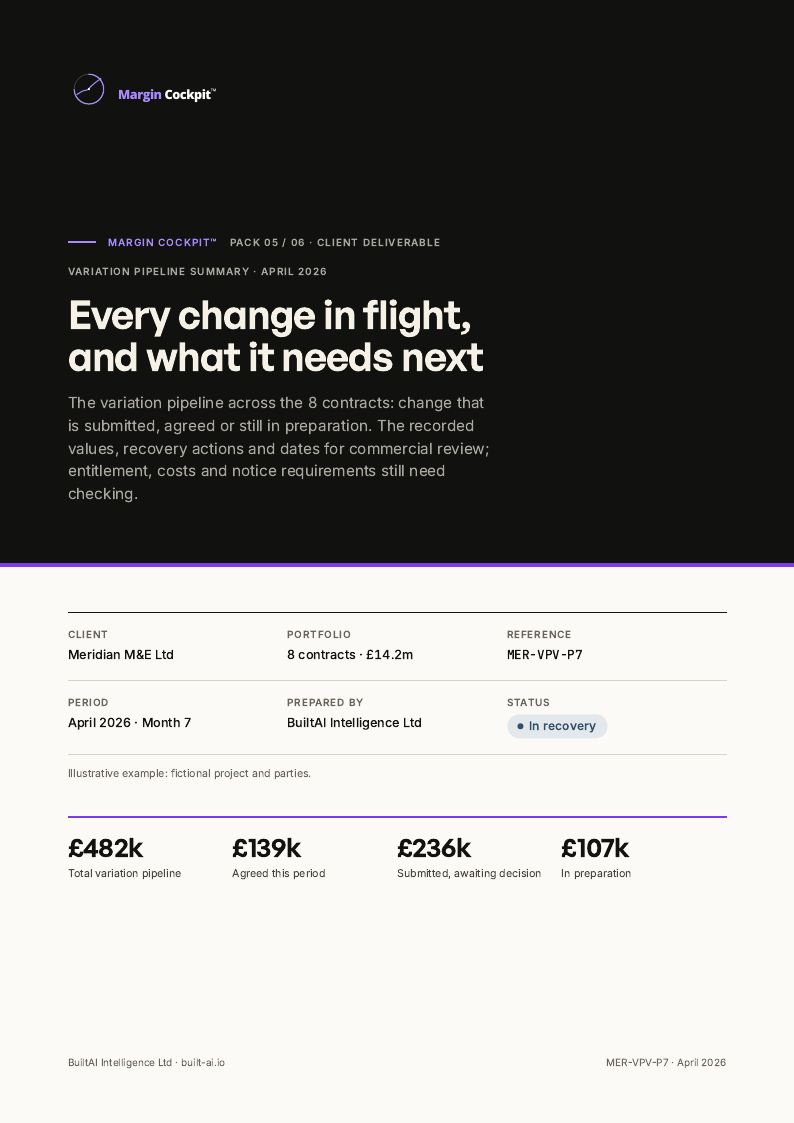
Example of how logged, submitted, agreed, disputed and invoiced variation values can be tracked.
Why this shapeLogged, submitted, agreed, disputed and invoiced are tracked as a pipeline, so variation value isn't lost between site and final account.
Example of how high-risk triggers such as gas, fire, flooding or trapped persons can be escalated through controlled rules.
Why this shapeHigh-risk triggers - gas, fire, flooding, trapped persons - escalate through fixed rules, so safety doesn't depend on which operator took the call.
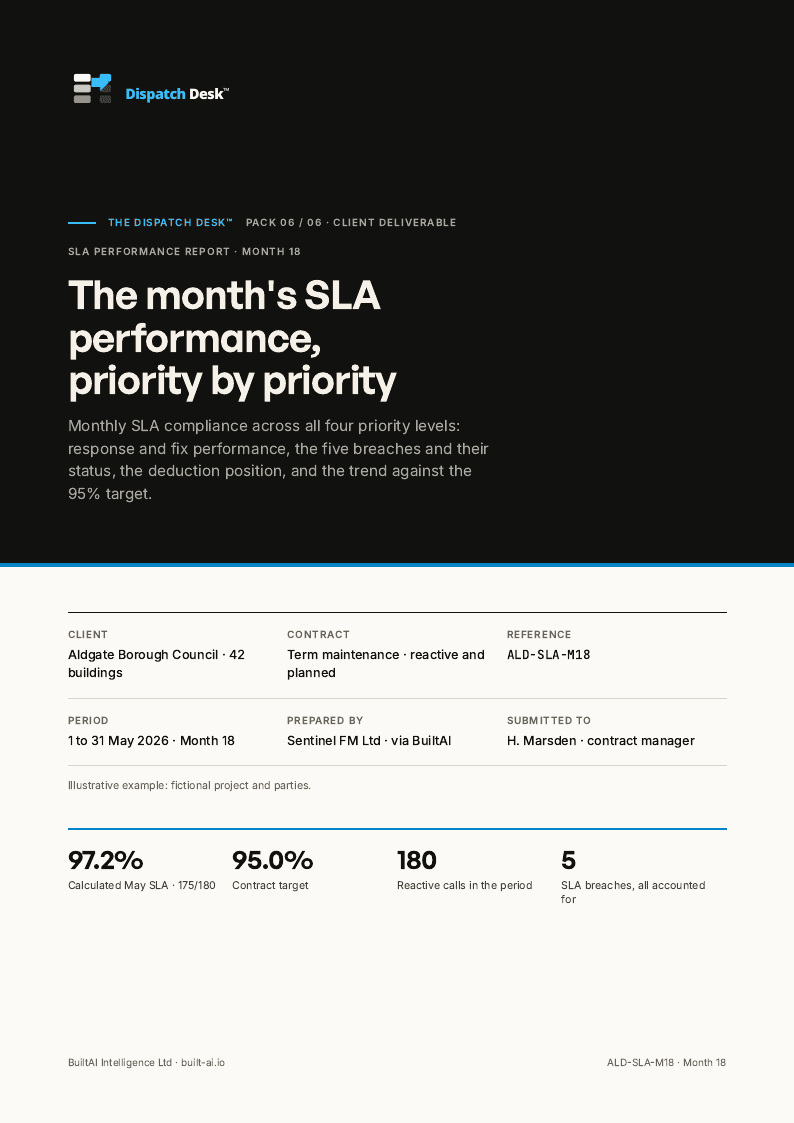
Example of how triage quality, priority decisions and escalation actions can support SLA evidence.
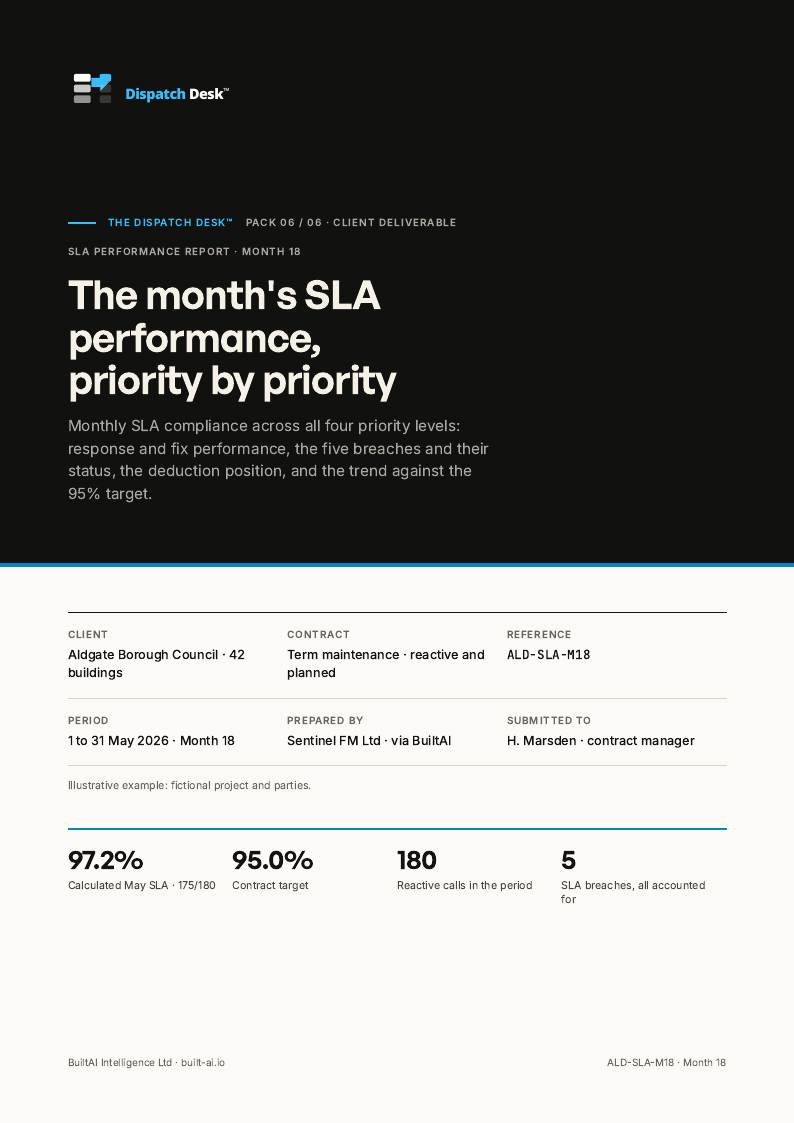
Why this shapeTriage quality, priority decisions and escalations are recorded, so the monthly client review has a defensible record behind every SLA outcome.
BuiltAI drafts; your team reviews, edits and issues. Source-traced, never auto-sent. Final outputs require client-specific review and approval.
07 / Built to Order
Built to Order examples
Built to Order™ builds reusable Claude skills around your brief, templates, brand and review process. The examples below show the kinds of documents a skill can prepare; your team reviews, approves and issues the final work.
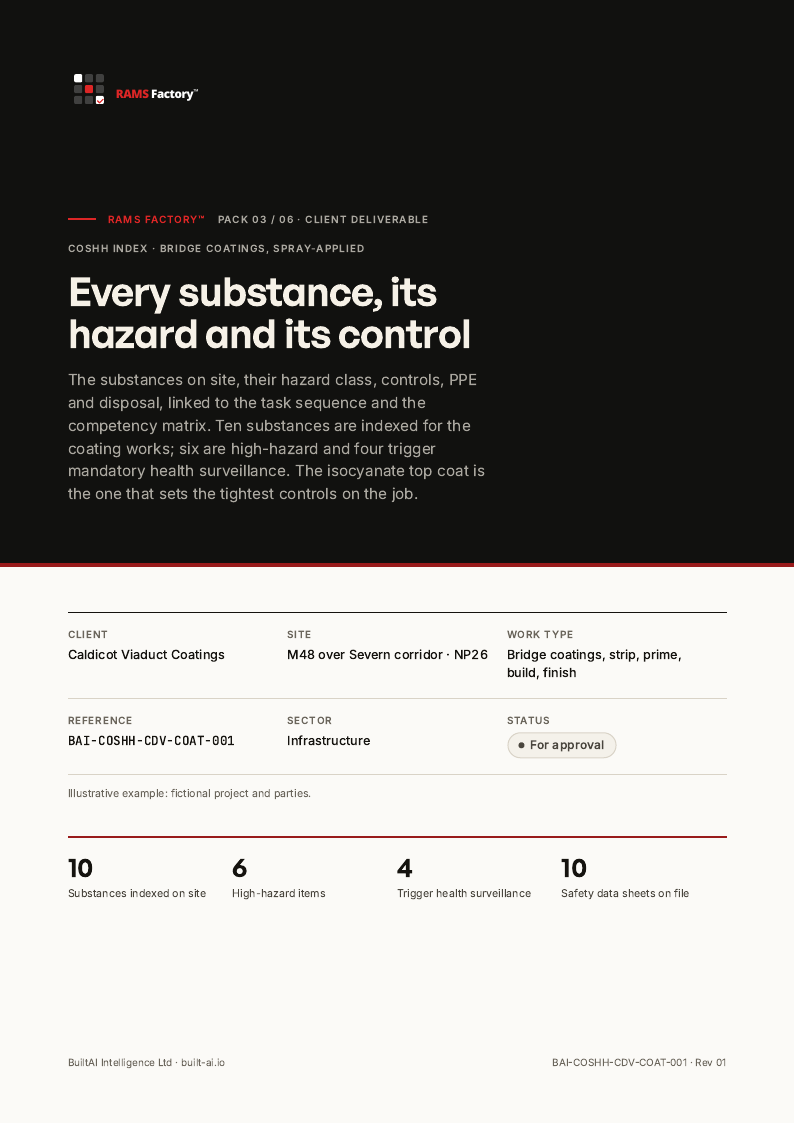
Example of a site-specific RAMS pack produced for client review, task sequence, hazard-control matrix, COSHH index and permits.
Why this shapeA site-specific RAMS - task sequence, hazard-control matrix, COSHH and permits - prepared for the competent person's review before issue.
Example of a programme produced from scope and constraints, phased milestones, critical-path callouts and resource assumptions.
Why this shapePhased milestones, critical-path callouts and resource assumptions are made explicit, so the programme is a basis for review, not a black box.
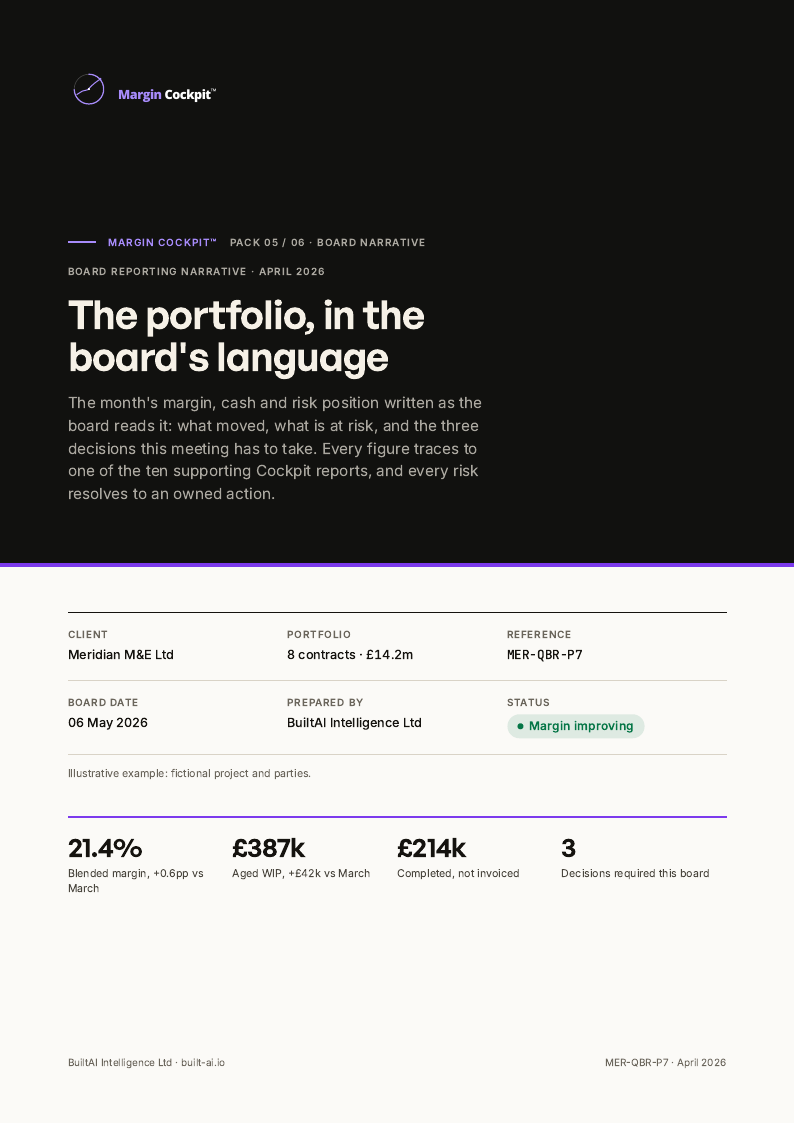
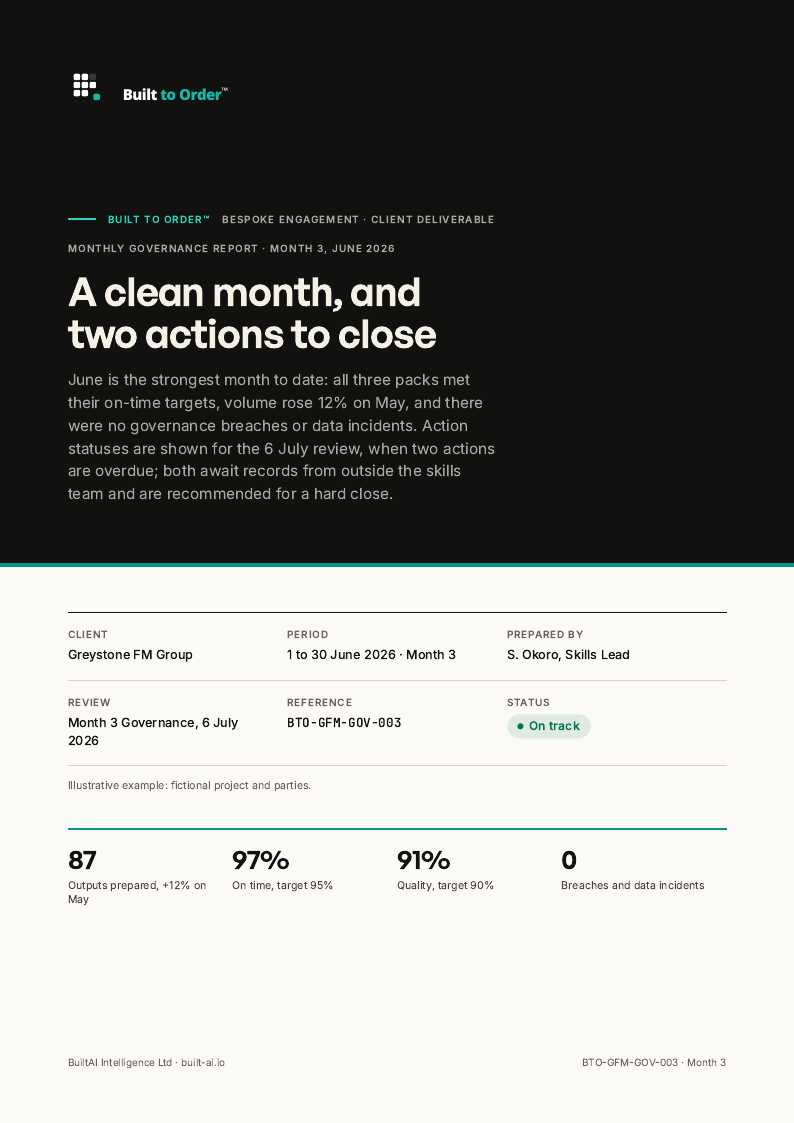
Example of a board-ready monthly report produced from operational data, margin RAG, milestone status, risk callouts and recommended actions.
Why this shapeMargin RAG, milestone status and risk callouts are structured for a leadership read, with the operational data traceable behind each line.
BuiltAI drafts; your team reviews, edits and issues. Source-traced, never auto-sent. Final outputs require client-specific review and approval.
08 / Audit
Operational Intelligence Audit™ examples
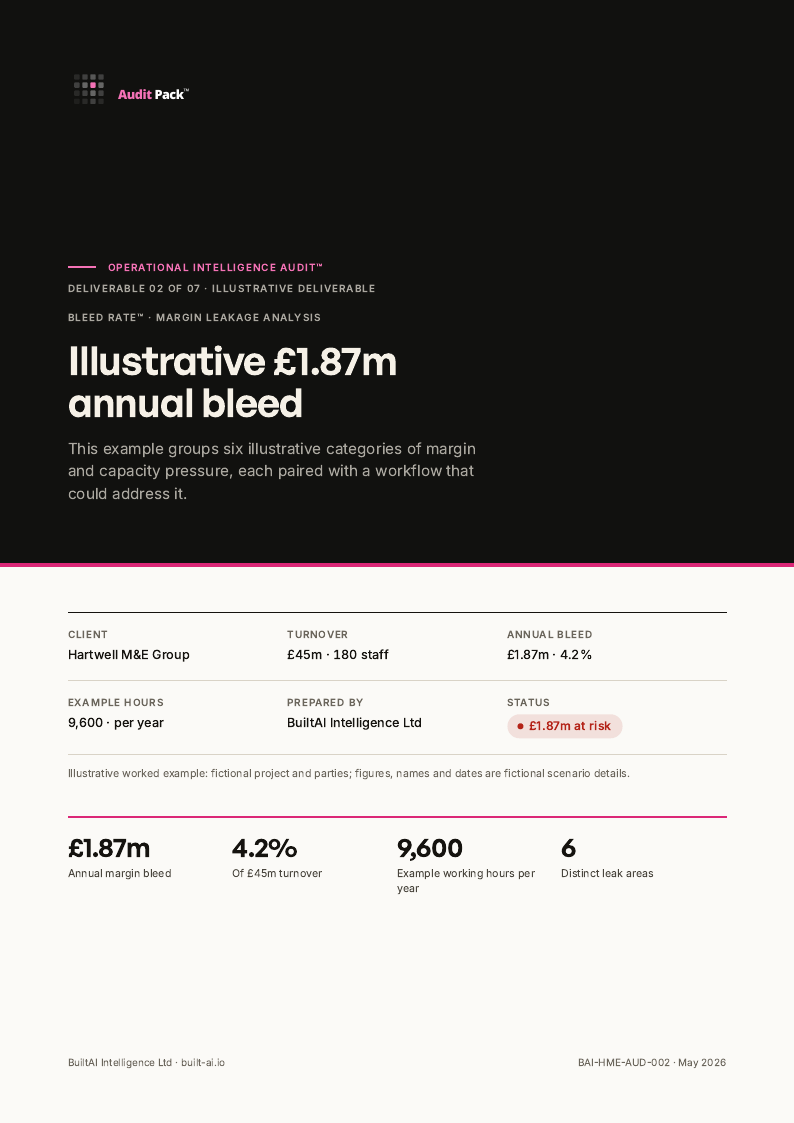
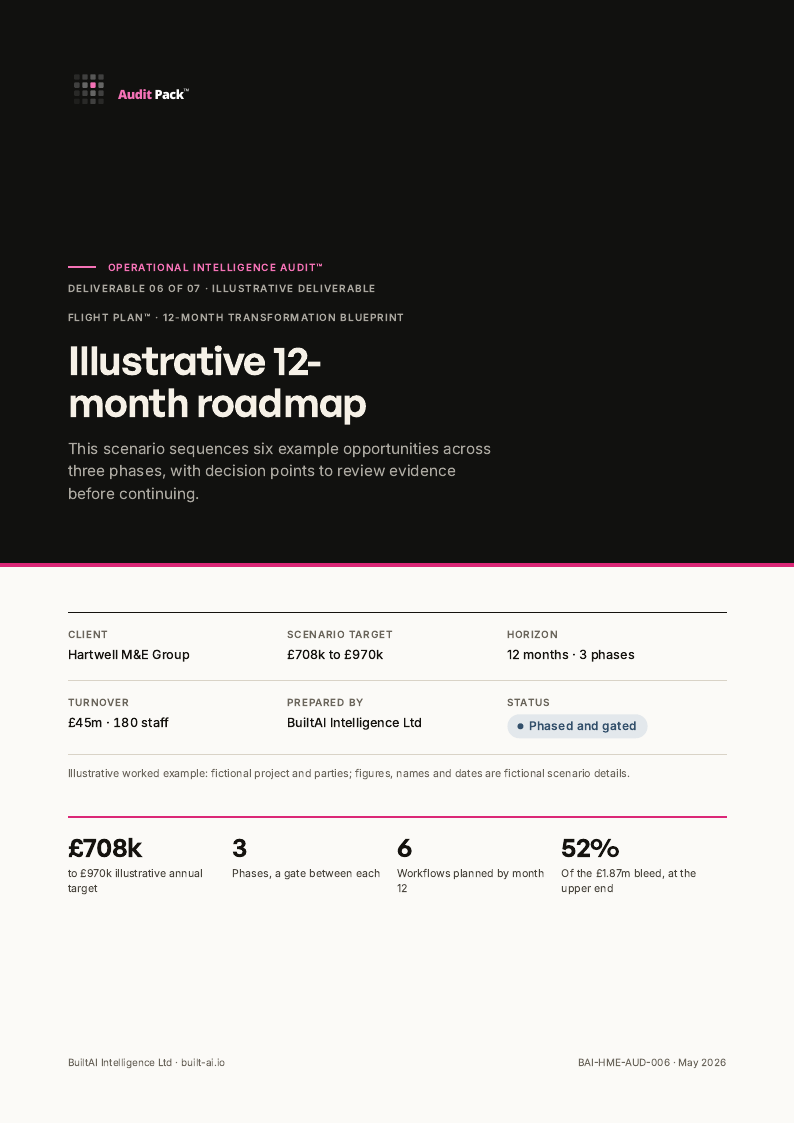
The Operational Intelligence Audit™ can produce decision-ready outputs that help leadership teams identify where AI can create the greatest operational and commercial value.
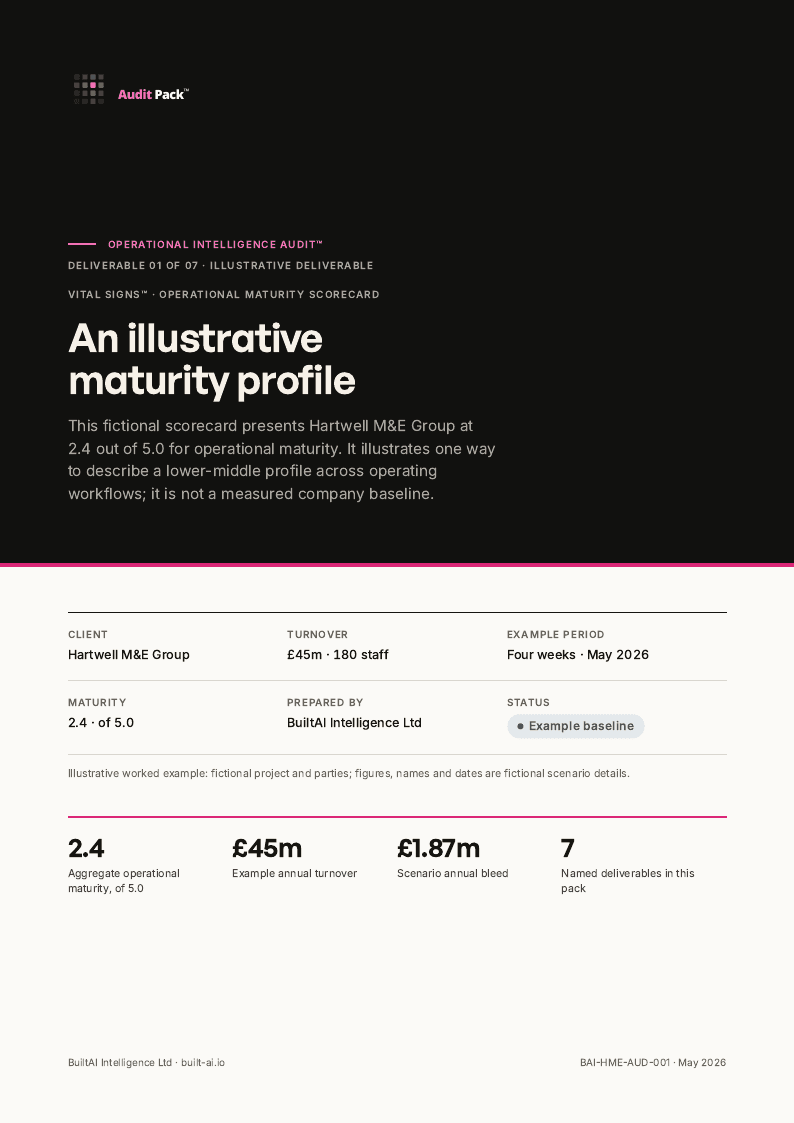
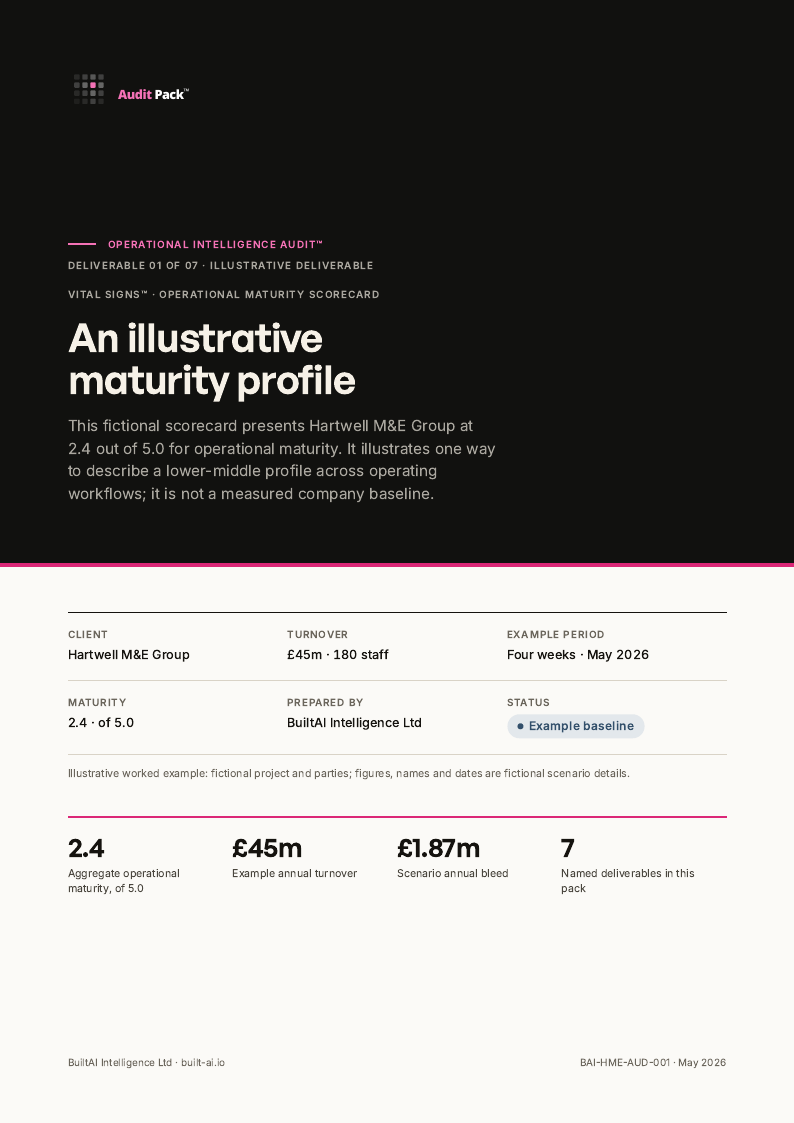
Example of how current-state maturity can be assessed across bid, compliance, commercial, reporting and governance areas.
Why this shapeMaturity is assessed across bid, compliance, commercial, reporting and governance, so the starting point is evidenced rather than asserted.
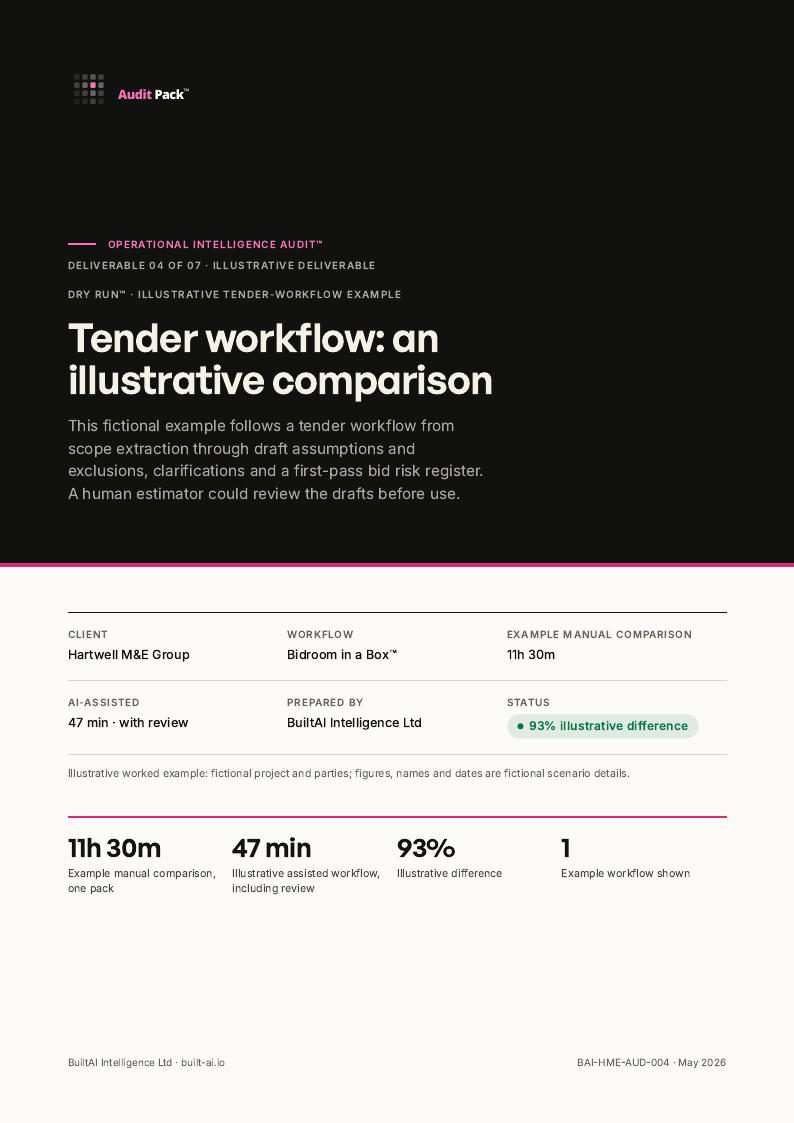
One fictional tender, worked through all five Bidroom in a Box® stages: ten sample documents, including five client-facing deliverables and five internal working documents.
Step through the six Commercial Control Kit™ stages that carry one change event from detection to submission, opening the sample document each stage produced.
Terms of proof and representative scenariosHide the terms and scenarios↕
Proof on agreed terms
Set the test before judging the result.
Agree the brief, inputs, benchmark, usable-output window, review method and query terms in writing. Where a comparison needs two sides, both sides should be available for review.
01The Beat-Your-Best ChallengePre-engagement
Compare a BuiltAI draft with an agreed benchmark using the same brief, source information, review window and scoring method.
Any public account requires written permission and an identified approver. Client review and named approval remain required before issue.
02The 24-Hour ChallengePre-engagement
Agree a usable-output window in writing, together with the inputs, scope, review points and acceptance criteria that apply.
Any public account requires written permission and an identified approver. Client review and named approval remain required before issue.
03The Cold-Start ChallengePre-engagement
Test an agreed environment and inputs without prior business data, then review the first structured draft before approval.
Any public account requires written permission and an identified approver. Client review and named approval remain required before issue.
04The Audit Trail ChallengeIn-engagement
Review how the draft links decisions, assumptions and supporting material so a competent person can query the record.
Any public account requires written permission and an identified approver. Client review and named approval remain required before issue.
05The Disagreement ChallengePre-engagement
Ask where BuiltAI is not the right fit for your operation and review practical alternatives before committing.
Any public account requires written permission and an identified approver. Client review and named approval remain required before issue.
06The Inversion ChallengePre-engagement
Reproduce an agreed published example with your own tools, then compare the reported time and cost under agreed confidentiality and publication terms.
Any public account requires written permission and an identified approver. Client review and named approval remain required before issue.
Issue a challenge
Bring a document and define the test.
Email the team directly, or open the optional five-field brief after this page has loaded. Choosing a file records its name; the file itself must still be attached in your email client.
Only with your permission. We would agree what can be shared before publishing your organisation's name, a quote or engagement details. You can decline.
Any account of a real engagement would be agreed with the customer before publication, including which identifying details and results can be shared. The scenarios on this page are representative examples.
Ask us about reference availability through the contact form. Any introduction would depend on a suitable customer being available and giving permission.
Questions
Before we talk.
Questions teams ask about these examples.
Are example outputs real client deliverables?
Public examples use fictional projects and sample formats unless named customer proof is published with written permission. They are not guarantees of outcome.
Which packs have examples here?
Tender and bid (BidRoom in a Box), pre-con, RAMS, commercial control, margin reporting, FM dispatch / service desk, Built to Order and Operational Intelligence Audit examples.
Can I use an example as a submitted document?
No. Examples are for inspection of structure and review discipline. Any live document needs your source information, commercial validation and competent review before issue or reliance.
How do proof challenges work?
Challenge formats (for example Beat-Your-Best) are agreed in writing – brief, inputs, benchmark, review window and publication terms. Public publication of a run needs recorded permission.
Choose a useful starting point
What should your team make clearer first?
Bring a task, document or recurring workflow. We can discuss the information you have, the review it needs and a practical next step.