

About BuiltAI / how we work

Clear ownership at every step.

BuiltAI structures recurring operational work for construction, facilities management, M&E and specialist subcontracting teams. We prepare the work around your information; your people review, approve and issue it.

01 / understand the opportunity
Audit.
02 / put a workflow into practice
Deploy.
03 / make it part of how you work
Embed.

01 / operational context

Built around the work your team already knows.

BuiltAI Intelligence Ltd was established in 2026 to structure recurring work across UK construction, facilities management, M&E and specialist subcontracting businesses.

The six packs cover tendering, pre-construction, RAMS, commercial control, margin visibility and service-desk operations. Each starts with work the team already performs and keeps a named person responsible for the final decision.

BuiltAIEstablished 2026

Entity
BuiltAI Intelligence Ltd
Registered
England and Wales · 17269241
VAT
521 7623 08

02 / Audit. Deploy. Embed.

One lifecycle. Five delivery stages inside it.

We select the stages that fit the scope. An Operational Intelligence Audit is one way to start; it is not a prerequisite for every engagement.

AuditUnderstand

DeployPut into practice

EmbedImprove with use

The five stages below sit inside that lifecycle. These outputs show possible deliverables; we agree which apply to your engagement.

Five delivery stages / 30 example outputs

01Diagnostic

Audit

We review your workflows, documents, data and pain points to understand where AI can create measurable value. This may include tendering, RAMS, commercial control, margin reporting, service desk triage, WIP, invoice readiness and governance.

Deliverables can include

  • AI maturity scorecard
  • Workflow opportunity map
  • Leakage and efficiency analysis
  • KPI baseline
  • Governance assessment
  • Recommended pilot track

Final deliverables are scoped per engagement.

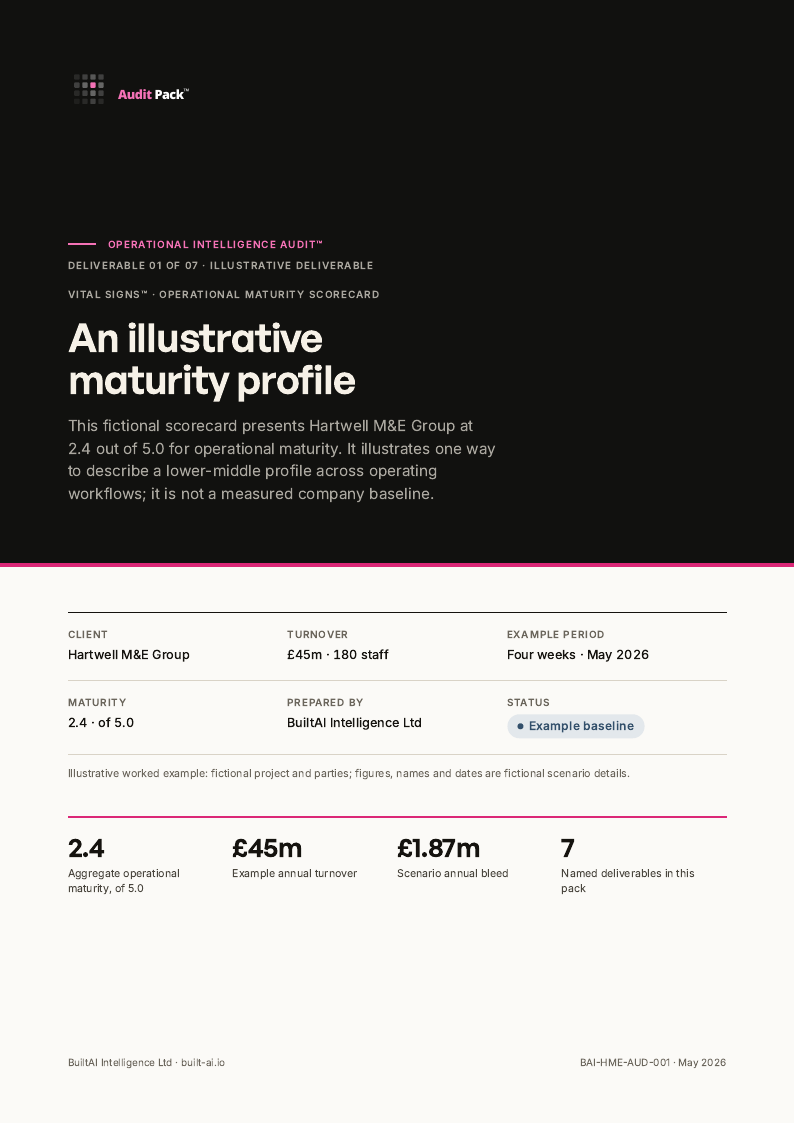
See an example: Vital Signs AI Maturity Scorecard
Page 1 of the Vital Signs AI Maturity Scorecard sample document
Audit: the Vital Signs scorecard.Open the readerPDF3 pages

01 / Diagnostic

Audit

We review your workflows, documents, data and pain points to understand where AI can create measurable value. This may include tendering, RAMS, commercial control, margin reporting, service desk triage, WIP, invoice readiness and governance.

Deliverables can include

  • AI maturity scorecard
  • Workflow opportunity map
  • Leakage and efficiency analysis
  • KPI baseline
  • Governance assessment
  • Recommended pilot track

Final deliverables are scoped per engagement.

See an example: Vital Signs AI Maturity Scorecard

02 / Controlled demo

Prototype

We create a controlled demonstration using your own information. This could be a tender pack, a RAMS workflow, a margin snapshot or a service desk triage example. The prototype shows what a Phase 1 workflow could look like before you commit to wider implementation.

Deliverables can include

  • Tender intelligence prototype
  • RAMS automation prototype
  • Margin snapshot prototype
  • Service desk triage prototype
  • Workflow sample outputs
  • Implementation recommendation

Final deliverables are scoped per engagement.

See an example: Dry Run prototype report

03 / Controlled deployment

Pilot

We deploy one workflow in a controlled environment. The pilot is deliberately focused: one workflow, one team or contract, one defined scope and one reporting cycle. We agree the measures and review the evidence before deciding whether to extend the workflow.

Pilot examples include

  • Bidroom in a Box, tender capacity
  • RAMS Factory, compliance documentation
  • Commercial Control Kit, variation recovery
  • Margin Cockpit, WIP and margin visibility
  • The Dispatch Desk, FM triage and SLA evidence

Final deliverables are scoped per engagement.

See an example: Green Light Phase 1 proposal

04 / Standardise

Scale

Once the workflow is proven, we standardise it across additional teams, contracts, regions or work types. Scaling may include template refinement, training, governance updates, reporting cadence and wider rollout.

Deliverables can include

  • Standard operating process
  • Workflow templates
  • Training materials
  • QA checklists
  • Approval gates
  • Reporting rhythm
  • Rollout plan

Final deliverables are scoped per engagement.

See an example: Margin Cockpit board narrative

05 / Ongoing managed operations

Optimise

After rollout, BuiltAI can support ongoing optimisation on a managed-operations basis: governance checks, KPI reviews, template updates, controlled use-case expansion and continuous improvement.

Deliverables can include

  • Monthly or quarterly KPI review
  • Governance review
  • Updated workflow libraries
  • Improvement backlog
  • New use-case recommendations
  • ROI narrative

Final deliverables are scoped per engagement.

See an example: Flight Plan 12-month blueprint

03 / agreed operating practice

Prepared by BuiltAI. Decided by your people.

We agree which controls apply to your workflow, who owns them and how completion is recorded before work starts.

  1. Human review and approvalWe name the people who review the draft, challenge assumptions and decide what can be approved and issued.
  2. Source traceabilityWe agree which source material the workflow may use and keep references with the prepared output.
  3. Assumptions registerWe make material assumptions visible so a reviewer can confirm, change or reject them.
  4. Evidence indexWe agree how supporting records are identified and connected to the work they support.
  5. Quality checksWe document the checks that must be completed before an output reaches its named reviewer.
  6. Version controlWe agree how drafts, review comments and issued versions are distinguished and retained.
See the other four controls
  1. Data classificationWe agree what information may enter the workflow and how restricted material must be handled.
  2. Audit trailWe record the source, version and review points needed to follow the draft-to-decision trail.
  3. Escalation rulesWe identify the conditions that should stop the workflow and return the work to a responsible person.
  4. Usage boundariesWe set out the workflow's intended use, its limits and the decisions that remain with your team.
Foundations agreed before delivery
  • Consistent output formats
  • Named reviewers
  • Traceable source material
  • Agreed data handling
  • Less duplicated effort
  • A defined workflow
  • A useful KPI baseline
  • A practical implementation plan
Read the Trust Centre

04 / where to start

A useful starting point depends on the work.

Choose a defined workflow, diagnose the opportunity through a four-week Audit, or bring a specific Built to Order brief.

Compare the three ways to buy
  • A defined outcomeThe change or deliverable is clear enough to scope.
  • Usable source informationThe team can identify the material the work relies on.
  • Named reviewersResponsible people can review and decide what is issued.

05 / measurement policy

How evidence becomes a published claim.

See how each measure is defined and what evidence is needed before a result can be shared.

Public outcome claims need at least 60 days of operating evidence, a disclosed method and client-owner approval. This is not a minimum engagement length.

Five publication principles
  1. 01
    Baselines first, claims second

    Before a workflow lands, we name the metric, its source and owner, then freeze the baseline. Without a usable baseline, we do not publish an outcome claim.

  2. 02
    Ranges, not isolated numbers

    Where results cover more than one engagement, the range and sample size travel with the reported result so its variability remains visible.

  3. 03
    Per-pack, not blended

    Each workflow is measured against the operational metrics it is intended to move. Unrelated outcomes are not blended into one productivity figure.

  4. 04
    Owner-confirmed

    A client-side operational owner must confirm a result before BuiltAI can publish it.

  5. 05
    Method disclosed

    A published result states what was counted, what was excluded and the period over which it was measured.

Eight measurement definitions

These rows define how a measure would be assessed. They do not show a live result or prove that a named technical control is active.

Measurement definitions retained by workflow
Workflow or registerMetricDefinition
Bidroom-in-a-BoxTender response cycle timeCalendar hours from ITT receipt to submission, measured per tender, anonymised against a 6-tender pre-pack baseline.
Bidroom-in-a-BoxClarification close-rateShare of ITT requirements with a recorded, evidenced clarification before submission. 100% target; baseline typically <55%.
Commercial Control Kit™Recovery cadenceDays from instruction issued to variation logged + evidence linked, monthly cohort.
RAMS Factory®RAMS rework rateShare of submitted RAMS that came back from the H&S approver for rework, against a 90-day pre-pack baseline.
The Dispatch Desk™SLA recoveryP1/P2 ticket SLA attainment, measured weekly, segmented by site cohort against a 30-day pre-pack baseline.
Margin Cockpit™Margin movement traceabilityShare of monthly margin deltas with a recorded narrative + source pointer. We measure traceability, not the margin number itself - the latter is the client's to disclose or not.
Contract Obligations RegisterOwner-coverageShare of contract obligations with a named owner, an evidence requirement, and a defined notice trigger. Target 100%; baseline typically <60%.
AI Governance Policy PackRED-block enforcementShare of attempted AI calls against Red-classified data that were blocked at the gate. Target 100%, monitored continuously via the platform's AI usage log.
Boundaries on public claims

BuiltAI does not publish:

  • Individual hours saved where individual productivity has not been measured.
  • ROI multiples that depend on how a client chooses to use recovered time or margin.
  • Industry-wide benchmarks without a representative sample and a disclosed sample size.
  • Outcome claims drawn from fewer than 60 days of operating evidence.
  • AI-versus-human productivity claims isolated from the workflow in which the work is performed.

06 / before we start

Clear answers. A useful next step.

Does BuiltAI replace our team?

BuiltAI prepares drafts and supporting information. Your people bring the judgement, review the detail and decide what can be approved and issued.

How is our data handled?

We document the hosting, subprocessors, retention and access arrangements that apply before work starts. Project material is used for the agreed service and is not used by BuiltAI to train models. The agreed service terms and applicable supplier terms govern each workflow.

Visit the Trust Centre
What if we are still working out where to start?

The Operational Intelligence Audit maps your workflows, documents and data, then returns findings and a practical next step. You can also begin with a specific workflow or a Built to Order brief; the Audit is one route, not a prerequisite.

Explore the Discovery questionnaire

Capacity to grow. Clarity to lead.

Make room for your next move.

Tell us what your team wants to take on, where work slows down and what a useful outcome would look like.

Book a 30-Minute Call