
RAMS Extract Walkthrough / worked example
From site brief to review-ready RAMS.

RAMS Factory®
This walkthrough shows how RAMS Factory® can help structure task-specific RAMS content around the actual works.
Follow the WorkOpen the deliverablesWorked exampleThese documents use fictional projects and figures. Open the originals to inspect their source context.
- Working stages
- 11
- Deliverables
- 06
01 / follow the working record
Eleven outputs, in production order.
The example set spans eleven jobs, from a roofing make-safe to a cleanroom shutdown. Each row identifies the job it demonstrates and opens the original output.
Setting
eleven different fictional jobs, one per output
Read each document in your browser. Where a PDF exists, it is linked beside it.
See the deliverablesJob Intake Form
Output 01 · gates the whole pack
What this stage shows: Job Intake Form, Output 01 · gates the whole pack
Example projectExchange House, Reading - emergency temporary roofing
Eleven sections completed before a word of the RAMS is drafted: job identification and applicable standards, client, site and the rooftop access route, scope and exclusions, working hours in a fully occupied building, welfare, a twelve-item high-risk trigger review, the permits and isolations register, COSHH substances, emergency arrangements and competency requirements. The closing summary carries the flags forward and records the job as only conditionally ready to draft - an asbestos survey and a structural load check are unresolved.
Why it mattersRAMS should be built around the actual job, not copied from a generic template.
Task Sequence Builder
Output 02 · the spine everything else hangs off
What this stage shows: Task Sequence Builder, Output 02 · the spine everything else hangs off
Example projectSaxon Wharf, Bristol - structural steel frame
The erection broken into 21 tasks across six phases, each task carrying its predecessor, duration, hold points and whether it sits on the critical path. Six tasks are critical-path and four are hold points. The method statement, hazard matrix, PPE schedule, permits and evidence pack are all structured against this list rather than against a template.
Why it mattersA clear task sequence helps hazards and controls map to the actual works being carried out.
Hazard-Risk-Control Matrix
Output 03 · hazards mapped task by task
What this stage shows: Hazard-Risk-Control Matrix, Output 03 · hazards mapped task by task
Example projectWessex Buildings, Manchester - Cat B fit-out
33 hazards mapped across the eight tasks of the fit-out sequence, each with a control written for the task it sits against and an initial and residual risk score. Twelve hazards start at high or very high; none remain at either level once the controls are applied, and thirty finish low.
Why it mattersTask-based control mapping improves clarity and reduces generic RAMS wording.
PPE, Plant & Equipment Schedule
Output 04 · what goes on site, and its currency
What this stage shows: PPE, Plant & Equipment Schedule, Output 04 · what goes on site, and its currency
Example projectLambeth Grid substation - HV transformer maintenance
A task-by-PPE-type matrix marking each item required, additional or not needed for the twelve scheduled tasks, then the plant schedule with inspection currency, the equipment list with calibration status and an operator competency matrix. One item is flagged due for re-certification and has to be resolved before mobilisation.
Why it mattersPPE is tied to the task that calls for it and every plant and equipment item carries its inspection or calibration status, so an out-of-date item surfaces before mobilisation rather than on site.
Permits & Isolations Checklist
Output 05 · twelve permits, ten isolations
What this stage shows: Permits & Isolations Checklist, Output 05 · twelve permits, ten isolations
Example projectApex Pharma, cleanroom AHU - planned shutdown
Twelve permits and ten isolations for a ten-hour cleanroom outage, each permit mapped to the tasks it covers with its validity window, signatory, conditions, training requirement and witness. Three permits are still pending and are shown gating the tasks that depend on them; the hot-works permit is stated as pending fire-system isolation confirmation.
Why it mattersRAMS Factory® helps connect compliance requirements into the same workflow rather than treating them as separate admin.
COSHH Index
Output 06 · substances, controls and surveillance
What this stage shows: COSHH Index, Output 06 · substances, controls and surveillance
Example projectCaldicot Viaduct - bridge coatings
Ten substances on a coatings job, each with its supplier, GHS hazard class, controls, PPE, storage, disposal and training flags. Four exposures are called out as triggering health surveillance - isocyanates in the top coat, lead disturbed from the existing coating, solvent exposure during sustained spray campaigns and skin sensitisers - with the regulation each one sits under.
Why it mattersSubstances are linked to the tasks that use them and to the surveillance they trigger, so a health obligation is visible while there is still time to arrange it.
Environmental Controls
Output 07 · calibrated to the receptors present
What this stage shows: Environmental Controls, Output 07 · calibrated to the receptors present
Example projectRiver Marsh Bridge - bridge replacement
Six control categories holding 33 individual controls, written against the receptors actually present at that location: a watercourse twelve metres away inside an SSSI buffer, Schedule 1 breeding birds restricting vegetation clearance to a set window, residential properties at eighty metres, listed cast-iron parapets, a diverted public footpath and an archaeological watching brief. Discharge to the watercourse is a stated prohibition and a breach of any control is grounds to stop works.
Why it mattersEnvironmental controls are engineered to the receptors at this location, so the plan can be checked against the site instead of accepted as boilerplate.
Emergency Arrangements
Output 08 · the rescue plan, agreed in advance
What this stage shows: Emergency Arrangements, Output 08 · the rescue plan, agreed in advance
Example projectCambridge city centre - sewer confined-space entry
Twelve emergency contacts, five procedure scenarios and a confined-space rescue plan for sewer entry, with six pre-mobilisation gates the supervisor has to confirm before signing any entry permit: a full mock retrieval drill at the live entry point, calibrated atmospheric monitors, in-date thorough examination on the tripod and harness, a proven comms link, a named dedicated top-man with no other duties, and the specialist rescue team pre-briefed rather than called on the day.
Why it mattersThe rescue arrangement is agreed and rehearsed before entry is authorised, not requested at the point of an incident.
Competency & Training Matrix
Output 09 · who is authorised, and until when
What this stage shows: Competency & Training Matrix, Output 09 · who is authorised, and until when
Example projectThe Marlowe Hotel, Canterbury - heritage refurbishment
Twelve trades and forty-one operatives with forty-two tracked certifications, each shown as current, expiring or expired against the programme. Four actions are listed as gating mobilisation: an expired lead-awareness course needed for heritage paint stripping, two access qualifications running out inside the fourteen-week programme, and a heritage-timber briefing that has never been held.
Why it mattersCurrency is checked against the programme, so a certificate that lapses mid-job is a course to book now rather than a stop-work later.
Evidence Pack Checklist
Output 10 · what gets captured, and by whom
What this stage shows: Evidence Pack Checklist, Output 10 · what gets captured, and by whom
Example projectSt Magdalene's Chapel, Salisbury - Grade II listed roof
Forty evidence items across six categories, each with the format required, the person responsible and a captured or outstanding status. Thirty-two are captured and the eight outstanding items are stated as gating handover. A heritage overlay adds the photographic and salvage records the Conservation Officer asked for at pre-start, retained for the archive whether or not the RAMS strictly needs them.
Why it mattersWhat has to be captured, and by whom, is agreed before the works rather than reconstructed from memory at handover.
RAMS QA Checklist
Output 11 · the gate before issue
What this stage shows: RAMS QA Checklist, Output 11 · the gate before issue
Example projectThornbury House - passive fire stopping
28 checks over the pack's completeness, task-specificity, hazard mapping, compliance cover and evidence readiness. This example returns twenty-five passes, three advisories and no fails, and closes as conditionally approved: the safety data sheets are not yet attached and the photographic record format is not agreed, so both have to be resolved and the pack re-confirmed before it is issued.
Why it mattersFinal RAMS remain subject to competent review, site-specific validation and approval before issue.
02 / inspect the output
What the eleven outputs assemble into.
Three complete RAMS submissions, each with its method statement, risk assessment, COSHH framework and permit register for one job, plus three standalone site sheets. The last three are web documents only.
Inside the example
Output 02 · the spine everything else hangs off
A complete first-page preview. Open the original to inspect all 3 pages at full size.
Inspect Original: Output 02 · the spine everything else hangs off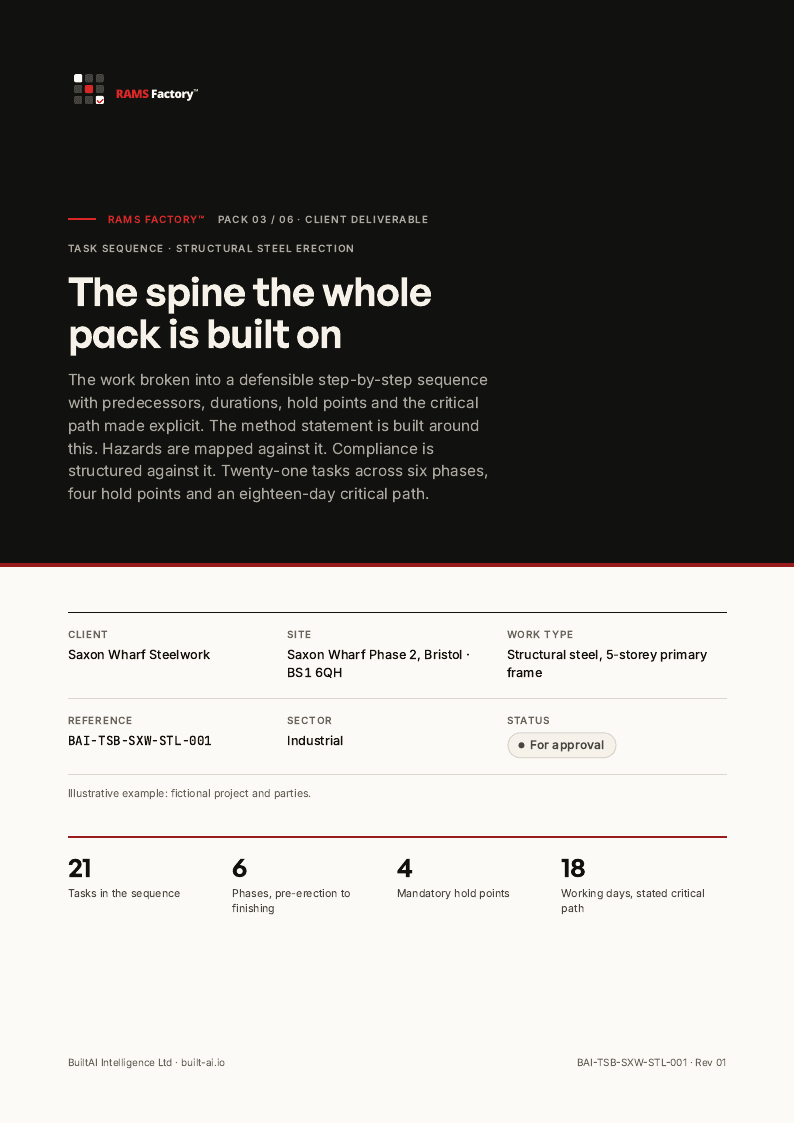
- PRJBoiler Plant Upgrades RAMSPDF of Boiler Plant Upgrades RAMS
- PRJASHP Decarbonisation RAMSPDF of ASHP Decarbonisation RAMS
- PRJACO Drainage Works RAMSPDF of ACO Drainage Works RAMS
- MSMethod Statement Sheet
- RASRisk Assessment Sheet
- TTCToolbox Talk + Certificate
About these examplesEvery client, site and figure is invented for this example. The eleven outputs demonstrate different fictional jobs; they are not one reconciled site pack.
Before anything is issuedFinal RAMS remain subject to competent review, site-specific validation and approval before issue.
Put BuiltAI to work
What could this make room for?
Bring a real piece of work. Explore what a structured workflow could give back to your team.
All worked examples