
Variation Narrative Walkthrough / worked example
Follow the change. See the commercial record.

Commercial Control Kit™
This walkthrough shows how a change event can be turned into a structured commercial narrative with evidence and entitlement logic.
Follow the WorkOpen the deliverablesWorked exampleThese documents use fictional projects and figures. Open the originals to inspect their source context.
- Working stages
- 06
- Deliverables
- 08
01 / follow the working record
Six stages, one change event.
Follow the record from identifying a change through the notice, evidence, valuation and monthly submission. Open the document behind each stage.
Setting
Crestfield Distribution Centre Phase 2, a fictional NEC4 M&E package
Read each document in your browser. Where a PDF exists, it is linked beside it.
See the deliverablesThe Radar™
Change Capture & Contractual Classification
What this stage shows: The Radar™, Change Capture & Contractual Classification
Fourteen compensation events detected and classified against the NEC4 clause that gives rise to each one - a project-manager instruction changing the Scope, the employer failing to provide something by the date on the accepted programme, and physical conditions an experienced contractor would not have foreseen. The log records the clause, the source, the date of detection, the estimated effect and the status, and it is the feed the later stages read from.
Why it mattersCommercial control starts when the change happens, not at final account.
The Clock™
Notice & Acknowledgement Tracking
What this stage shows: The Clock™, Notice & Acknowledgement Tracking
The four NEC4 notice windows tracked at once for all fourteen events: the eight-week notification window whose expiry time-bars the entitlement outright, the project manager's one-week response, the three-week quotation window and the two-week deemed-acceptance trigger. Each row carries every date and acknowledgement; one near-miss is highlighted in the table, notified late and caught with three days to spare.
Why it mattersA notice window that closes takes the entitlement with it regardless of the merits, so the deadline is tracked as a fact rather than remembered.
The Case™
Cause, Effect & Entitlement Narrative
What this stage shows: The Case™, Cause, Effect & Entitlement Narrative
The entitlement chain, shown twice on the same event: a weak version that says only that the work costs more, and the structured version that names the instruction, the clause relied on, the components of the cost effect, the programme consequence and the evidence behind each. The full narrative follows in four sections - cause, effect, entitlement and programme impact - and closes on a six-point gate before the event moves to evidence assembly.
Why it mattersA clear cause helps link the variation to an instruction, delay, access issue or scope change.
The File™
Evidence Assembly
What this stage shows: The File™, Evidence Assembly
Ten evidence items indexed for the same event - the instruction itself, the third-party agreement behind it, the contract extract being departed from, supplier and civil estimates, the accepted and revised programme extracts, the early-warning and notification trail and site photographs of the existing installation - each typed, dated, cross-referenced to the narrative section it supports and given a filed status.
Why it mattersEvidence discipline strengthens the submission and reduces reliance on memory or retrospective reconstruction.
The Count™
Valuation Build-Up
What this stage shows: The Count™, Valuation Build-Up
The Defined Cost build-up set out under the Schedule of Cost Components - plant and materials, subcontractor, people, equipment and charges - with the original allowance deducted line by line so only the change is claimed, and the contract Fee percentage applied at the end. Every line names the evidence item, timesheet or contract rate it traces to.
Why it mattersA valuation whose every line traces to a document in the evidence bundle can be checked by the assessor rather than argued about.
The Drop™
Submission Pack Assembly
What this stage shows: The Drop™, Submission Pack Assembly
This section brings the narrative, evidence and valuation basis together for review. The pack that went to the project manager runs to seven documents - cover letter, entitlement narrative, Defined Cost build-up, assessed programme, evidence index, the attached evidence and the notice audit trail - each attributed to the stage that produced it, alongside the four-week monthly submission cycle and an audit log recording every submission, its recipient, its response deadline and its status.
Why it mattersFinal submissions remain subject to QS, commercial and contract-specific review.
02 / inspect the output
What the six stages produced.
Two period registers covering the job's change events, followed by six documents for a compensation event: narrative, evidence, entitlement, valuation, monthly submission and forecast final-account position.
Inside the example
Variation Narrative
A complete first-page preview. Open the original to inspect all 4 pages at full size.
Inspect Original: Variation Narrative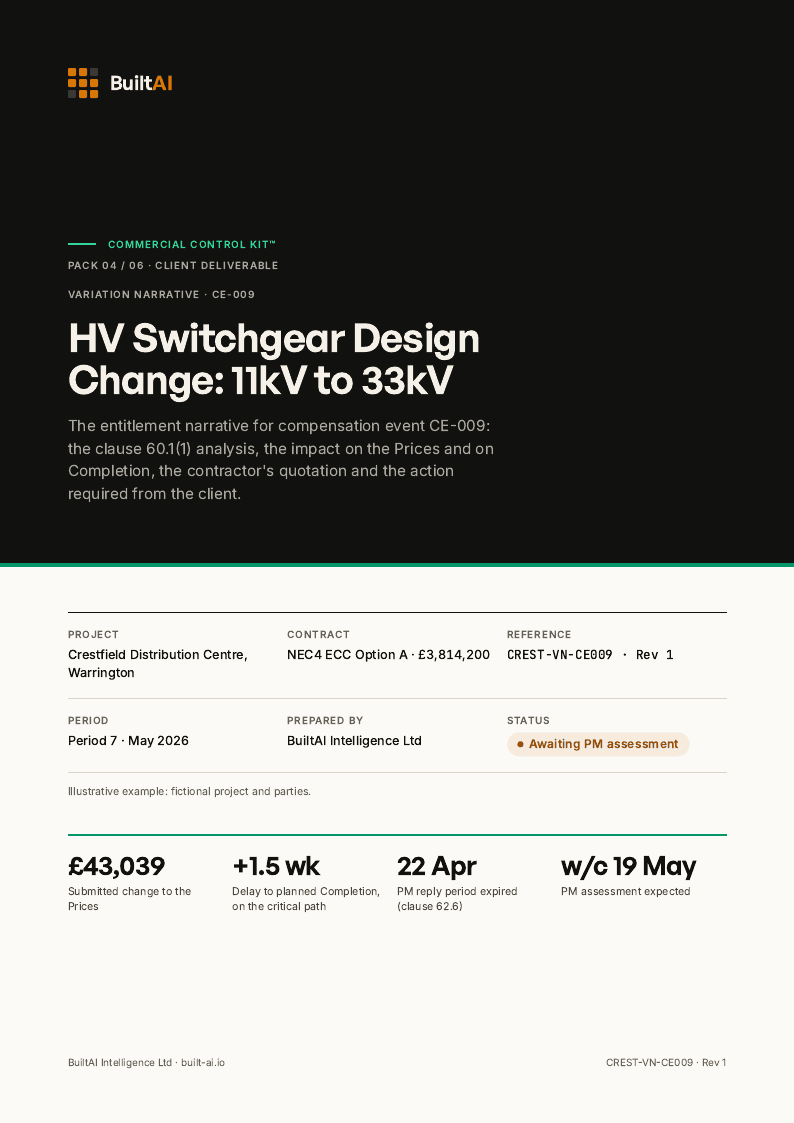
- CELChange Event LogPDF of Change Event Log
- NTNotice TrackerPDF of Notice Tracker
- VNVariation NarrativePDF of Variation Narrative
- EBIEvidence Bundle IndexPDF of Evidence Bundle Index
- ESEntitlement StatementPDF of Entitlement Statement
- VBUValuation Build-UpPDF of Valuation Build-Up
- MCSMonthly Commercial SubmissionPDF of Monthly Commercial Submission
- FAPFinal Account PositionPDF of Final Account Position
About these examplesThe project, parties and figures are fictional. The stage files and deliverables use different suppliers and assessed figures to illustrate the format; the two example sets should not be read as a reconciled commercial account.
Before anything is issuedFinal submissions remain subject to contract-specific review, commercial validation and approval before issue.
Put BuiltAI to work
What could this make room for?
Bring a real piece of work. Explore what a structured workflow could give back to your team.
All worked examples